
About Disgaea 2 PC
In Veldime, Overlord Zenon's curse turns the population into demons, leaving Adell as the only unaffected human. A ritual meant to summon Zenon instead brings his daughter Rozalin into Adell's home, setting the pair on a journey through the Netherworld. Disgaea 2 PC combines the original story with the added Dark Hero Days content and Axel Mode.
Disgaea 2 PC begins in Veldime, a human world transformed by Overlord Zenon's curse. Its inhabitants become demons and monsters, while memories are altered and the land itself takes on the character of a Netherworld. Adell remains human, an exception that gives him a personal reason to oppose Zenon and try to restore the world. His family attempts to summon the Overlord, but the ritual brings Rozalin, Zenon's daughter, to their home instead. Adell agrees to escort her back to her father, believing this will give him a way to confront Zenon and undo the curse. Their uneasy partnership supplies the central story movement: Adell is direct and stubborn, Rozalin is an imperious Netherworld princess far from her familiar setting, and their route draws in people and creatures with their own interests. The story balances the danger of a population living under a curse with comic reversals and an extravagant demon-world cast. It follows a new lead and setting from the first Disgaea, so the conflict is built around Adell and Rozalin's attempt to reach Zenon rather than continuing the previous game's central story.
Adell's household gives the journey a close-knit counterpoint to its supernatural scale. His mother, father, younger brother Taro and little sister Hanako are involved in the summoning that brings Rozalin into their lives, and their family dynamics remain part of the adventure as the party grows. The wider cast mixes original characters with returning faces: Etna and the Prinny penguins appear in the world of Disgaea 2, while Axel, a self-proclaimed Dark Hero and former star, becomes the focus of additional story material. The Netherworld is not presented as one unified enemy territory. Overlords and demons have rival ambitions, and characters can become allies, adversaries or unexpected obstacles as Adell pursues Zenon. The humour often comes from the contrast between grand declarations of evil and petty, personal concerns, while the curse gives the comic premise real stakes for Veldime's people. The PC release includes the Axel chapters associated with Dark Hero Days and the separate Axel Mode, which turns attention toward Axel's efforts to recover his lost popularity. This extra storyline provides another perspective on the setting and its characters alongside Adell's main campaign.
Most of the campaign is played through turn-based tactical battles on three-dimensional, square-gridded maps. At the start of a turn, units emerge from a base panel and can be moved to positions within their movement range. Their placement determines which enemies they can reach and which allies can support them. The player chooses actions for the deployed squad, then ends the turn and allows opponents to act. Attacks and special techniques depend on weapon, unit and learned abilities, so forming a party is more than choosing the highest-level characters: different classes and equipment supply different ranges and roles. The grid also makes elevation and the arrangement of units important parts of a map. Disgaea 2's battles let characters lift and throw allies or enemies, moving them across the field or even into the base panel. Throwing an enemy into the panel can force it to face the units waiting there, while throwing an ally can extend how far the party can reach in a turn. Adjacent allies can participate in combination attacks, with more participants strengthening the coordinated strike. These actions make unit position a resource: a turn can be spent setting up a formation, transferring a character across the map, or arranging a multi-unit attack rather than simply moving each fighter toward the nearest foe.
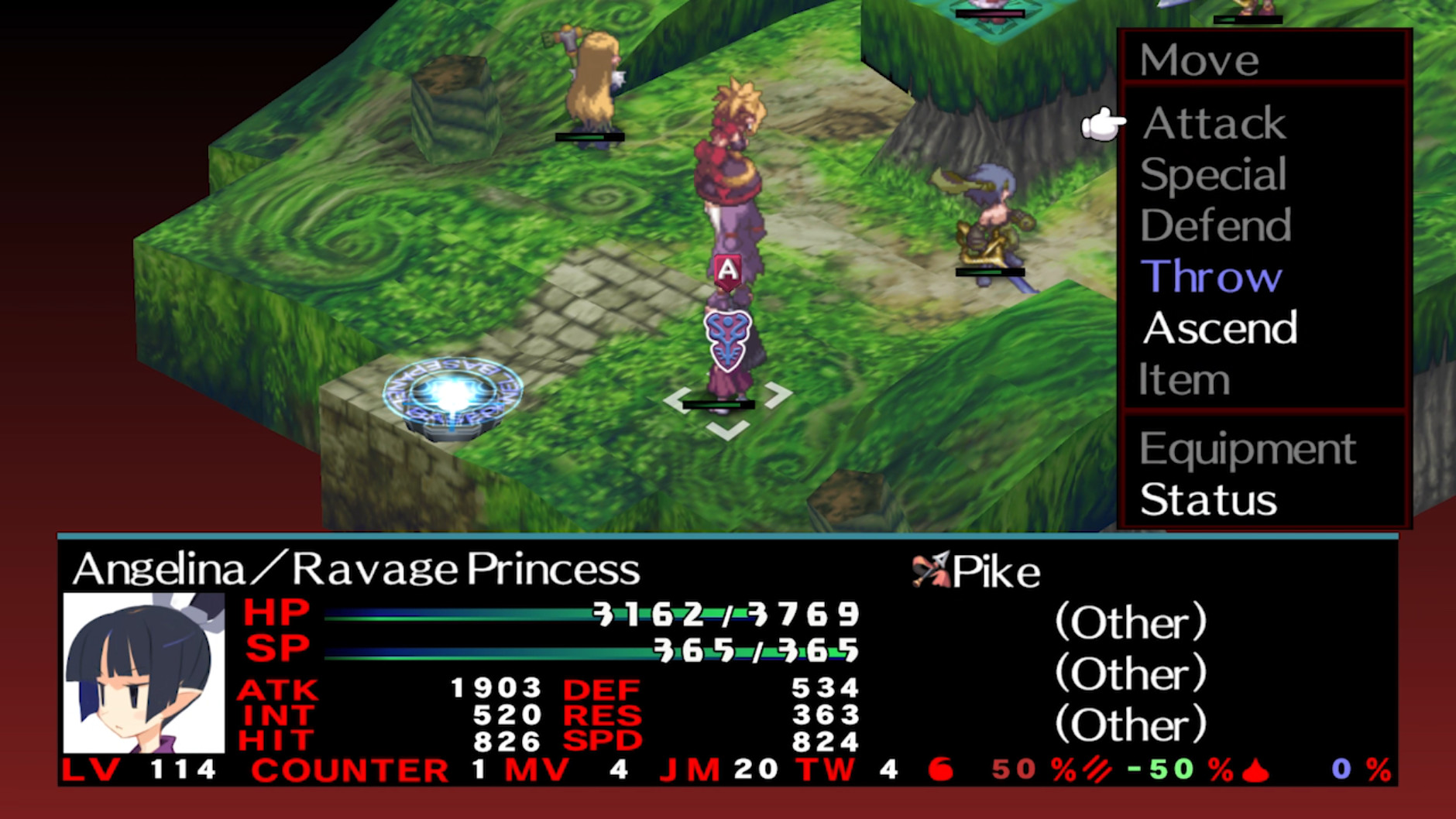
Some battlefields add Geo Panels and Geo Symbols, which change the consequences of occupying particular squares. Coloured panels can carry bonuses or penalties, and a Geo Symbol placed on them controls the effect across the linked area. Destroying a symbol can trigger a chain reaction across panels of the same colour, damaging units standing on them and changing the tactical conditions of the map. The player therefore has to weigh whether the panel's benefit is worth keeping, whether an enemy can exploit it, and whether a chain effect can be used to disrupt opponents. This layer interacts with ordinary movement and attacks: a unit's position can determine who receives a panel's effect, while destroying a symbol can alter several spaces at once. Disgaea 2 PC also lists Stack Attack among its battle features, giving the squad another way to combine characters in an assault. The point of these systems is that an encounter can be shaped through both direct combat and manipulation of the battlefield. Enemies are not only targets to reduce in number; their position, the terrain's effects and the order in which the party acts can all influence the result. Maps consequently support planning around formations and effects as well as choosing attacks.
Between battles, the hub connects party-building to the Dark Assembly, a demon senate that considers bills affecting the player's campaign. New custom characters and changes to the range of goods available in shops are among the kinds of requests associated with the Assembly. Adell's side earns mana through battle, which can be spent when creating a new unit; the new character is sponsored by an existing party member, establishing a master-and-student relationship. As the student advances, the relationship can return benefits to the master, and the two can gain bonuses by carrying out combination attacks together. Approval is not automatic: the senators vote on proposals, and the player can try to sway the result through the game's bribery and persuasion systems. The Dark Court provides a separate, deliberately perverse legal mechanism. Certain actions can produce a summons, and court proceedings may reward the party rather than simply punish it, reflecting the setting's upside-down moral order. These institutions tie tactical play to long-term roster decisions. Battles generate the resources and relationships used to expand the force, while the Assembly determines which new options can be opened. The result is a loop in which the player fights, develops characters, then returns to battle with a larger or differently composed squad.
The Item World turns equipment itself into a repeatable route of battles. From the hub, the party can enter an item and progress through the stages contained within it. Clearing floors strengthens that item, while opposition grows as the expedition goes deeper. This creates a choice between leaving with the gains already made or continuing farther for more development and greater risk. Disgaea 2 also places support facilities within the Item World, including a hospital to restore characters and shops that can supply goods or summon additional party members. Those services change how long a run can continue and help offset the pressure of successive encounters. The Item World therefore connects equipment growth with combat practice: the party's chosen item improves as its users fight through the stages, and the increasing challenge tests the same squad being developed for the main story. Outside this system, the campaign also features the Dark World, a distinct high-difficulty setting, and the Land of Carnage, where high-level enemies offer a further challenge. These modes give established parties more demanding places to test their builds, extending the tactical and character-development systems beyond the story's immediate battles.
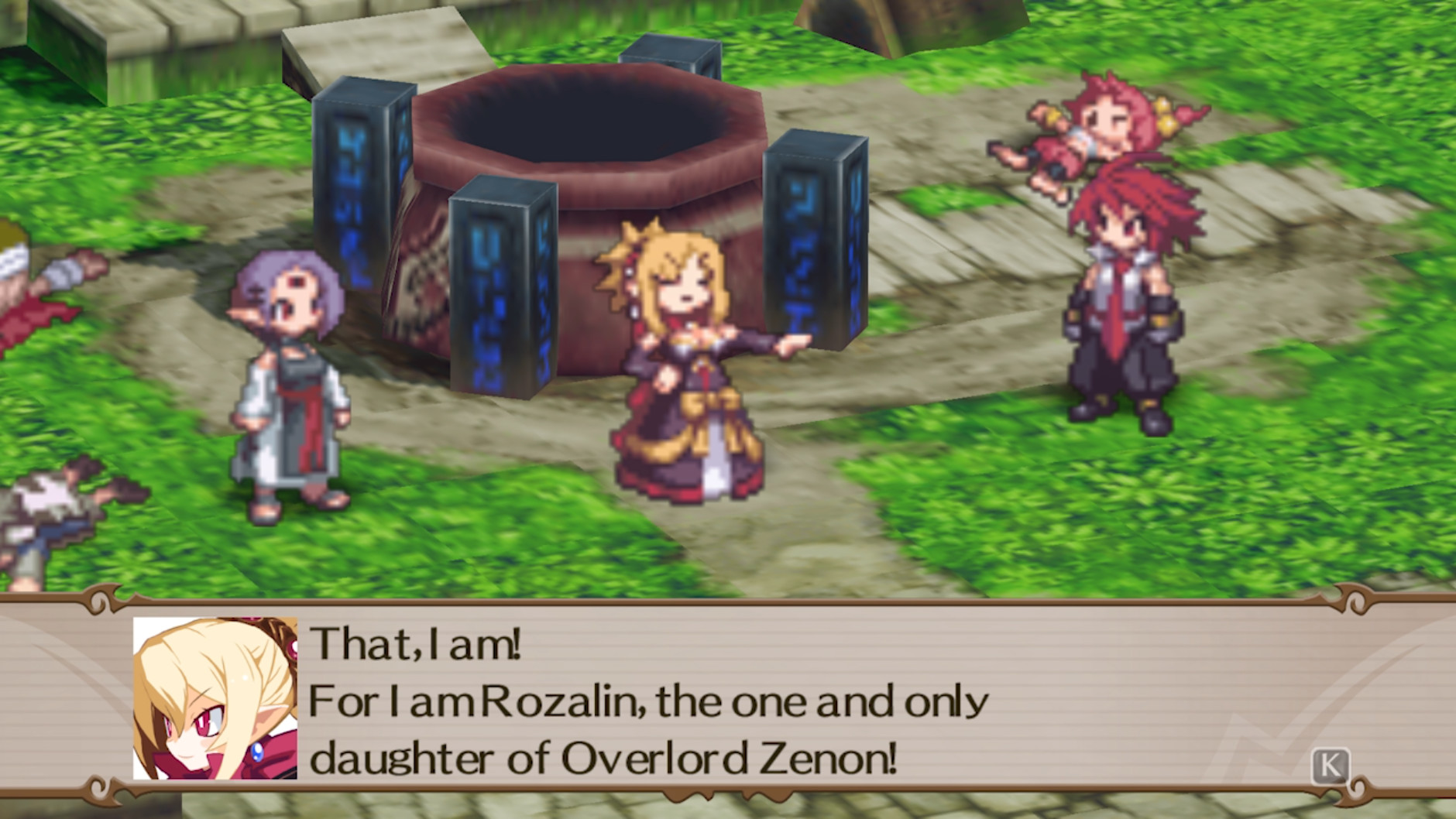
Disgaea 2 PC is the Steam release developed by Nippon Ichi Software and published by NIS America in 2017. It combines the PS2 Disgaea 2: Cursed Memories and PSP Disgaea 2: Dark Hero Days content, so the PC edition includes the latter's additions alongside the original campaign. Among the content brought to PC are Axel Mode and three playable characters: Dark Eclair, Gig and Miabel. The adaptation adds an updated interface, keyboard and mouse support, and new keyboard shortcuts. Steam lists English and Japanese interface, audio and subtitle options, along with Windows, macOS and SteamOS/Linux system requirements. The game's presentation uses anime-style character sprites and illustrated story scenes around the isometric tactical maps, shifting between conversational comedy and battles built from compact, readable grids. Bicubic visual filtering gives players another display option for the game's sprites. The mixture of Adell's journey, Axel's added chapters, roster development and equipment expeditions makes this edition a broad entry point to Disgaea 2's world and tactical systems.
- Developer
- Nippon Ichi Software, Inc.
- Genre
- Strategy RPG / tactical role-playing game