
About Disco Elysium - The Final Cut
In Disco Elysium - The Final Cut, an amnesiac detective investigates a murder in Martinaise, a district of Revachol. Search the city, question its residents and shape the detective through 24 skills, clothing, tools and thoughts in the Thought Cabinet, while political vision quests add further paths through the investigation.
Disco Elysium - The Final Cut opens with a detective waking in Martinaise, a district west of the river in Revachol, with his memory missing and a murder case waiting outside the hostel. Lieutenant Kim Kitsuragi arrives as his partner; together they begin working out who died, what happened and why the people nearby are reluctant to explain it. Martinaise is a compact part of a much larger, politically scarred city, with an industrial harbour, streets, apartments and an abandoned coastline to investigate. The detective’s missing past makes the case personal without telling the player who he is supposed to become. He can try to present himself as a disciplined officer, chase a grand political identity or make a mess of ordinary conversations. The case supplies a practical reason to question people and search places, while the detective’s own identity becomes another mystery threaded through the same streets.
The player moves through the district, inspects objects and talks with people who may have evidence, errands or their own version of local history. Conversations can open additional questions, lead to tasks or change how someone responds later. Kim is a working partner in that process, and one of the detective’s skills, Esprit de Corps, can show what fellow officers are doing beyond the protagonist’s immediate view, including Kim when he is away. The city can be explored in different orders, so the investigation is built from leads gathered across Martinaise rather than a single chain of rooms. The case is not the only task available: small practical jobs sit beside longer investigations, and a witness can point toward a new person, place or subject to revisit. As the detective talks, the in-game clock advances, making the timing of conversations part of the day’s work. The player decides which leads to pursue while the district and its residents carry on around him.
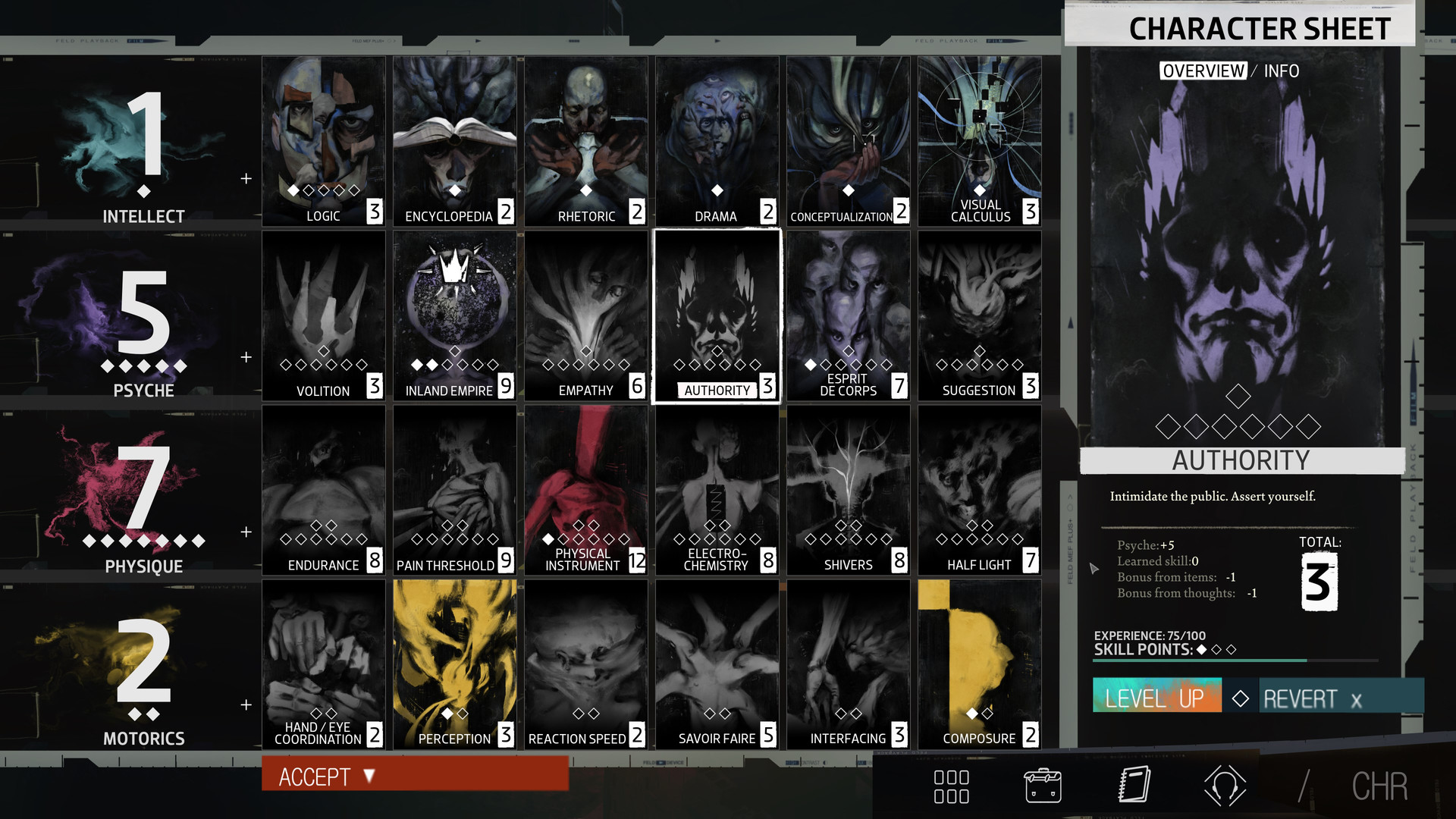
Skills give those encounters a mechanical edge. Logic can help form a theory or catch inconsistencies; Empathy reads other people; Authority pushes toward command, while Visual Calculus turns physical details into deductions. Across four attributes, the Final Cut offers 24 skills, and each can contribute to active checks or to thoughts that speak up without being called. An active check weighs the detective’s skill, items and thoughts against a task’s difficulty, with a dice roll deciding the attempt. White checks can be reopened later by raising the relevant skill or changing the situation; red checks happen once, and failure plays out a different response instead of simply stopping the story. Clothing modifies stats in both helpful and harmful directions, so changing a jacket or hat can matter before a difficult attempt. Skill points improve abilities and can help reopen a white check, but saving a point also leaves room to adapt after a new lead appears.
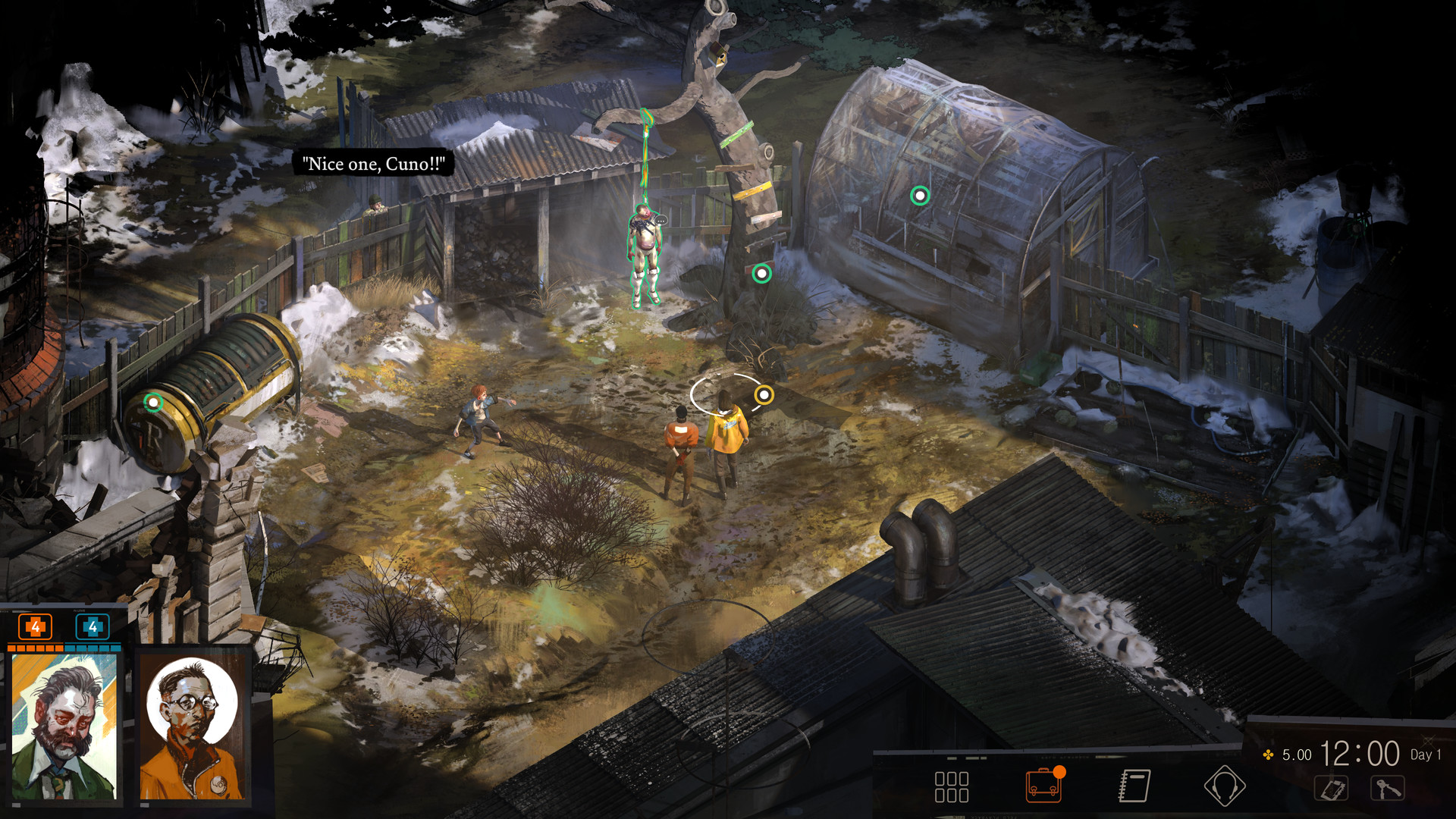
The Thought Cabinet turns ideas and habits into another kind of character progression. Thoughts gathered from conversations can be placed in a limited set of slots and internalized over in-game time. Their effects may include new dialogue, story events, a bonus or a drawback, so choosing what to keep changes both the detective’s outlook and his capabilities. The process can make a repeated line of thought into a declared identity: the detective might lean into art, political slogans or some private obsession that began as a passing remark. A completed thought can also suggest a question to take back to a particular person, folding character development into the investigation. Skill points matter here too, since they can be used to clear a thought or make room for another one. The Cabinet makes role-playing less like choosing a fixed class at the start and more like deciding which ideas the detective is willing to live with as the case progresses.
Martinaise’s history shapes what the murder means to its residents. The district bears the marks of a failed revolution, foreign intervention and economic control, while the present conflict around its harbour gives people immediate reasons to take sides. The detective can pursue political vision quests that connect his chosen worldview to longer paths through the city. They differ in length and form, and their events can change aspects of the world; they run alongside the murder case rather than replacing it. Tasks have no rigid division between main and side stories, so searching for a small practical answer can reveal something about the district’s larger disputes. The journal map and fast travel in The Final Cut help organise movement between places already known. Time spent in conversation still advances the day, and the people available or willing to talk can change as circumstances shift. The investigation therefore combines evidence gathering with attention to who has power, work, money or a reason to avoid the RCM.
The Final Cut adds full English voice acting, political vision quests, new characters, clothing, cutscenes and an extra area. Those additions sit inside the same dialogue-led investigation: a political path may give the detective another reason to speak with a resident, while a newly voiced exchange can make a familiar face or argument more immediate. The player can question witnesses, take bribes, try to persuade someone, or choose a response that damages a conversation. There is no combat loop built around defeating waves of enemies; the main confrontations are social and investigative, shaped by what the detective has learned and how he chooses to act. Even a failed check can leave a scene with a new direction, a consequence or an awkward answer that belongs to this version of the detective. Martinaise remains the space where these systems meet, from the unresolved case to the political questions its people have been living with.
- Developer
- ZA/UM
- Genre
- Role-playing game