
About Devil May Cry 5
A demonic invasion takes hold of Red Grave City as demon hunters Nero, Dante and the mysterious V confront the threat. Devil May Cry 5 is a mission-based action game built around three distinct combat styles, weapon combinations and the pursuit of expressive attack strings against demons and large bosses.
Devil May Cry 5 is a mission-based action game set during a demonic invasion of Red Grave City. The crisis begins when the seeds of a demon tree take root and monsters spread through the city. Nero arrives with Nico, a mechanic and weapons craftswoman who travels with him in the Devil May Cry motorhome. The story also follows the veteran hunter Dante and the enigmatic V, bringing three playable protagonists into the same conflict. Their missions move through overrun streets, ruined buildings and other spaces shaped by the invasion, with demon encounters and large boss fights breaking up the forward push. The campaign’s chapters give the action a clear direction, while its main emphasis stays on how each character approaches the enemies in front of them.
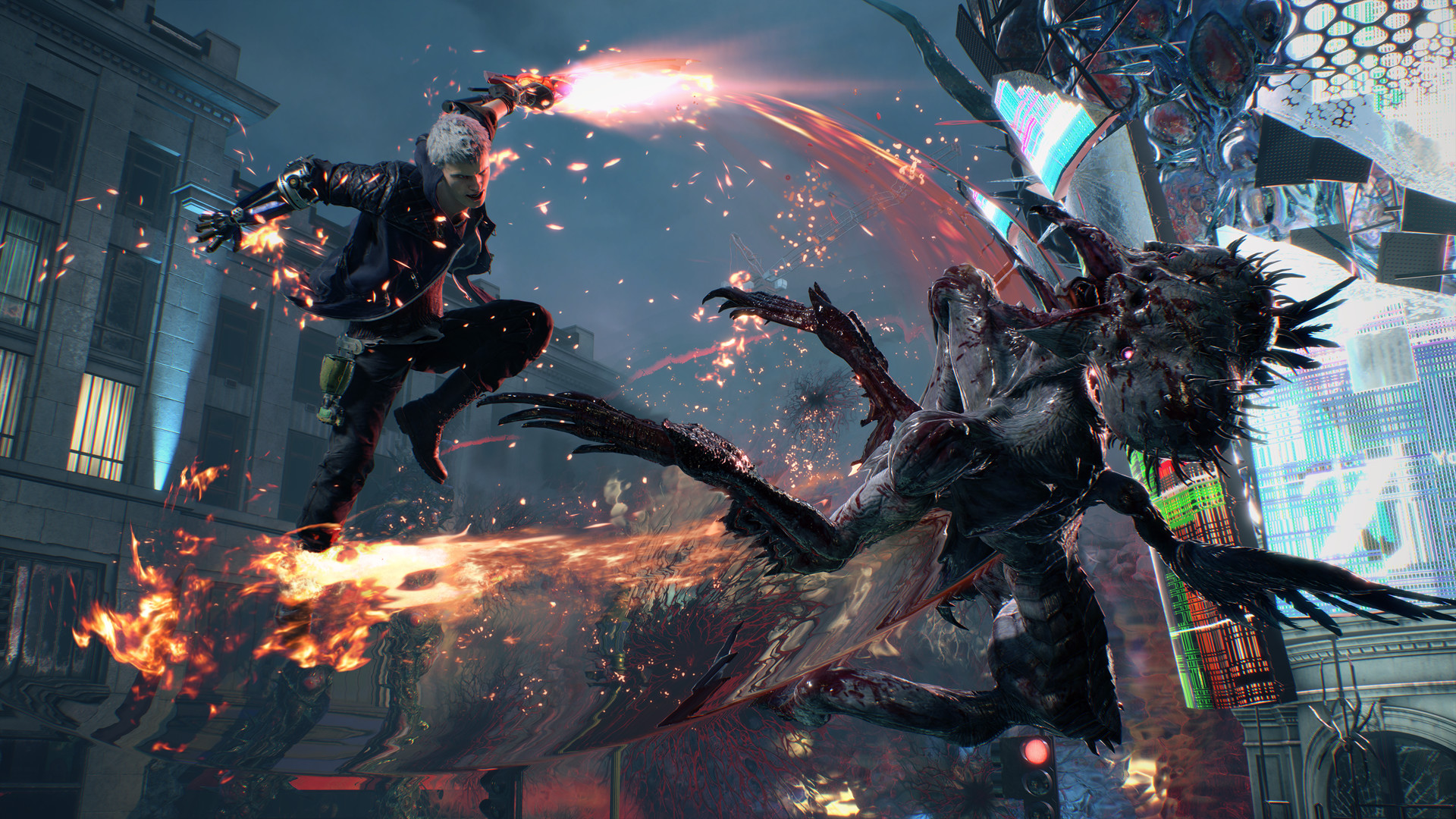
Nero’s combat combines the Red Queen sword, the Blue Rose revolver and a sequence of mechanical Devil Breaker arms built by Nico. The sword and gun let him attack at close and long range, while each equipped arm adds a different special move. These arms are powerful but disposable: using a Break Age attack consumes the current arm, and enemies can also break it, so the player has to decide when a special effect is worth losing that option. An arm’s moves can depend on Nero’s position and directional input; Gerbera, for example, can deflect projectiles from a neutral stance or propel him into an evasive move. Nero can also deliberately break an arm to push away nearby enemies. Devil Breakers can launch Nero through the air, disrupt an enemy or create another opening for his regular weapons. This makes his fights a rhythm of chaining sword and gun attacks, choosing an arm for the situation and adapting when it breaks. Nico’s workshop also provides a place to adjust his equipment and purchase abilities as the campaign advances.
V approaches a fight from a distance. He directs his familiars Griffon and Shadow to attack, using their ranged and close combat abilities while keeping himself positioned to avoid incoming threats. Nightmare, a larger summoned demon, adds another source of pressure to the arena. The familiars can take damage and become temporarily unavailable, so V must watch their condition rather than treating them as limitless extensions of his attack. This gives V an unusual balance of safety and exposure: he can direct attacks from elsewhere in the arena, but still has to keep the familiars functioning and enter danger himself to finish enemies. Weakened enemies are finished with V’s cane, which makes closing in at the right moment part of his play style. The result is a different kind of combat loop: keep the familiars active, control where the pressure lands, and move V into range when a demon is ready to be finished.
Dante brings a broad collection of weapons and four styles that can be changed during combat: Trickster for movement, Swordmaster for close-range weapon attacks, Gunslinger for firearms and Royalguard for defense and counters. His familiar sword and pistols are only part of his arsenal; other weapons introduce different ranges, attack patterns and ways to keep an enemy under pressure. Changing styles and weapons in the middle of an encounter lets the player build longer strings from moves that serve different purposes. Capcom’s launch material notes that Dante’s styles and weapon toolkits can be upgraded, opening additional moves as the campaign progresses. His sections therefore ask the player to manage several connected systems at once, shifting between evasion, attacks and defense as the fight changes.
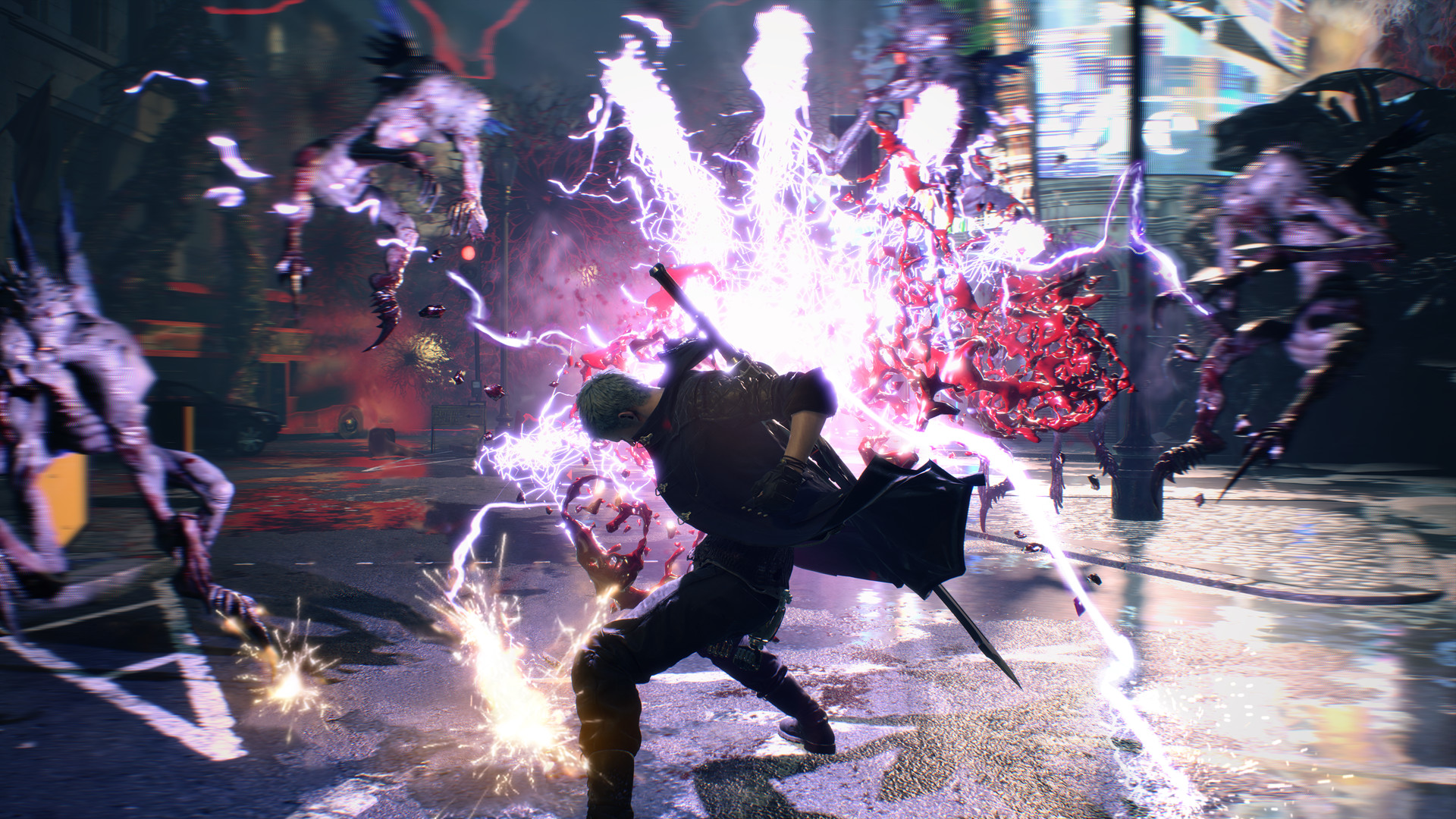
Across the campaign, combat encounters and boss battles act as the main tests of these systems. The player studies an enemy’s reach and attack patterns, moves into position, and combines character-specific tools to maintain an offensive while avoiding interruption. Red Orbs found through play can be spent on skills and weapon abilities, letting each hunter gain additional options over time. Mission interludes at Nico’s mobile workshop connect that growth to the story: her van functions as a place to acquire abilities and configure Nero’s Devil Breakers before returning to the streets. The three protagonists share the invasion and its major confrontations, but switching between their missions changes the available weapons, movement options and tactical decisions rather than simply changing the character model.
Outside the next story mission, the Void gives players a place to practise each hunter’s moves and test how a new ability fits with the rest of a character’s kit. Repeating a mission offers another chance to refine timing, try different combinations and build longer attack strings with tools unlocked later in the campaign. After completing the story, Bloody Palace offers a separate sequence of combat challenges using the same three hunters. These activities make the differences between Nero, V and Dante useful beyond their assigned chapters: a player can return to one style of fighting for focused practice, then take it back into a mission or a longer challenge. Vergil remains a separately sold playable character for the standard PC release; his campaign and the extra modes of Special Edition are separate from this progression.
- Developer
- CAPCOM Co., Ltd.
- Genre
- action; character action