
About Deus Ex: Invisible War
Set about two decades after Deus Ex, Invisible War follows Alex D, a Tarsus Academy trainee caught between powerful groups rebuilding society after a worldwide collapse. Missions combine exploration, dialogue, stealth and combat, while a modular biomod system lets Alex adopt and upgrade abilities for different approaches.
Deus Ex: Invisible War takes place roughly twenty years after the first game, in a world still recovering from a catastrophic worldwide depression known as the Collapse. The player controls Alex D, a trainee in Tarsus Academies’ Security Operations Residency. At the start of a new game, the player chooses Alex’s portrait, which also determines the character’s gender presentation. Tarsus trains a small group for work involving technology, special operations, counterespionage and problem solving, and its students expect to enter a world of corporate and security assignments. Events quickly draw Alex beyond the academy’s planned career path and into conflicts over how cities should be governed, who should control advanced technology, and what form a stable society should take. The story develops through assignments, records, conversations and competing requests from organisations with incompatible political aims.
Alex’s initial circle includes fellow trainees Billie Adams, Leo Jankowski and Klara Sparks, as well as Seattle coordinator Dr. Leila Nassif. Their relationships to Tarsus differ: Billie’s experience growing up in post-Collapse Chicago has left her suspicious of institutional authority, while Leo is ambitious and Klara is drawn to negotiation and conflict resolution. These characters give the academy setting a personal dimension as the trainees are pushed into consequential events. The wider conflict features the World Trade Organization, or WTO, whose enclave administration promises security and reconstruction, and the Order, a religious movement that contests the WTO’s control and technological priorities. Alex can take work from competing interests, and missions often leave room to investigate before deciding how far to cooperate. Information, access, money and local trust can be affected by these choices, while the game preserves space for Alex to delay a commitment or hear another side of a dispute.
The campaign moves through interconnected city hubs and smaller mission areas, where conversations and environmental interaction are as important as firefights. Alex can question residents, use holocomms, read emails and datacubes, inspect terminals and track assigned goals in the Datavault. That interface stores notes, codes, images and completed objectives so discoveries remain available after leaving their source. Security devices, doors and containers communicate useful information when targeted; a lock may require the right soft key or a number of multitools, and some obstacles can be approached through nearby controls or alternate routes. Multitools are consumable nano-devices that bypass electronic security and pick locks, with harder tasks taking more. Credits support purchases of weapons, information, supplies and black-market biomods. Dialogue choices can influence how people respond and may carry consequences across the story, making social encounters part of mission planning rather than a break from it.
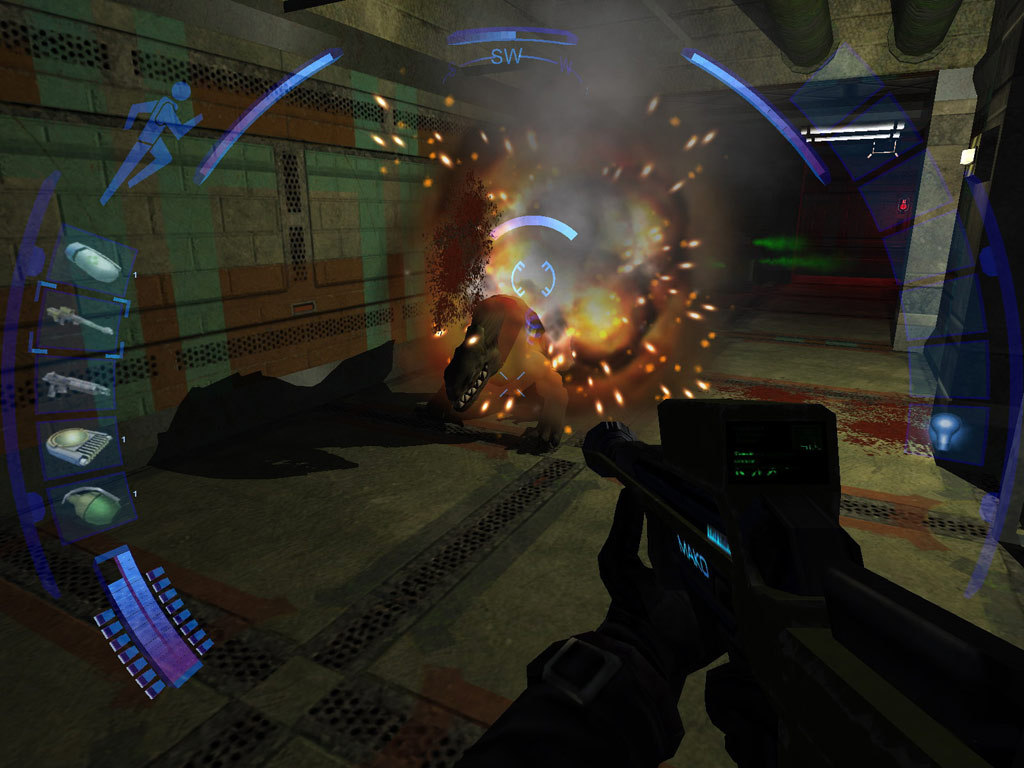
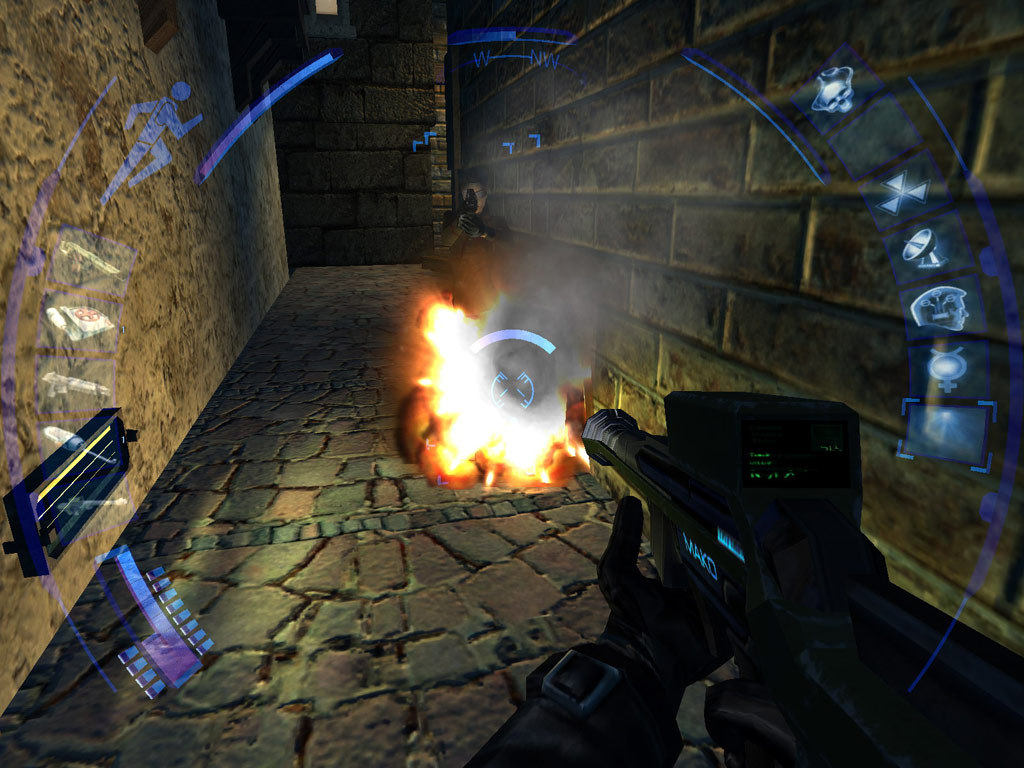
Combat supports firearms, explosives and close-range weapons, but stealth and non-lethal tools can also help Alex pass or subdue threats. Non-lethal options include the boltcaster, stun prod and gas grenades, alongside biomods that can conceal Alex or reduce movement noise. If combat begins, shot location matters, and environmental hazards such as radiation, heat, biotoxins and electromagnetic fields require attention. One defining resource rule is that every firearm draws from a shared pool of nano-mass ammunition; heavier weapons consume more per shot, and a player has to balance the use of a pistol against a rocket launcher or other high-cost weapon. Ranged weapons and grenades have alternate-fire modes, including scopes, burst effects and special ammunition effects, some of which consume additional rounds. Weapon modifications can expand how a firearm works, while the six-slot toolbelt and compact inventory require choices about what to keep ready.
Alex’s central character-development system is biomodification. The game provides five assignable body slots and a sixth fixed light slot. Each assignable slot offers two standard biomods and one black-market alternative, so finding a canister gives Alex a choice of which capability to install or improve. The options vary by body region and role: Strength Enhancement increases melee and thrown damage and permits heavier lifting; Vision Enhancement improves low-light sight and can scan through walls at higher levels; Bot Domination lets Alex control a nearby bot, camera or turret; Move Silent reduces noise; and Cloak conceals Alex from humans and animals. Active biomods consume bio-energy, while passive ones work continuously. Energy cells restore the power supply, and some abilities can drain it quickly. Standard and black-market biomod canisters have distinct installation rules, and a newly installed choice can replace another mod in its slot if Alex has another canister, at the cost of the old mod’s effects and upgrades.
Biomod canisters also provide a distinct form of progression: an installed ability can be upgraded twice, increasing its power, and later canisters may be spent on either a new installation or an upgrade. Since the six slots define much of Alex’s capability, the same obstacle can be addressed through different combinations of stealth, strength, vision, healing, environmental protection or security control. A Cloak biomod applies to people and animals but does not hide Alex from cameras and bots; Thermal Masking instead conceals Alex from electronic devices. A Spy Drone offers remote viewing and an EMP attack, while a Hazard Drone protects against environmental dangers. These differences make the slot decision more specific than simply choosing a stronger version of the same action. Replacing a mod remains possible, but the canister and lost investment make switching a meaningful resource choice.
One recurring presence in the city hubs is NG Resonance, a holographic pop singer whose virtual image speaks with fans and can ask Alex to gather local information. Her appearances link a personal side story to the game’s wider interest in networks, authority and surveillance: Alex can follow leads, report discoveries and receive further work through a personality presented as entertainment. This kind of hub activity sits beside assignments from the WTO and the Order, giving Alex room to pursue local disputes while larger reconstruction questions remain unresolved. Alex’s conversations, exploration and use of terminals can therefore serve both immediate mission objectives and smaller stories that reveal what life in a post-Collapse city looks like.
- Developer
- Ion Storm
- Genre
- First-person action role-playing game with stealth and immersive-simulation systems