
About Deus Ex: Game of the Year Edition
In 2052, UNATCO operative JC Denton investigates the theft of a vaccine in a world strained by disease, inequality and political violence. Deus Ex combines first-person combat, stealth, exploration and role-playing systems, letting players develop Denton’s skills and nanotechnological augmentations while navigating a widening conspiracy.
Deus Ex takes place in 2052, when economic collapse, widening inequality and the spread of the fatal Gray Death have destabilised societies around the world. The player is JC Denton, a nano-augmented covert operative working for UNATCO, the United Nations Anti-Terrorist Coalition. His early assignments focus on the National Secessionist Forces, a group opposing the coalition, and on securing Ambrosia, a scarce vaccine whose distribution is controlled by powerful institutions. What begins as counterterrorism work leads Denton through a network of agencies, corporations and underground organisations whose public explanations do not always match the evidence he uncovers. The plot unfolds through briefings, conversations, intercepted communications and records found in the environment, allowing the political conflict to emerge alongside the missions rather than through a single uninterrupted explanation.
UNATCO gives Denton a chain of missions and contacts, including his brother Paul Denton, fellow operatives Anna Navarre and Gunther Hermann, and headquarters director Joseph Manderley. Other people encountered in the field can provide information, offer access, or complicate an assignment; conversations with them add context and can change how a local situation develops. The National Secessionist Forces appear first as an armed adversary, but the game gradually supplies more perspectives on the conflict. Denton’s goals also distinguish essential mission objectives from optional secondary goals. The latter can reward investigation and interaction beyond the minimum route. Messages, emails, datacubes, computer terminals and conversations supply passwords, security codes and background information, while the goals and notes display gathers mission instructions and useful discoveries in one place.
Each mission area is built around connected spaces, locked routes and multiple kinds of access. Denton can search rooms, read terminals, speak with occupants, climb, crouch, swim, use environmental objects and move through vents or less conspicuous passages. Doors and security systems may be opened with the right key or code, bypassed with tools, defeated through computer access, or attacked when their construction allows it. Lockpicks and multitools are consumable resources, so using them on one obstacle affects what remains for another. Computers can expose information or grant control over security devices, while notes preserve discovered passwords and codes. The game’s spaces encourage the player to assess what a route costs and what it reveals, because a locked door can be a tactical problem, a resource choice or a prompt to search for another entrance.
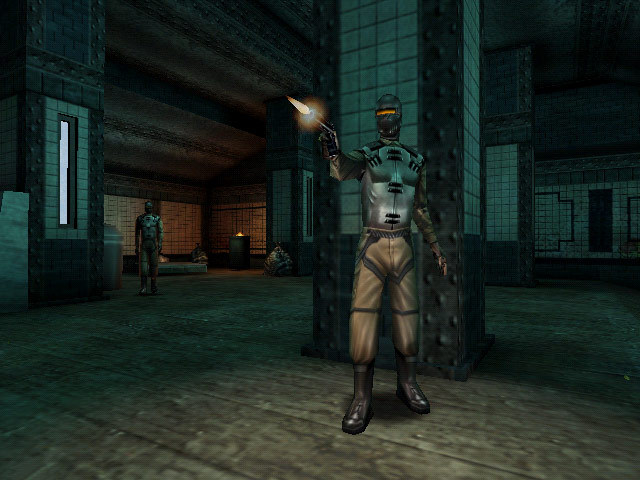
Combat is one available response rather than the only way to complete objectives. Denton can use firearms, explosives, melee weapons and equipment, or avoid detection through careful movement and concealment. Enemies have body locations that respond differently to damage: a head shot is powerful but difficult, while shots to arms or legs can disable without being fatal. Ammunition, healing items and inventory room all place limits on preparation. Larger weapons occupy more inventory space, and many supplies share the same compact carrying system as tools and mission equipment. Weapon upgrade kits improve compatible firearms in areas such as accuracy, recoil, clip size or firing speed; upgrades become attached to the selected weapon. The combination of weapon handling, aiming, sound, line of sight and scarce supplies makes each encounter a practical question of positioning and expenditure, not simply which weapon has the highest damage.
Denton’s conventional advancement is built around skills that improve through skill points. The game has eleven skills, including weapon disciplines, lockpicking, electronics, computers, medicine, demolitions, swimming and environmental training. Each skill moves through Untrained, Trained, Advanced and Master levels, improving the effectiveness of the related action or equipment. Players allocate an initial pool during character creation and earn further points as they progress; once a mission is underway, skills can be raised but not reduced to reclaim points. Specialising makes particular approaches more dependable: investment in computers improves the value of terminal access, while lockpicking skill changes how efficiently Denton can use picks on secured doors and containers. Skills are separate from his nanotechnological augmentations, so a character’s general competence and installed physical abilities grow through different resources and decisions.
Augmentations occupy body-specific slots and add abilities such as enhanced vision, improved movement, stronger combat, environmental protection or greater resilience. Finding an augmentation canister is only part of installation: Denton must bring it to a medbot, where the canister offers a choice between two augmentations for the corresponding slot. Installing one permanently removes the alternative for that slot, making the selection a long-term character decision. Most installed augmentations are activated when needed and draw from bio-energy while running. Bioelectric cells replenish that energy, so an ability’s benefit must be weighed against how much charge remains for later. Upgrade canisters raise an installed augmentation’s technology level and are used directly, without a medbot; these upgrades are permanent. This system gives exploration a second progression track, as searching mission spaces can reveal equipment that changes how Denton moves, fights, sees or handles hazards.
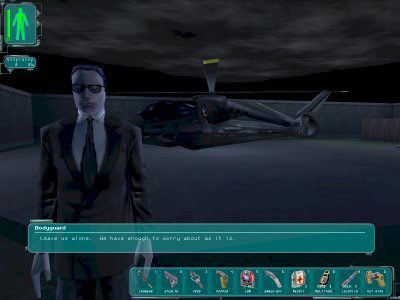
Mission conduct can affect later character interactions. People Denton has met may respond to how he handled earlier situations, and UNATCO colleagues can react differently to lethal or restrained actions against the NSF. That carryover gives the player a reason to consider what happens after an immediate obstacle is cleared, especially when an objective can be completed without killing its defenders. Secondary goals also offer smaller ways to investigate an assignment or help people in its vicinity, while the primary objective keeps the mission moving. These outcomes sit alongside the conspiracy plot: Denton gathers evidence, compares what allies and opponents tell him, and weighs those accounts against information found in the field. Conversations, voice transmissions and mission records preserve context as contacts and instructions change. The result is a campaign where choices about force can shape both the route through a location and how characters address Denton later.
- Developer
- Ion Storm
- Genre
- First-person action role-playing game with stealth and immersive-simulation systems