
About Death's Door
A crow employed by the Reaping Commission must recover a stolen soul in a land where death has stopped. Explore connected regions, fight with weapons and magic, solve ability-based puzzles, and gather three Giant Souls to open Death’s Door. Follow the route as tools open new paths.
Death’s Door opens in the Reaping Commission, where a crow’s work is to collect the souls assigned to them. The Crow’s first assignment goes wrong when its target is stolen, and the trail leads beyond the office into a land where death has stopped. Creatures there have outlived their natural span and gathered power around themselves. An old crow points to three Giant Souls as the means of opening Death’s Door, giving the Crow a concrete task while hinting that the Commission’s routine depends on forces it does not fully control. The adventure’s dry office humor sits beside a more melancholy question: what happens to a world when its inhabitants cannot pass on? The Commission’s rules also connect unfinished work with the crow’s own lifespan, so recovering the stolen target becomes a matter of survival as well as professional duty.
The Hall of Doors is both workplace and travel hub. Its doors provide routes to places already reached, and the Commission’s staff give the Crow somewhere to return between expeditions. Souls collected on the road can be spent through the Vault Manager to improve combat attributes, so this home base links exploration to gradual character development. The Lost Cemetery functions as a local crossroads: paths lead away from it toward the larger regions, and opening gates or lowering ladders creates shortcuts through ground the Crow has already crossed. Reaper doors in the field return the player to the Hall, while those physical shortcuts reconnect nearby rooms. Together, these systems make backtracking a way to use new tools and reach previously closed passages, rather than simply repeating the whole route. The visual contrast reinforces this divide: the Commission is rendered in stark monochrome, while the regions beyond the doors introduce distinct colors and terrain, from the muted cemetery to a lush forest and snowy peaks. Returning to the Hall therefore marks a shift from the hazards of field work back to the clerical world that sent the Crow out.
The three Giant Souls belong to the Witch of Urns, the Frog King, and Betty. Their routes move through several connected spaces before reaching each ruler: the Witch’s Estate and Ceramic Manor, the Overgrown Ruins and Mushroom Dungeon leading toward the Flooded Fortress, then the northern passage through the Old Watchtowers to Betty’s Lair. This progression changes the surrounding challenges as the landscape shifts from manor rooms and wooded paths to a fortress and icy mountain approaches. Along the way, gates, keys, switches, and enemy encounters divide the larger journey into smaller tests. The bosses are milestones in these territories, but finding the way to them means reading the level itself and making use of shortcuts opened from the far side.
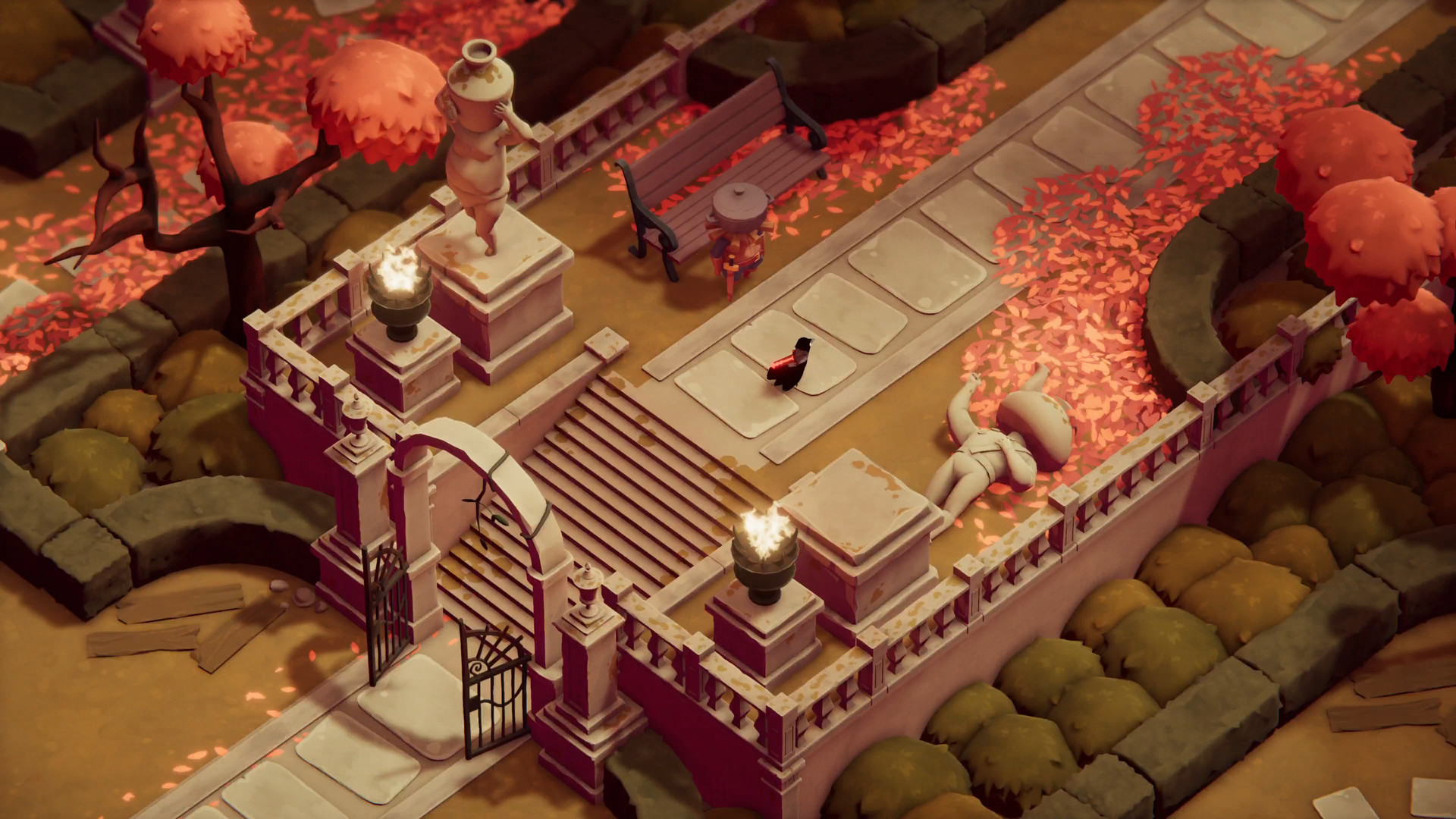
Combat pairs a quick dodge with deliberate melee attacks and ranged magic. The Crow starts with a sword; weapons discovered later trade damage, reach, and swing speed, changing how much space the player needs before committing to a combo. Attacks do not consume stamina, but their animations and recovery leave openings that enemies can punish. Agile creatures may leap around the Crow and throw boomerangs, while shielded knights absorb pressure until the player finds a better angle or heavier strike. Some rooms combine several enemy types and lock the exits until the group is defeated. These arenas encourage prioritizing threats and moving between attacks instead of standing still to trade hits. A short dodge can avoid a strike, reposition the Crow, and create an opening for another attack.
Abilities gradually turn environmental details into routes. The bow can hit distant buttons, fire lights braziers and clears cobwebs, bombs break cracked walls, and the hookshot crosses marked gaps. These functions recur in puzzles that ask the player to connect a visible mechanism with the tool that can reach it. In Castle Lockstone, for example, the player lights fires and works through buttons, levers, pillars, and platforms to activate the elevator; some button sequences are timed, so the route must be crossed before the mechanism resets. Elsewhere, opening a gate from the far side creates a shortcut back through a room already explored. Magic charges are limited and can be restored by striking enemies or certain objects, tying spell use to the melee rhythm. Optional ability challenges add upgrades that change how these tools work in combat. The design often lets one puzzle teach a rule that returns in a more demanding room: a distant button may need an arrow, a gap calls for the hookshot, and the opened route may expose the next lever or brazier. Rather than separating exploration from combat, the same limited set of actions carries across both.
Souls from enemies and discoveries fund four direct attribute upgrades: strength, dexterity, haste, and magic. Shrines increase health or magic capacity, while life seeds can be planted in empty pots to create a return point for healing; choosing when to use one matters on a longer route. These systems serve different needs: upgrades improve the Crow over time, shrines expand available capacity, and planted seeds help recover within a region. The Commission also gives the adventure a recurring narrative pause. After major fights, a gravedigger delivers a brief eulogy that recounts the defeated figure’s actions, mixing solemn remembrance with a joke. Those ceremonies complicate the simple goal of collecting powerful souls: each target has a history and motivation, and the Crow’s work affects more than the office ledger. Souls already collected are retained after defeat, so the currency earned during a difficult stretch still contributes to the next improvement even when the player must retrace a route.
- Developer
- Acid Nerve
- Genre
- Action-adventure