
About Dead Space 2
Engineer Isaac Clarke awakens on the Sprawl, a crowded space station orbiting Saturn, three years after the Ishimura disaster. As Necromorphs spread through its public and industrial districts, he fights to survive, investigate the Marker’s influence and navigate a crisis complicated by haunting visions and failing systems.
In Dead Space 2, engineer Isaac Clarke wakes in a hospital on the Sprawl, a vast station orbiting Saturn, three years after the Necromorph outbreak aboard the USG Ishimura. He has little control over the crisis unfolding around him and is soon forced to move through a station where ordinary life has been overtaken by violence. Residential blocks, schools, shopping districts and medical facilities give the disaster a human scale. Isaac tries to survive, understand the Marker-related catastrophe and contend with visions of Nicole, whose death continues to affect his perception. Around him, survivors attempt to escape, respond to the outbreak or pursue their own beliefs about the Marker. Unitology, the religion formed around the alien artifact, remains part of the conflict, while the Sprawl’s public and industrial infrastructure becomes a maze under emergency conditions.
The campaign is a third-person survival-horror action game in which Isaac moves through connected interiors, follows objectives and searches rooms for ammunition, health supplies, credits and upgrade resources. Much of the interface remains attached to his suit: health and Stasis are visible along his back, while projected menus let him check objectives and inventory without replacing the view with a fixed dashboard. Doors, lifts, security systems and damaged machinery turn traversal into practical obstacles. Some tasks call for rerouting power, operating equipment or solving a compact environmental puzzle; others lead directly into an ambush. Exploration therefore serves both navigation and preparation, because supplies gathered in quieter rooms determine how much flexibility Isaac has when a corridor fills with enemies.
Combat revolves around strategic dismemberment. Necromorphs are most efficiently stopped by removing limbs, so the familiar Plasma Cutter is useful for placing precise shots rather than simply firing into a creature’s body. Isaac can carry a limited selection of weapons, including returning equipment such as the Line Gun and Ripper as well as tools such as the Javelin Gun and Detonator. Each has a distinct use: the Javelin can pin a target to a surface, while the Detonator lays proximity mines. Power Nodes collected during the campaign improve weapons and Isaac’s suit at benches, making upgrades a choice about where to invest scarce resources. The result is a loop of scavenging, selecting a loadout and adapting aim to the enemy in front of you.
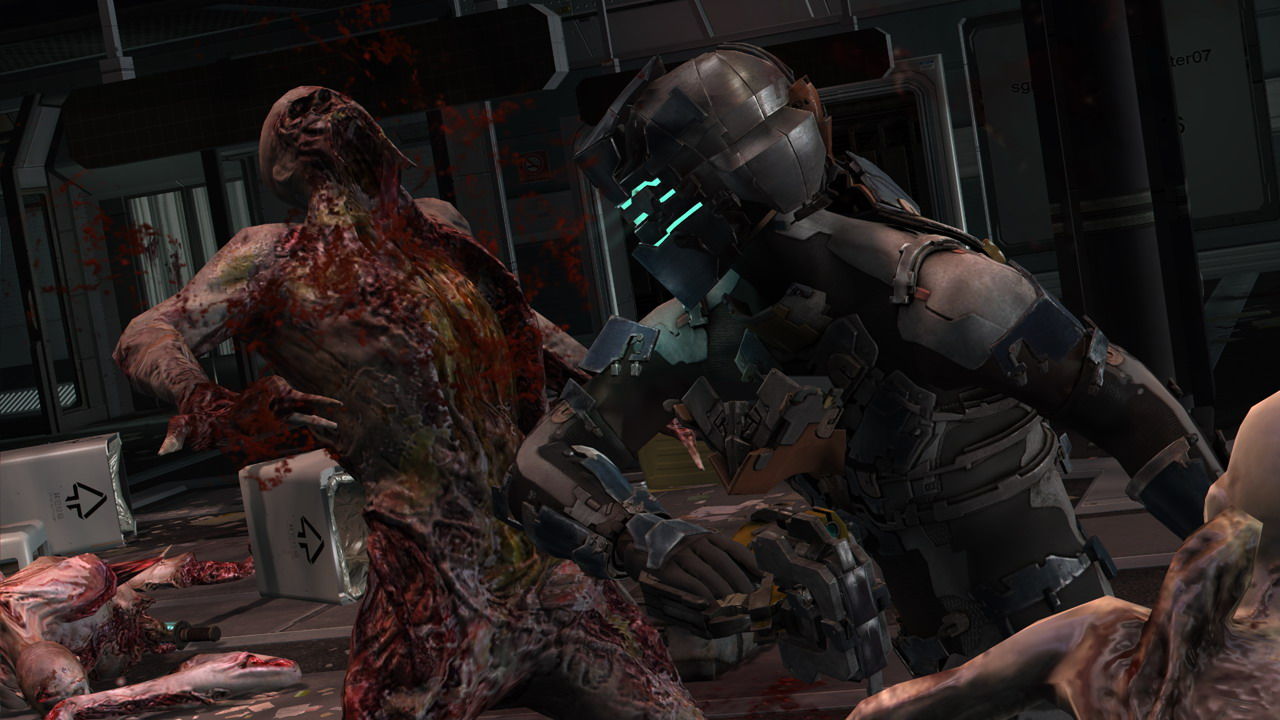
Isaac’s engineering equipment also works directly on the environment. Kinesis pulls objects toward him and launches them as projectiles, allowing severed limbs or sharp debris to become emergency ammunition when conventional rounds are low. Stasis slows a target or moving hazard for a short time, creating a window to reposition or aim. The Sprawl’s pressure systems add another danger: a breach can pull loose objects, enemies and Isaac toward an opening, forcing a quick response to the changing room. Zero-gravity sections let Isaac maneuver freely with suit thrusters, rotate in open space and reorient himself toward a surface. These passages combine movement with small physics puzzles, asking him to reach machinery or manipulate objects while there is no stable floor.
The Necromorph roster builds on the creatures encountered aboard the Ishimura while introducing threats that pressure different habits. Some swarm in numbers, while others hide behind cover or rush when Isaac is distracted. Stasis can halt a charging enemy, but ammunition, reload time and room layout still matter; a useful tactic in one encounter may leave Isaac exposed in another. Fights are interspersed with short hacking challenges, repairs and movement puzzles, then escalated by pursuits and sudden changes in the environment. The station’s varied public spaces also change how combat reads: a school, apartment block or shopping concourse carries traces of daily life even when its corridors have become routes through an active infestation.
Resource management runs through two stations Isaac revisits: Stores and upgrade benches. The Store handles Credits, weapon schematics, ammunition, health supplies and suit upgrades, while the bench spends Power Nodes on improvements to weapons and suit capacity. Items can be shifted into a Safe to clear inventory space and retrieved at any Store, so a pickup may be useful later even when the current loadout is full. These decisions shape how Isaac prepares for the next stretch: a player can spend Nodes to raise weapon damage, improve health or increase Stasis capacity, while the Store supports restocking and a different weapon choice. The RIG also holds mission objectives, status and recorded transmissions, keeping practical navigation and collected story material together.
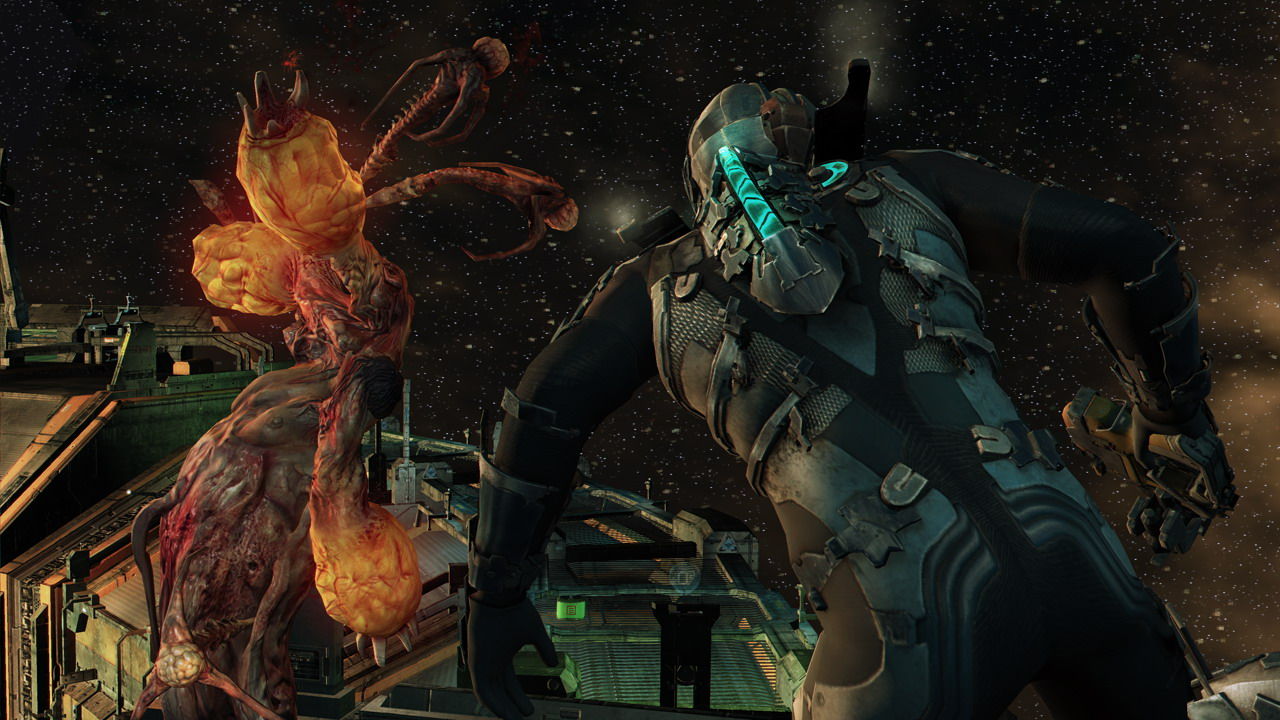
Dead Space 2 includes a separate multiplayer mode alongside the single-player campaign. The story follows Isaac through the Sprawl and its outbreak; multiplayer puts players on human and Necromorph teams in objective-based matches. That mode uses dismemberment-focused combat from a competitive perspective, while the campaign’s progression centers on moving through chapters, collecting resources and improving Isaac’s equipment. New Game Plus carries earned upgrades into a repeat run, giving weapon and suit decisions a longer arc. The sequel expands Isaac’s movement and weapon options while making the populated station itself part of the horror: its public spaces show what was lost when the outbreak spread.
- Developer
- Visceral Games
- Genre
- Survival horror action