
About Dead Rising Deluxe Remaster
Freelance photojournalist Frank West enters the quarantined Willamette Parkview Mall to investigate a zombie outbreak. Over three in-game days, he follows timed cases, photographs the crisis, fights through crowds with improvised weapons, and tries to guide stranded survivors back to the Security Room before help arrives.
Dead Rising Deluxe Remaster retells the first Dead Rising story, following freelance photojournalist Frank West after he is dropped into Willamette, Colorado, during a military quarantine. He reaches the Parkview Mall expecting a major news story, only to find its concourses and shops overrun by zombies. The mall’s Security Room becomes a refuge and reporting base: from there, Frank can enter the complex, respond to people in danger, and return with evidence of what is happening. His investigation runs against a 72-hour clock tied to the promised arrival of help. The plot unfolds through scheduled case events and conversations, so Frank’s movement through the mall connects the personal stories of people caught inside with the larger question of how the outbreak began. The setting gives the crisis a deliberately ordinary frame: food courts, stores, service corridors and public spaces become routes, shelter, supply points and dangerous bottlenecks.
The watch is central to planning because it displays the current time and the active Scoop cues that lead to side events and survivor encounters. Each case or Scoop has a window; reaching a destination late can mean losing that opportunity, while travelling directly between objectives can leave other people unaided. The player decides how to spend the hours: continue the main investigation, detour to a call for help, search for equipment, or take a route that makes a return to the Security Room practical. The clock creates pressure through overlapping commitments rather than a simple sequence of isolated missions. The manual also describes a time fast-forward feature at save points that has requirements, so the schedule can be managed in some circumstances. This structure rewards checking the watch and map before leaving a safe point, then balancing the distance and risk of a route against how much time remains on the current objective.
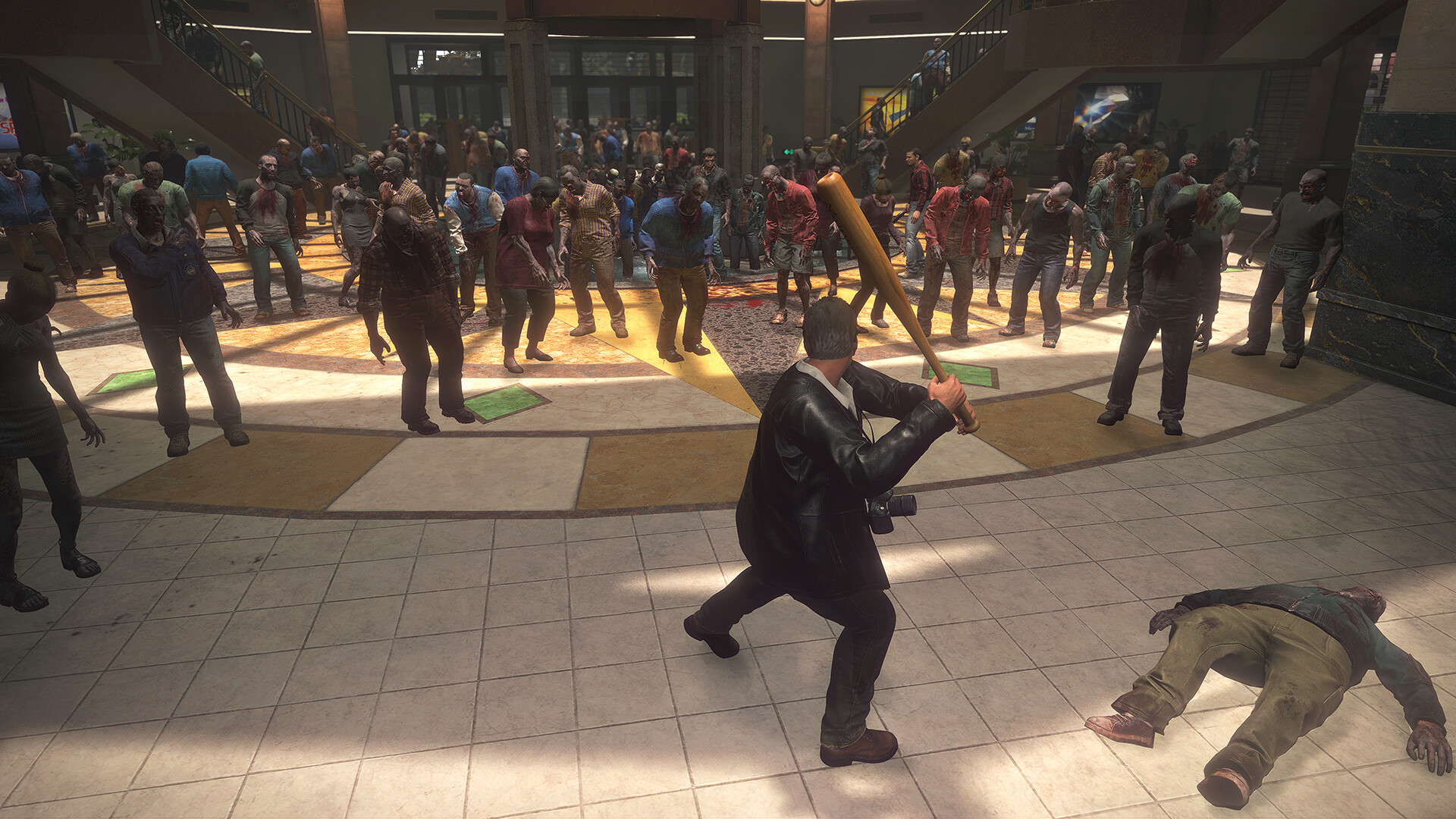
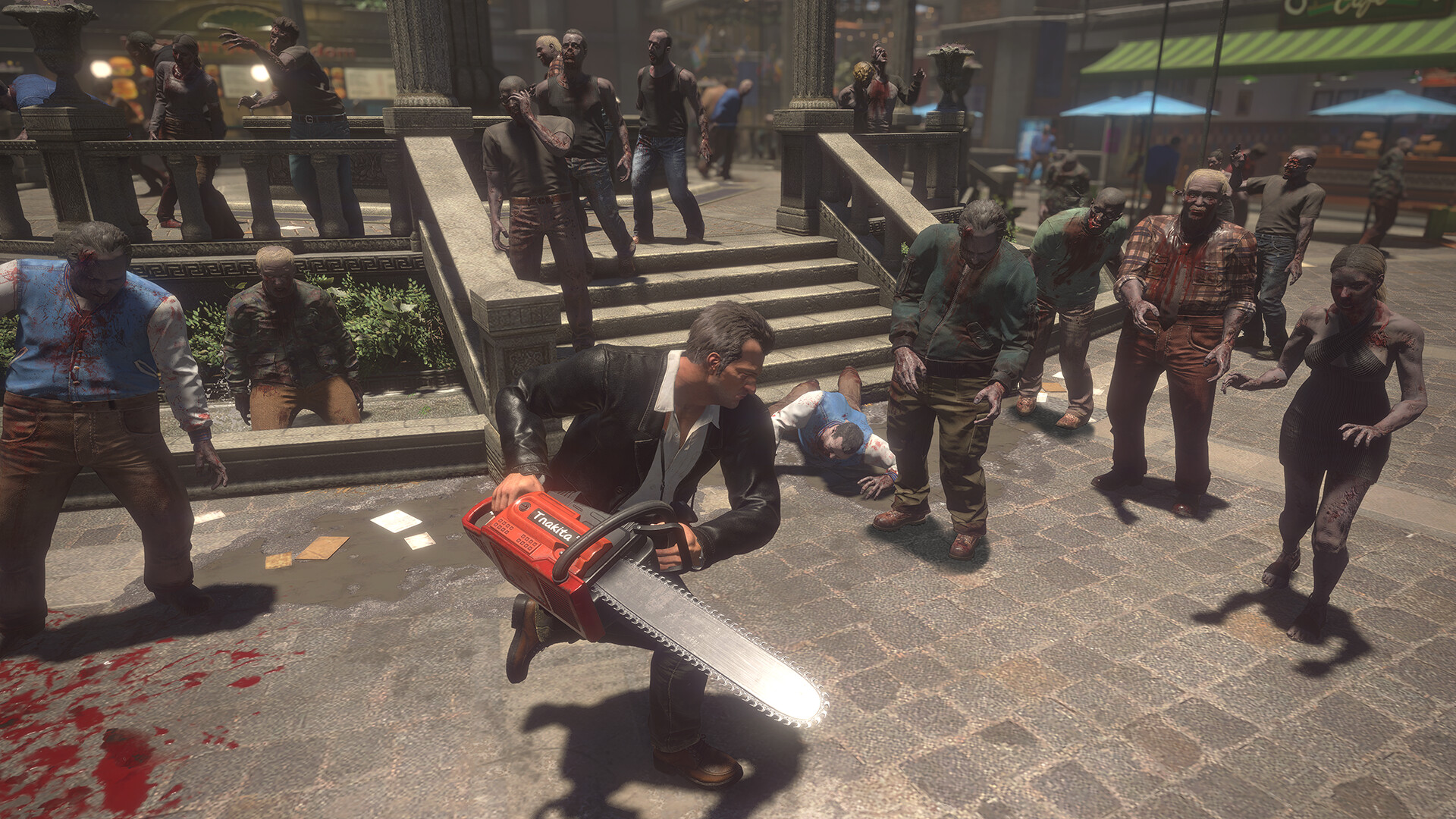
Combat uses the objects around the mall as a changing supply of weapons. Baseball bats, guns and other purpose-built arms sit alongside everyday goods that can be picked up and used against the undead. A weapon occupies an item slot, and its condition or ammunition limits how long it can serve; moving through shops and public areas therefore means choosing what to carry and when to replace it. The player can break through dense crowds, create space to move, or engage human threats known as Psychopaths, whose encounters interrupt the routine danger posed by zombies. Frank’s level and abilities grow through Prestige Points earned during play, connecting combat and other activities to character development. The result is a loop in which the mall itself supplies both hazards and resources: a shop may offer a route past a horde, an item to fight with, or a brief chance to change tactics before the next timed call draws Frank elsewhere.
Frank’s camera is both a journalist’s tool and a progression system. He can take pictures during the outbreak, and the game evaluates each image for its subject and composition. The camera manual identifies categories including Horror, Brutality, Outtake and Drama; the target marker indicates potential PP, with unusual moments such as an attack or injury increasing the value. Objects bearing PP stickers also reward photographing them. Camera parts found at a photographic supplies shop add functions, while the battery limits how often Frank can shoot before finding a replacement. Pictures can be reviewed from the pause menu, and selected images can be protected from automatic deletion when the camera’s storage fills. These rules give photography a practical role beyond documenting story scenes: the player watches for moments that can build Frank’s PP and feed into level growth while managing the camera as another piece of equipment.
Survivors turn navigation into a group-management task. People encountered around the mall may need to be persuaded to follow Frank; once they agree, the player can call them over or set a destination marker. Their personalities affect how they behave, and those left behind when Frank changes areas gradually lose health. Some cannot travel unaided and must be carried, supported or led by the hand. Each survivor has preferred items visible through the watch: giving a liked weapon improves their attack power, while liked food restores their health and raises morale. Increased affinity can prompt them to find items, protect companions or help Frank. Escorting a group back to the Security Room earns PP, but the route remains exposed to zombies and human enemies. This makes rescue a sequence of decisions about who can travel, what to equip them with, when to move and whether the group can safely cross into another mall area together.
The Deluxe Remaster presents this first-game story with a new RE ENGINE graphical overhaul and changes to presentation and controls. Capcom describes revamped controls, a redesigned user interface, full voice acting and autosaves as quality-of-life changes; the Steam listing identifies it as a single-player action-adventure game. Its core structure remains a race through Willamette’s mall during the quarantine, built from timed investigation, improvised fighting, photography and survivor rescues. The ordinary interiors support several kinds of play at once: shops are potential equipment sources, corridors shape travel between cases, and the Security Room anchors returns with people or information. Frank can change clothes in the refuge, while optional costumes and mall background music are managed through separate menus. The combination keeps attention on the same central problem throughout: decide which leads and people to pursue, make use of whatever the mall provides, and reach the next event before its place in the schedule disappears.
- Developer
- Capcom
- Genre
- Action and adventure