
About Dead Island 2
Dead Island 2 follows six Slayers trapped in a quarantined Los Angeles as a zombie outbreak tears through its neighborhoods. The first-person action RPG combines close-quarters combat, scavenging and quests with a flexible skill-card system, weapon modification and optional three-player cooperative campaign progress.
Dead Island 2 begins with survivors trying to escape Los Angeles as the city is sealed off during a fast-moving zombie outbreak. The playable survivor, known as a Slayer, is one of six distinct characters who remains in the campaign from beginning to end. The story follows their attempt to get through the quarantine and understand the infection, while bringing them into contact with a colorful cast of Angelenos whose plans and personalities shape the route through the crisis. The setting is a quarantined version of Los Angeles, nicknamed HELL-A, where familiar Southern California locations have become isolated pockets of danger. The campaign moves through places such as Beverly Hills, Venice Beach and Santa Monica, presenting recognizable streets, homes and public spaces as compact spaces to explore rather than one seamless city map.
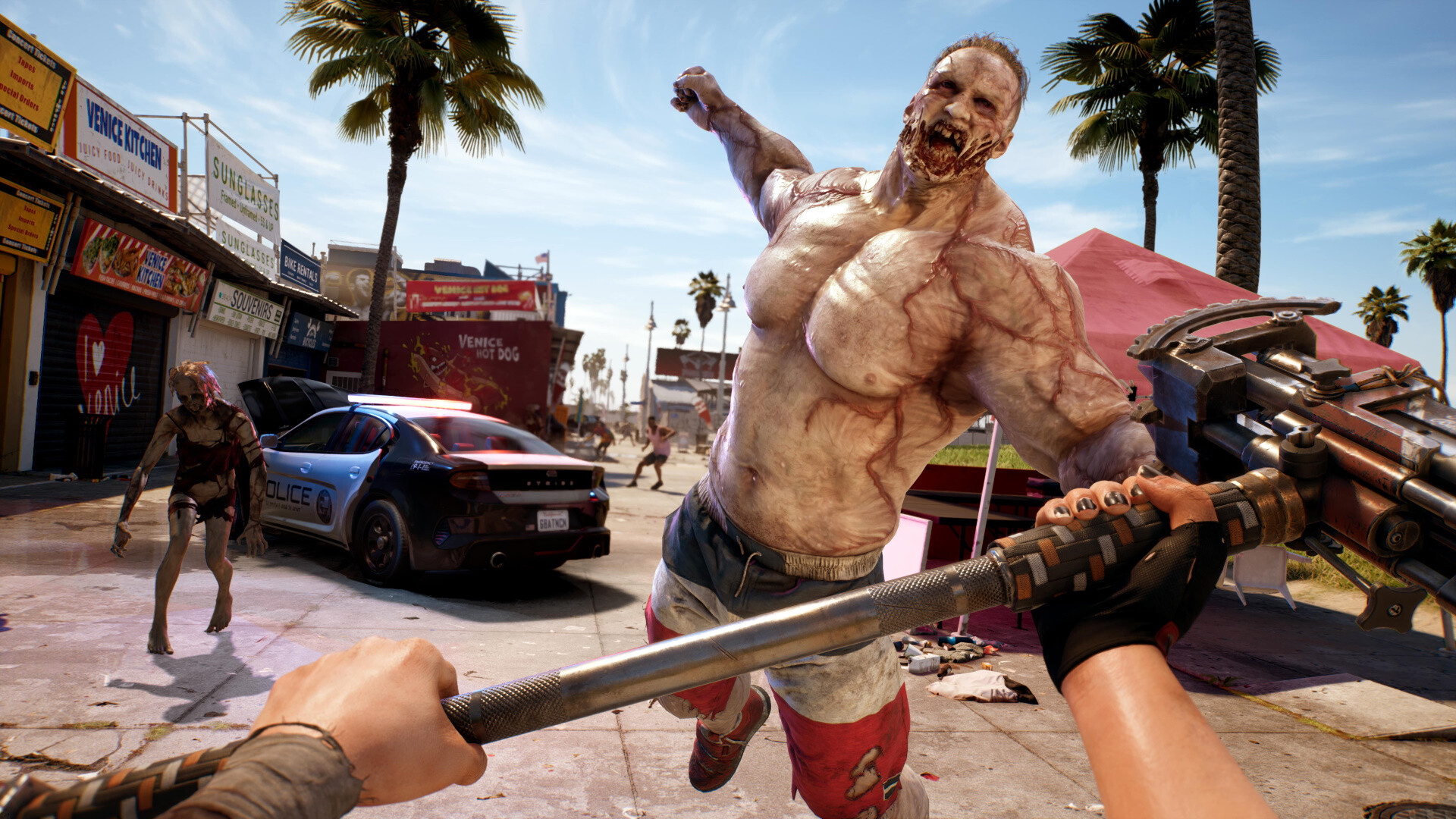
The main activity is first-person melee combat against infected people, with firearms and improvised weapons supplementing an arsenal built around close-range attacks. Zombies differ in appearance, movement and attacks, so a crowd is not simply a row of identical targets: the player responds to threats at different distances and adapts to each encounter. Dead Island 2’s FLESH technology models zombies with layers of skin, fat, bone and internal organs, allowing attacks to produce location-specific damage and dismemberment. This is also part of the combat feedback: hits and weapon types visibly affect bodies, while physics-driven reactions make positioning, staggering and controlling nearby enemies important. Because damage is localized, strikes can expose and damage successive layers rather than behaving like generic health loss, and different weapon contacts produce different visible results. The combat loop repeatedly combines attack, movement, defense and use of the surrounding space as the Slayer pushes through infected encounters.
Choosing a Slayer establishes a character identity and starting strengths rather than a separate branching campaign. Each of the six characters has individual attributes and an innate skill that influences their combat approach, and each has a distinct voice in conversations and reactions to story events. As the campaign continues, level-ups and discoveries add Skill Cards to the collection. Cards can be found while exploring, earned through progression or recovered from defeated zombies; equipping them changes abilities, survivability and attack effects. The deck is organized into categories that include innate traits, abilities, survivor bonuses, Slayer attacks and later Numen powers. Because the deck can be rearranged, a player can change the combination of moves and modifiers to respond to a different enemy mix or combat preference without restarting the character.
Card combinations connect individual actions to broader combat plans. Abilities such as Dash Strike and Ground Pound can be paired with cards that alter their impact, producing effects such as launching enemies, knocking down groups or igniting the ground. Other cards reward specific outcomes, including maiming, or improve defense and recovery. The point is not just to collect a larger list of perks: equipping a card changes what an action does and can make one move feed into another. The Slayer’s Fury mode also draws on the infection within the character and grants access to especially forceful attacks. Against crowded groups, a player may use a crowd-control ability to create space and then follow with a weapon or attack that takes advantage of the opening; against a durable infected foe, a build can emphasize damage, stability or survival.
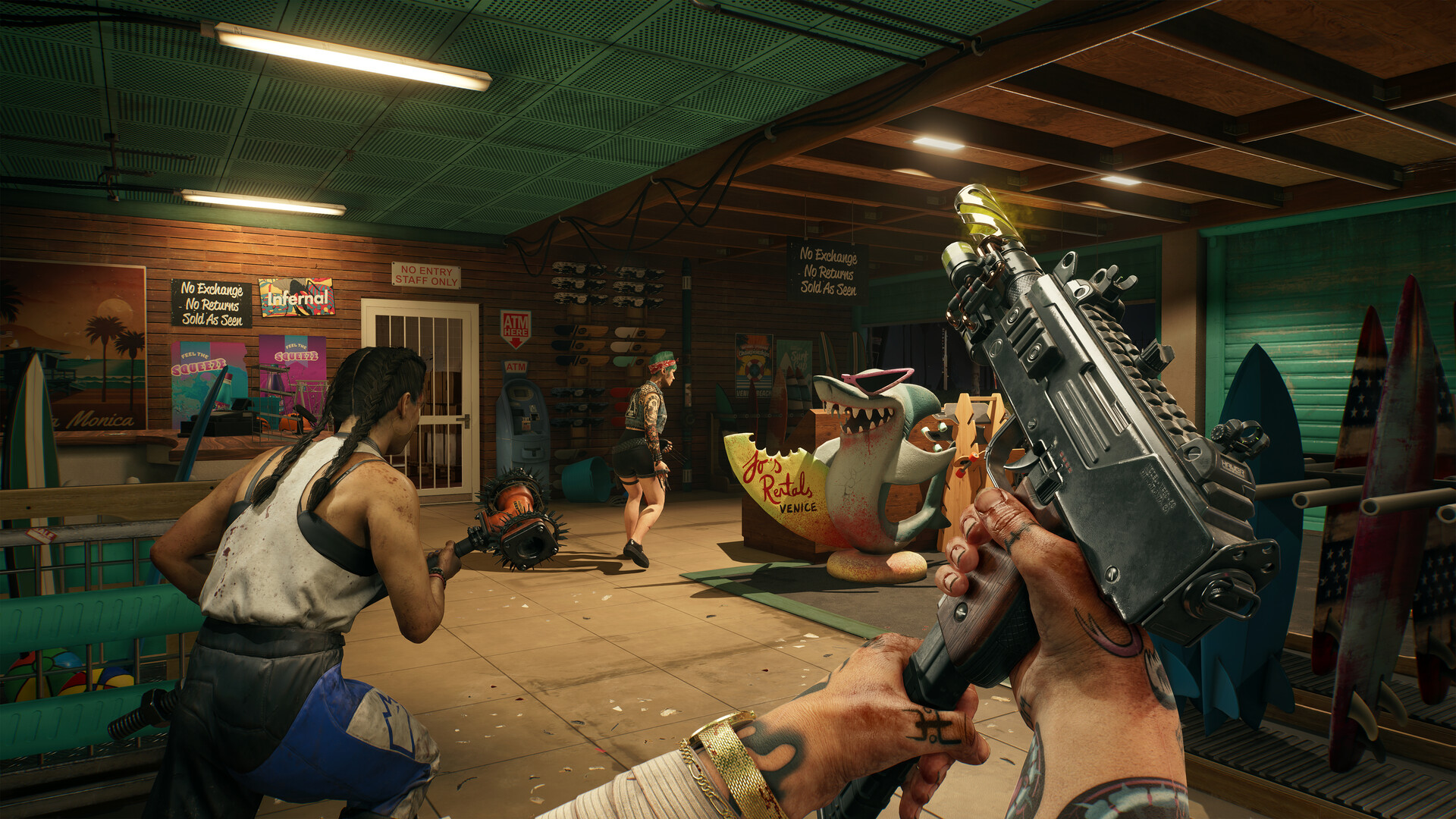
Exploration and scavenging support that fighting rhythm. Quests lead the Slayer between neighborhoods, encounters and characters, while side activities and environmental discoveries add context to Los Angeles and reasons to inspect homes, businesses and other spaces. Containers and defeated enemies can yield weapons, crafting materials and useful items. At workbenches, the player repairs weapons and applies modifications or perks that change damage types and combat effects. Weapon durability means a preferred tool has to be maintained, and the workbench gives scavenged resources a practical role in keeping an effective loadout ready. A variety of melee weapons, guns and throwable Curveballs support different ranges and tactics. The environment can also become part of a fight, as elemental hazards and reactive surfaces create opportunities to combine attacks with what is nearby.
The main campaign can be played alone or with up to two other players in online co-op. Cooperative play uses the same six Slayers and allows participants to retain character development and items as they continue through the story, while progression rules keep a player from joining a session that has advanced beyond their own campaign point. The quest structure remains the frame for both solo and shared play, with combat builds able to complement one another when the group stays together. Dead Island 2’s base campaign centers on the quarantined Los Angeles outbreak and its six Slayers; the separate Haus and SoLA story expansions add their own locations and events beyond that original campaign. The core journey is through HELL-A’s neighborhoods, where survival depends on clearing infected encounters, improving a chosen Slayer and piecing together the immediate crisis.
- Developer
- Deep Silver Dambuster Studios (additional development by Fishlabs GmbH)
- Genre
- First-person action RPG