
About Days Gone
Two years after a pandemic transforms the Pacific Northwest, drifter Deacon St. John rides the Broken Road through abandoned settlements, hostile survivor camps and roaming Freakers. His motorcycle is transport, storage and a lifeline, while jobs, scavenging and NERO sites build the skills and equipment needed to endure a dangerous open world.
Days Gone takes place in the wilderness around Farewell, Oregon, two years after an outbreak has collapsed ordinary life. Deacon St. John, a drifter and bounty hunter, travels through forests, high desert, snowy ground and the remains of towns while searching for a way forward with the people still in his life. Freakers are infected creatures, but they are only one threat: survivors defend their territory, wildlife can attack, and traps or ambushes can turn an apparently quiet road into a fight. The open world changes with weather and time of day, so a route that is easy to cross in clear daylight can become more hazardous when visibility and enemy activity shift.
The Drifter bike shapes how Deacon moves through that world. Upgraded saddlebags carry reserve ammunition, while other parts improve range, speed, durability and handling. The bike also gives him a way to escape when a fight grows beyond control. Fuel and damage make every long ride a small resource problem: scavenged fuel keeps the engine running, while scrap can repair the bike after rough travel. Encampment mechanics sell performance parts and visual customisation, including paint and decals. The motorcycle also affects how players approach danger: a larger tank extends a trip, a muffler reduces noise, and equipped saddlebags provide reserve ammunition during an encounter. Weather affects traction, so steering and choosing a line across wet or uneven ground matter as well as simply holding speed.
Most journeys mix deliberate jobs with unscripted encounters. Deacon can track a bounty, search abandoned buildings and vehicles for supplies, clear a hostile camp, or investigate a NERO checkpoint. A route may also reveal a road trap, an ambush, or a disturbance that draws Freakers into the area. The player can use firearms, crafted explosives and melee weapons, but supplies are limited enough that avoiding a fight can be as useful as winning one. Scrap has several practical uses, including repairing equipment and, once Deacon learns Field Repairs, restoring crafted melee weapons before their durability runs out. The result is a loop of travelling, observing, choosing an approach, and then deciding whether the reward is worth the ammunition and materials spent.
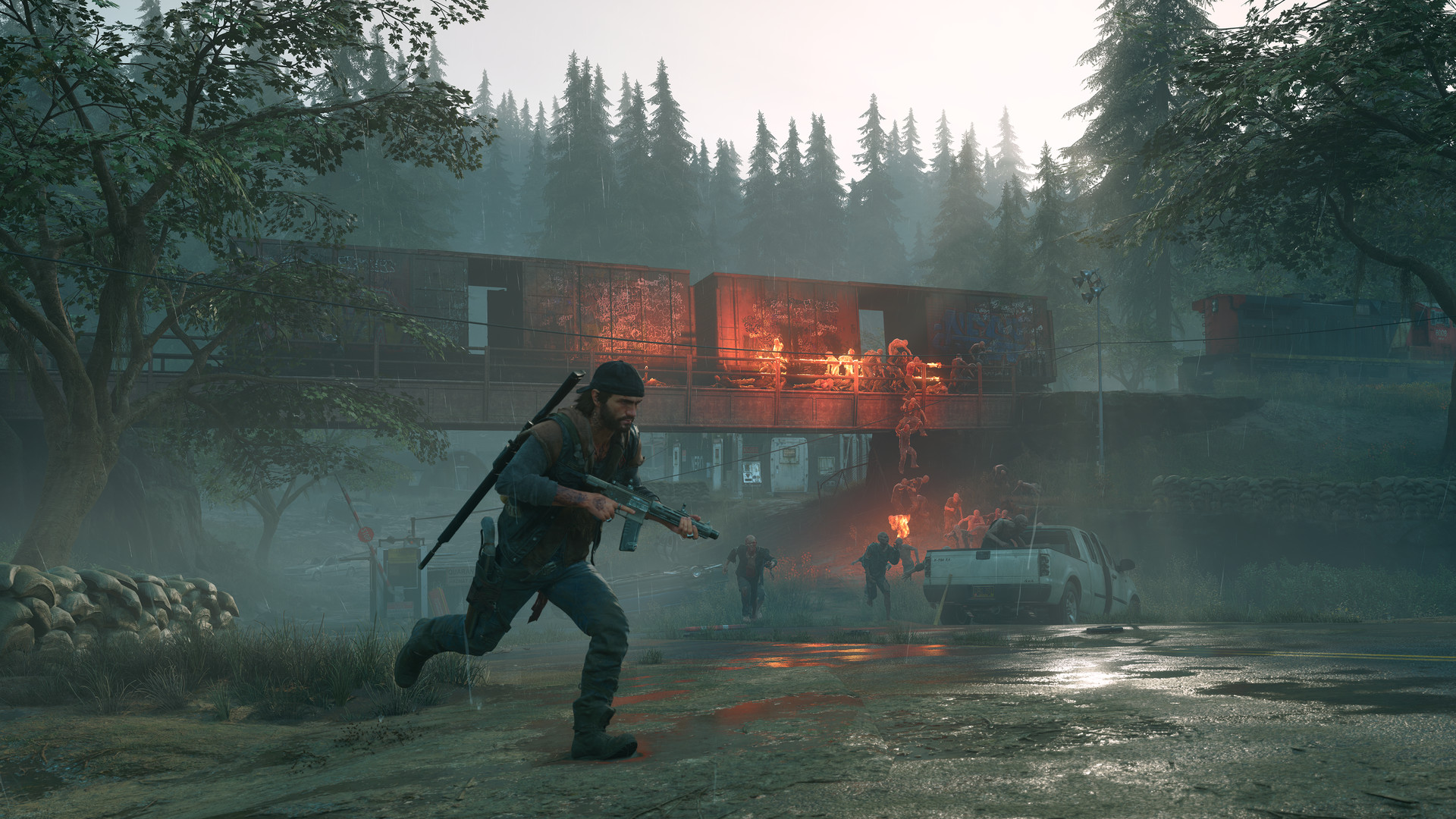
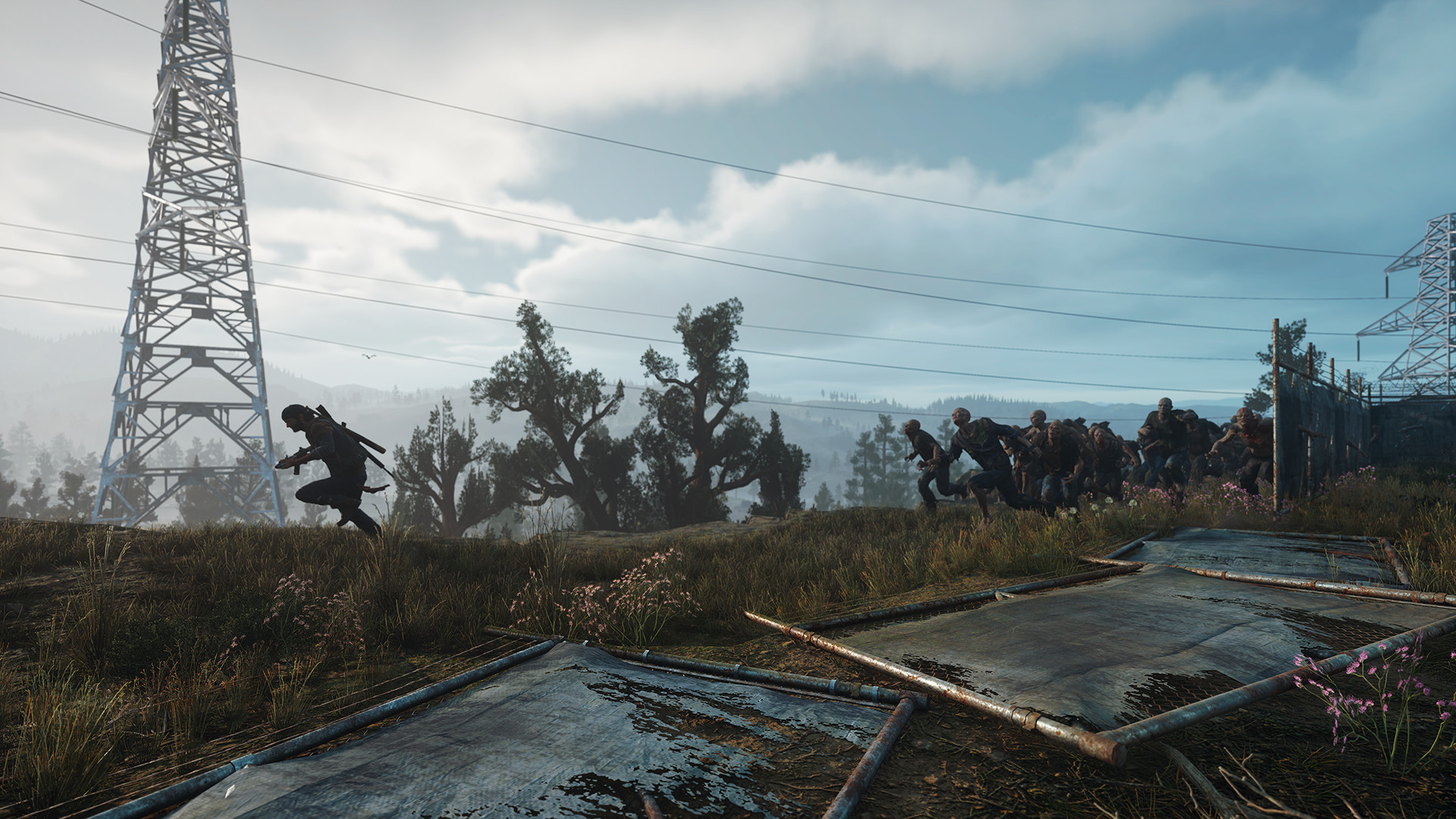
Freaker nests and infestation zones tie exploration to the map itself. Nests shelter Freakers during the day, so burning them can reduce a local danger and make the area easier to understand. Molotovs or incendiary crossbow bolts can set nests alight, while the creatures may be more active outside after dark. Clearing an infestation opens a fast-travel route through that part of the world. Hordes create a different scale of encounter: groups can range from a few dozen to hundreds of Freakers, and they pursue Deacon as a moving mass. The player can prepare ammunition and traps, identify narrow passages, lead the group past explosive objects, and keep an escape path to the bike. Their movement turns terrain and preparation into combat tools, rather than making a horde a conventional stationary target.
NERO checkpoints offer a quieter kind of progression. Searching them can provide crafting materials, access to a gun locker and fuel, while NERO injectors let Deacon improve one of three attributes: health, stamina or focus. Focus supports more accurate ranged attacks by slowing time while aiming; stamina affects how long he can sprint or evade, and health raises his capacity to take damage. Skills are purchased with earned points across melee, ranged and survival branches, adding options such as better weapon handling or scavenging. Each upgrade changes what the player can risk on the next trip, whether that means staying in a fight longer, landing shots under pressure or repairing a weapon in the field.
Encampments turn completed work into another form of advancement. Jobs, infestation clearing, bounties and horde kills can raise trust and earn credits at the camp connected to that work; each camp keeps its own trust and credits, and has its own stock and specialities. Copeland’s Camp has a mechanic for bike upgrades, while Hot Springs focuses on weapons. Choosing where to spend credits therefore links the player’s priorities to the next stretch of travel: better equipment may support direct combat, while a more capable bike can make distant jobs and escapes easier. The story’s journey is delivered alongside these routines of riding, scavenging, fighting and returning to camp, with Deacon’s relationships and the wider aftermath of the outbreak unfolding as he moves through the region.
The PC release also includes modes that change how the same world is approached. Survival I and Survival II raise enemy difficulty, remove awareness indicators and disable fast travel; the HUD is hidden, although Survival Vision can temporarily help with orientation. Challenge Mode offers twelve separate trials, including horde combat and timed bike races. Scores earn credits for bike skins and playable characters, while challenge patches provide stat boosts that can carry into the story. After completing the main story, New Game Plus lets Deacon begin again with previously earned weapons, bike upgrades, skills, recipes, camp trust and credits, alongside a new weapon. These modes extend the available play around the core campaign and retain the setting and systems of the base game.
- Developer
- Bend Studio
- Genre
- Open-world action-adventure with survival combat