
About Date Everything!
After losing a customer-service job, you receive magical Dateviator glasses that let you see your home’s objects as potential companions. Talk with 100 fully voiced characters, build relationships through branching conversations, and decide whether each connection becomes love, friendship or enmity.
Date Everything! starts with a mundane setback: the protagonist loses a customer-service job to new technology and is left at home without a clear next step. A mysterious stranger sends a pair of magical glasses called Dateviators, changing how the protagonist sees the house. Everyday objects become characters who can be approached and dated. The premise turns the familiar rooms of a home into the setting for a relationship-driven adventure, with the central question shifting from how to leave the house to whom to meet inside it. The tone is comic, but the structure treats each object as a distinct person with a conversation and an outcome of its own.
The Dateviators are the main way to discover the game’s cast. Looking around the home with the glasses reveals dateable characters among objects and even less tangible concepts. The official examples range from a bed and smoke alarm to an overwhelming sense of existential dread; Team17 also names objects such as a refrigerator, vacuum cleaner and laundry basket. This range gives exploration its basic purpose. A room is not just scenery between dialogue scenes: it contains possible encounters, and the player can decide which characters to approach. The premise applies the same dating-sim idea across the whole household, so the setting itself becomes the roster.
The game presents 100 fully voiced datable characters. Each has a story that opens through interaction, and the relationship can develop toward love, friendship or enmity. These outcomes make meeting someone different from simply unlocking a profile: the player’s conversations determine what kind of relationship forms. Team17 describes three resolutions for each dateable, while the Steam listing emphasizes that each character has an individual story. The broad cast allows the game to move between conventional romance, friendship and conflict without requiring every encounter to follow one emotional pattern. A household object can be a potential partner, ally or adversary depending on how the exchange unfolds.
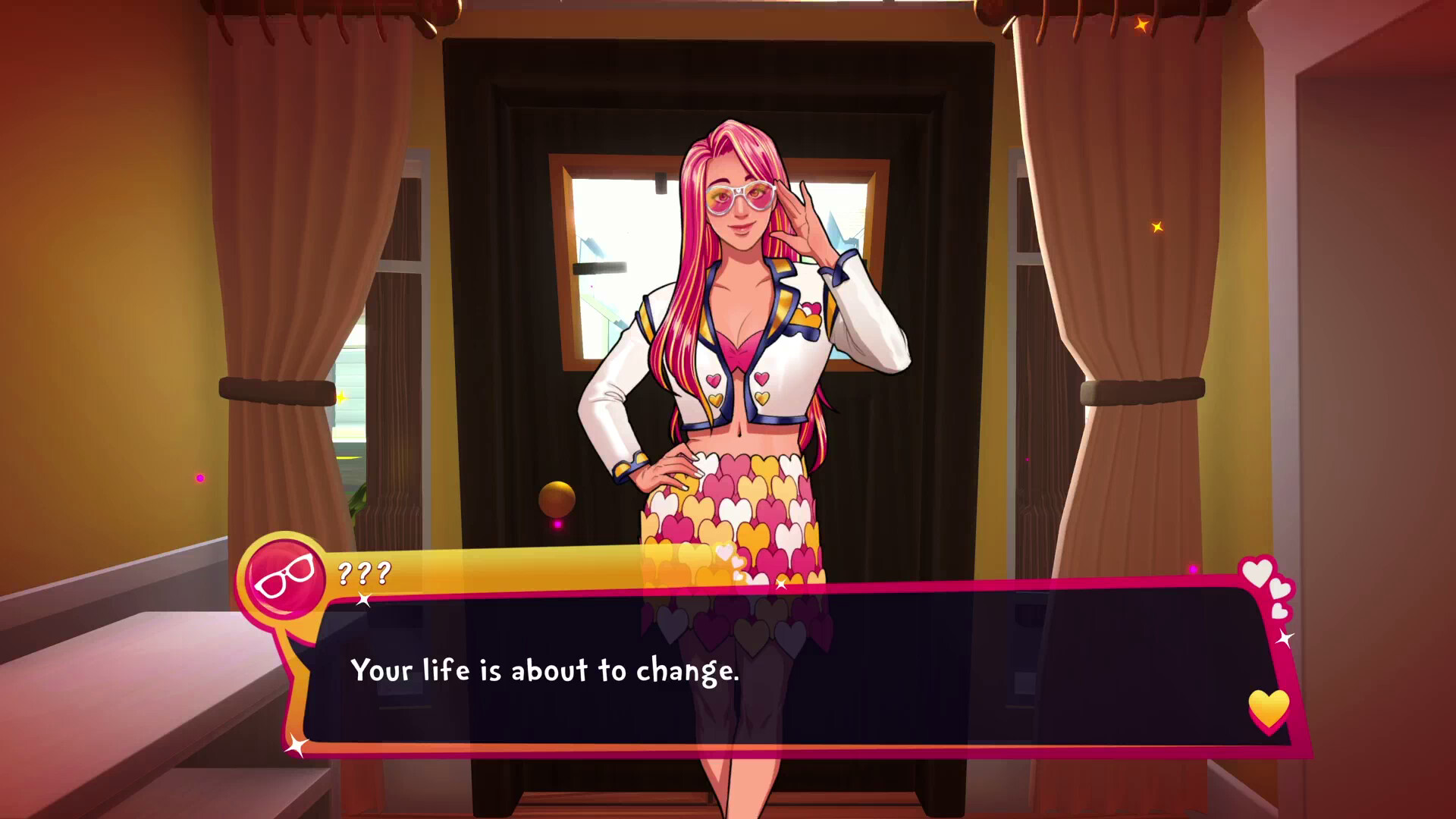
Branching dialogue connects those meetings to multiple endings for each character. Choices therefore operate at both a local and a larger scale: an exchange can shape one dateable’s route, while the game also has a critical path that ties the wider story together. That central thread gives the many individual encounters a shared frame, rather than leaving them as completely separate vignettes. The published description does not disclose the full choice system or every prerequisite, so the clearest account is that conversations branch and each character can reach different relationship resolutions. The premise invites experimentation, but the particular route a player reaches depends on the choices made in that playthrough.
The home is presented as a fully interactive three-dimensional overworld that changes according to choices. This makes the setting part of the relationship structure: players move through familiar domestic spaces to find characters, and decisions can alter how the overall environment appears. The house supplies a consistent map for an unusually broad cast, while its objects supply the encounters. The combination keeps the scale understandable even as the roster grows. Instead of travelling between towns or separate dating locations, the player returns to rooms and household things that have become socially active through the Dateviators. The layout also supports the premise that a conversation can begin in an ordinary domestic place, without a separate dating venue or travel sequence. Because the overworld responds to choices, the player’s decisions are reflected in the space used to find and meet the cast. It gives the broad roster a shared physical frame: the house remains recognizable as a home while its objects take on social roles. This approach links navigation and story presentation, keeping exploration connected to the same relationships developed through dialogue.
The game’s production details underline how much of the experience is carried by character writing and performance. Team17 lists more than 1.2 million words, 70,000 voice lines, over four hours of music, and more than 11,000 hand-drawn images. The official site calls the full cast fully voice acted, and the Steam listing likewise presents the characters as voiced. Those figures describe a large amount of authored material across the roster. Each dateable also has an individual musical theme according to Team17, giving encounters a character-specific audio identity alongside their dialogue and visual presentation.

Date Everything! is structured around choosing whom to meet and what kind of connection to pursue. Its three relationship outcomes provide a simple vocabulary for very different character routes, while branching conversations and multiple endings make the results depend on dialogue choices. The critical path supplies continuity across that variety, and the interactive home provides the shared place where the player finds and revisits characters. The result is a single-player dating simulator built from domestic exploration and a large voice-acted ensemble. The central joke—that nearly anything can become a date—also defines the game’s actual activity: look around, start a conversation, and see what kind of relationship the encounter can become.
- Developer
- Sassy Chap Games
- Genre
- Sandbox dating simulator