
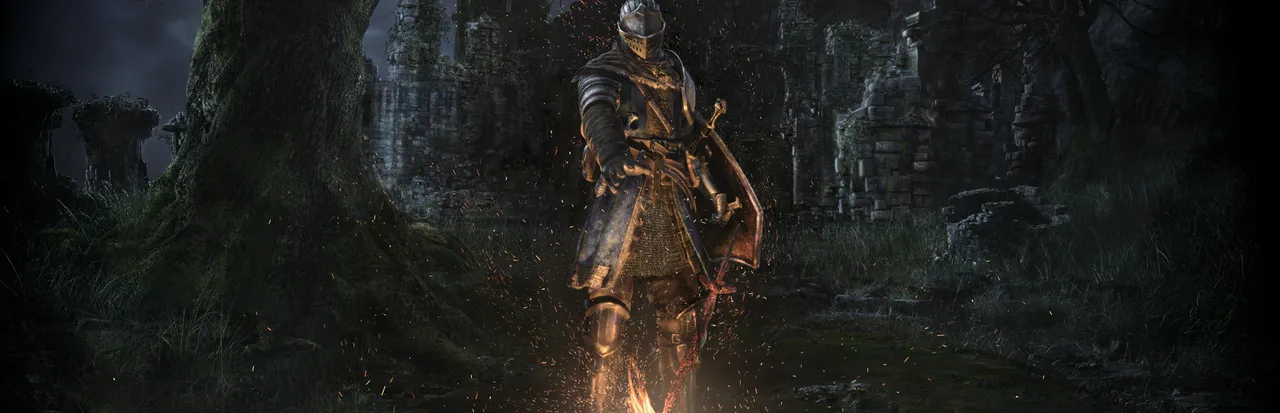
About Dark Souls
Imprisoned among the undead in Northern Undead Asylum, the Chosen Undead escapes and travels to Lordran, where a prophecy sends them to ring the Bells of Awakening. Explore a connected dark-fantasy kingdom, learn its routes and combat rhythms, and develop a character through weapons, magic, allies, and hard-won Souls.
Dark Souls begins in Northern Undead Asylum, where the player character is imprisoned with other undead. After escaping, the Chosen Undead is carried to Lordran and given a clear early purpose: make a pilgrimage and ring the Bells of Awakening. The rest of the kingdom does not lay out a conventional quest log or explain every cause behind its collapse. Instead, the player speaks with wary inhabitants, reads the shape of ruined settlements, and decides which path to test next. The journey’s direction comes from that prophecy, while the details of Lordran’s history emerge through places, encounters, and fragments of conversation.
Lordran is built as a connected world of distinct regions. From Firelink Shrine, paths lead toward a walled town, wooded areas, catacombs, flooded ruins, and larger fortifications, with lifts, stairs, locked gates, and shortcuts knitting them together. Reaching a boss or opening a mechanism can make an entirely new stretch accessible, while a side route may loop back to a familiar bonfire. This makes navigation part of progression: learning where two corridors meet or which door opens from the far side can save a long return through dangerous ground. The landscape rewards attention to landmarks and routes rather than following a sequence of isolated stages.
Combat is deliberate because attacks, rolls, blocks, and other exertions draw on stamina. A weapon’s reach and recovery determine how long the character is committed after swinging, while an enemy’s animation gives clues about when a strike is coming and when it will end. A shield can absorb a blow but consumes stamina; a timed roll can avoid it, and a parry can create an opening for a riposte. Heavy equipment protects differently from lighter gear and can slow movement, so the player balances defence against the ability to reposition. Bosses bring the same rules into larger arenas, asking the player to read patterns and choose safe moments to attack.
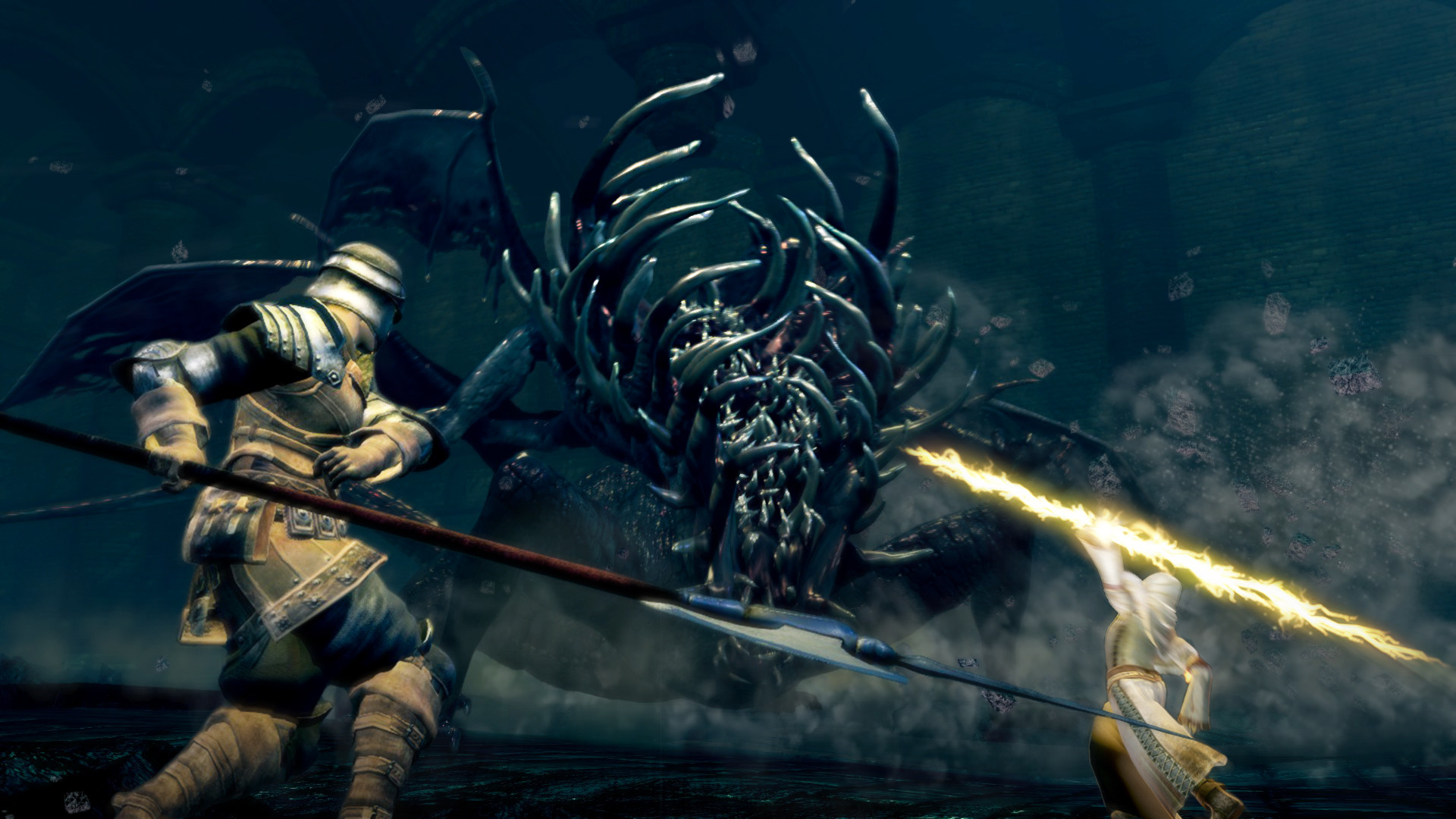
Bonfires are checkpoints and preparation points. Resting restores health and refills Estus, but also revives ordinary enemies in the nearby area. If the player dies, they return to the last bonfire and leave their carried Souls and Humanity at the death site. Recovering the cache requires reaching it again without dying; otherwise that reserve is lost. Souls serve several purposes: they purchase supplies, pay for equipment improvements, and raise attributes that influence health, stamina, weapon requirements, and spell use. Deciding whether to spend them before a new route or carry them toward a hoped-for level is part of every expedition.
Character creation and later levels support several ways of fighting. A starting class sets initial attributes and equipment, but does not lock the character into a single role. Strength and Dexterity can support different weapons, while Intelligence and Faith open access to forms of magic; shields, armour, rings, and weapon upgrades further shape the build. Blacksmiths can improve equipment along distinct upgrade paths, and found gear may offer a different reach, attack type, or defence than the current loadout. The character therefore develops through both permanent attribute choices and practical comparisons about what to carry into the next area.
Humanity connects the undead premise to online play, but its rules differ depending on whether the player is seeking help or offering it. Spending Humanity at a bonfire restores human form; as a human, the player can see and summon other adventurers, with the risk of being invaded. A hollow character is protected from those invasions and cannot call another world into their own. To offer help, however, the player can place a White Sign Soapstone summon sign and enter another person’s world as a phantom without first becoming human. This distinction makes Humanity relevant to receiving aid and invasion exposure, not a universal entry ticket to every cooperative action.
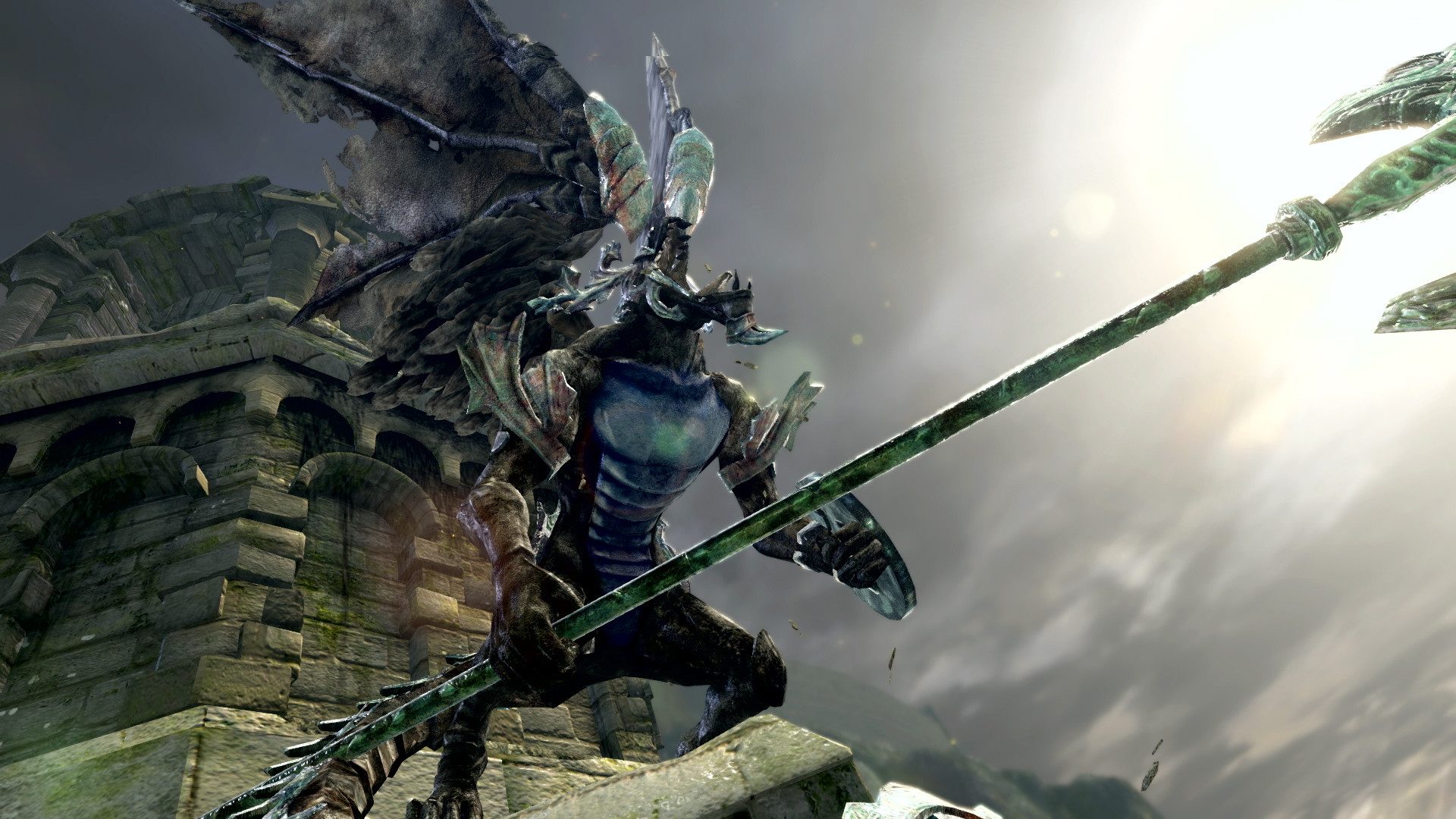
The world also carries traces of other players. Messages can offer warnings or misdirection, and bloodstains show a brief replay of another traveller’s final moments. NPCs encountered along the route can later gather at Firelink Shrine, where they provide conversation, services, gestures, spells, or items depending on who was helped. Covenants add affiliations with different online purposes and rewards. These systems make Lordran feel inhabited by people pursuing parallel routes: the player can read signs left behind, ask for assistance, or take on a covenant role while continuing their own pilgrimage.
Each region combines combat with practical discovery. A newly opened shortcut can change the cost of trying a boss again; a rescued character may add a useful service to the hub; and an upgraded weapon can make a difficult enemy’s defence less forbidding. The Bells of Awakening provide the early objective, while the roads between them leave room to explore optional passages and develop the character before pressing onward. Progress is therefore both geographical and mechanical: open a route, learn what blocks it, spend the resources earned along the way, and return with a build better suited to the next challenge.
FromSoftware's 2011 follow-up to Demon's Souls takes nearly everything its predecessor did and darkens it. The hub is gone. The sanctuary is gone. What's left is a single connected world that wants you dead and doesn't pretend otherwise.
The change that mattered was the map
Demon's Souls was a series of stages reached from a nexus. Dark Souls throws that structure away and builds one continuous place instead — an undead asylum at the start, then fetid swamps, dilapidated towns, grand castles, tunnels carved through rock, and trap-filled dungeons, all stitched together without a loading screen between them in spirit or a menu between them in practice.
That's the design decision everything else hangs off. Because the world is joined up, learning its shortcuts is progress in a way that unlocking a level select never was. You remember routes the way you remember streets. The closest comparison is to hand-drawn maps from early Metroid and Zelda rather than the randomised corridors of a dungeon crawler, and it's the right way to describe it — the geography has intent, and finding that one ladder back to somewhere familiar is its own reward.
Death is the tutorial, the motif and the punishment
You will die on the end of a sword, under a boulder, in poison, off a cliff, and while doing something you were sure was safe. The game treats that as education rather than failure. Every death tells you something about an enemy pattern, a route, or your own greed, and because the odds against you are so thin, the victories land with a weight that a game with a quicksave never manages.
There is a real cost to that and it's worth naming. Several hours of this world are unpleasant to be in — you spend most of your time undead, the swamp areas are genuinely miserable, and thirty hours in, standing in an underground poison bog, you will want to see the sun again more than you want to keep exploring. That's the game working as designed. Whether it's a good design depends on how much you value a world that has contempt for you.
The craft underneath the cruelty
What keeps it from being merely punishing is the sword combat, which is precise and readable, and the density of what's hidden in the world — secrets, magic, entire optional areas, and a sense of scale that a decade and a half of imitation hasn't really matched. It's fair in its language even when it's unfair in its consequences. You rarely die because the game lied to you; you die because you weren't paying attention or wanted one more swing.
The pulse
Time has been interesting to this one. It's the entry that turned difficulty into a marketing term, and an entire genre spent the following decade borrowing its vocabulary — bonfires, runbacks, item descriptions that carry the plot. The criticisms that have aged best are about the back third, where the world construction gets looser and some late areas feel rushed compared to the first half. The criticism that hasn't stuck is the difficulty itself, which is now generally discussed as legible rather than punishing for its own sake. Its reputation as the most important of the three is close to unarguable.
Should you play it
Yes, and it's still worth playing even if Dark Souls III exists and is more polished. The first one has the better world — the thing that made the formula matter rather than the thing that refined it — and the back half's roughness doesn't undo that.
Go in knowing the first hours are actively hostile and that the game will not teach you its systems. If that sounds like a chore rather than an invitation, start with Dark Souls III instead and come back to this one once the vocabulary is familiar. Nobody arrives at this game already speaking it.
Go deeper with V4mp
- Developer
- FromSoftware
- Genre
- Dark fantasy action RPG
Explore Dark Souls further
Explore the wiki for detailed reference pages on the game's world, systems, items and locations.