
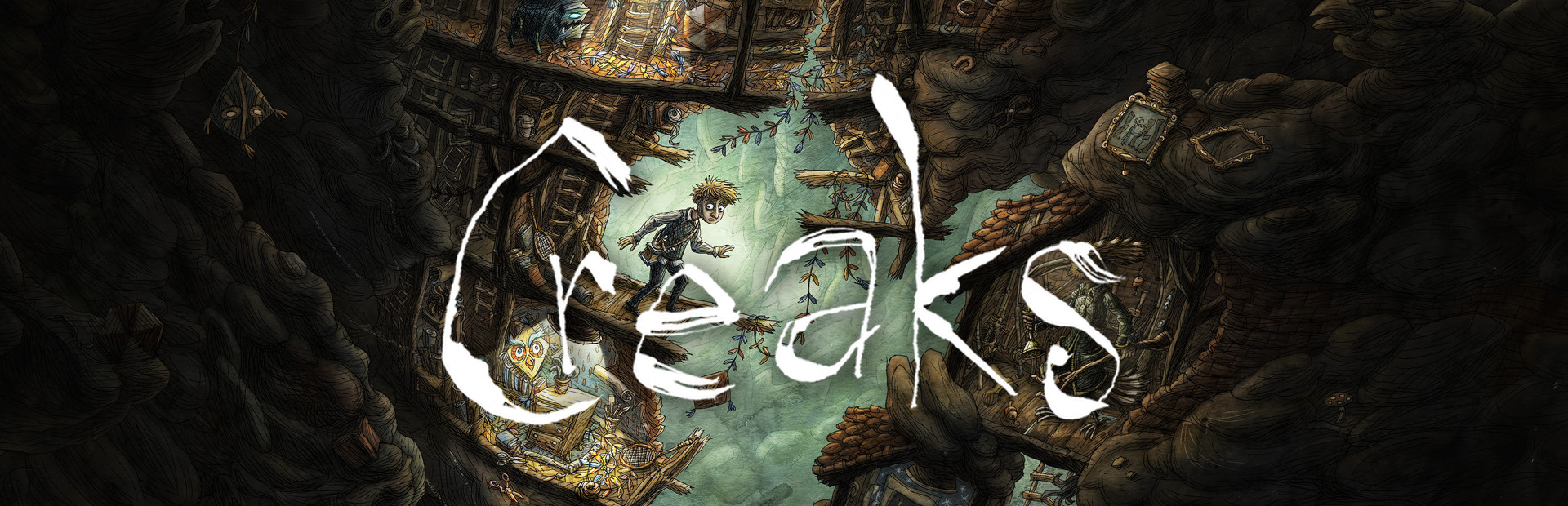
About Creaks
When shaking walls reveal a hidden world, a lone explorer descends into a mansion inhabited by peaceful birdfolk and dangerous creatures disguised as furniture. Creaks is a hand-drawn puzzle platform adventure built around light and observation: illuminate rooms, learn how creatures react, and manipulate the environment to find a safe route onward.
Creaks begins in a normal room that starts shaking, with breaking bulbs and strange sounds hinting at a hidden world behind its walls. A lone explorer descends into a vast, unusual mansion inhabited by peaceful birdfolk and dangerous creatures that resemble furniture. The premise draws on pareidolia: seeing a familiar shape in something ambiguous. What first looks like a barking threat may turn out to be a piece of furniture animated by the strange world below. This visual uncertainty gives the house its identity, but it also has a practical role: learning what a creature really is helps the player understand how to deal with it. The story unfolds through exploration of the mansion rather than spoken exposition or a combat campaign. The first descent changes an everyday domestic space into a threshold, making the house itself the central setting. Its residents are not all dangerous: the birdfolk are peaceful, while animated furniture guards the routes through the mansion. The player gradually learns that a familiar outline can conceal either a harmless object or an active threat.
The protagonist travels on foot through connected side-view rooms, climbing ladders and crossing floors while avoiding active creatures. A room’s geometry determines which routes are safe: platforms, doorways, ladders and hazards divide the space into possible paths. The player can be killed by touching a creature in its animated form, so moving too quickly through an unfamiliar room is risky. Failure returns the character to the room, where its mechanisms can be reconsidered. The controls do not grow into a skill tree or a set of attacks. Instead, the player learns how to read the existing architecture, notice which surfaces can be crossed and plan movement around creatures whose behavior changes with the room. Climbing and crossing are part of the logic rather than a test of speed. The player needs to identify a reachable ladder, a platform that can support the character or a corridor blocked by a creature, then decide when it is safe to move. This gives each room a readable beginning, a hazard to understand and a route to unlock.
Light is the main means of changing a creature’s state. Shining a beam on an enemy reveals it as ordinary furniture, which can then be pushed or pulled and used as part of the room. A dog-like guard may become a movable object that helps the character climb to another level. The transformation only lasts while the object remains in the light; move it beyond the beam and it can return to its animated form. That condition makes the light source a spatial constraint as well as a reveal. The player must judge where to direct the beam, how far to move an object and whether the character can reach the next safe place before the creature becomes dangerous again.
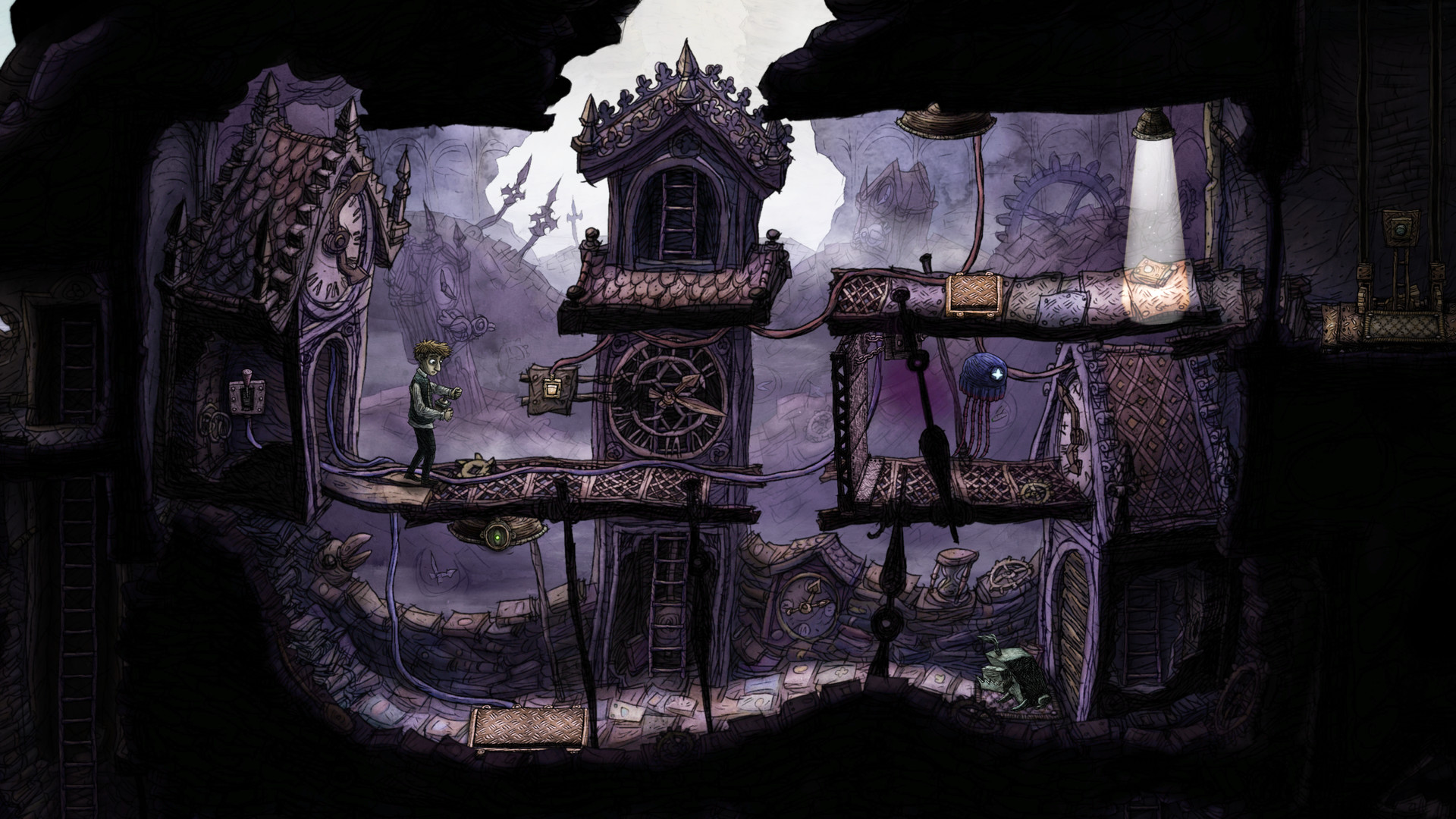
Other creatures follow different rules. A jellyfish-like enemy changes its vertical direction when it hits an obstacle, so placing a barrier can redirect its route. Light can trap it in a globe-like state that can be moved. The spy copies the protagonist’s movements and, when caught by light, becomes a coat rack. These behaviors reward observation before action: the player can watch a creature’s response to a wall or to the character’s movement, then use that rule in a puzzle. Later spaces can combine creatures, requiring the player to coordinate their positions rather than apply one universal trick. The game introduces behaviors separately before bringing them together, so the challenge comes from recombining known rules in a new arrangement. The spy’s copied movement makes the protagonist’s own position a signal the enemy follows, unlike the dog-like guard or obstacle-reactive jellyfish. That rule can be used to draw the spy toward a light or away from a narrow passage. When several types appear together, the player has to keep their different reactions in mind rather than treating all of them as patrols with the same weakness.
Rooms also contain mechanisms that change the available paths. Levers operate environmental devices, pressure plates respond to the protagonist’s weight, and movable furniture can block or enable movement. A solution may require placing an object where a creature’s path changes, stepping onto a plate to alter the room and then crossing before the creature reaches the route. The elements are visible, but their relationship is not always immediately obvious, so testing a mechanism is part of the puzzle. The player’s task is to understand what each interaction changes and arrange the room so that the danger and the route no longer intersect. These are environmental logic problems, not fights with enemies that can be damaged or defeated. The game does not describe a weapon or health upgrade that would let the protagonist overpower a hazard. Levers and plates change the space, while transformed creatures can become movable tools. The solution is usually to alter the relationships among character, light, object and enemy until the route is passable, with lethal contact giving each placement decision a clear consequence.
The mansion has five areas with distinct atmospheres and stories. The attic is an early region, filled with discarded things and watched by barking guards; the towers are quieter and more contemplative. The peaceful birdfolk share this house with the creatures, so exploration includes distinguishing residents from threats. Rooms, paintings and architecture carry fragments of the birdfolk’s world without pausing for long explanatory scenes. The house is not simply a stack of puzzle screens: its changing spaces suggest a culture and history beneath the protagonist’s room. Progress through the different areas changes the tone of the surroundings even as the central rules of light and creature behavior remain in use.
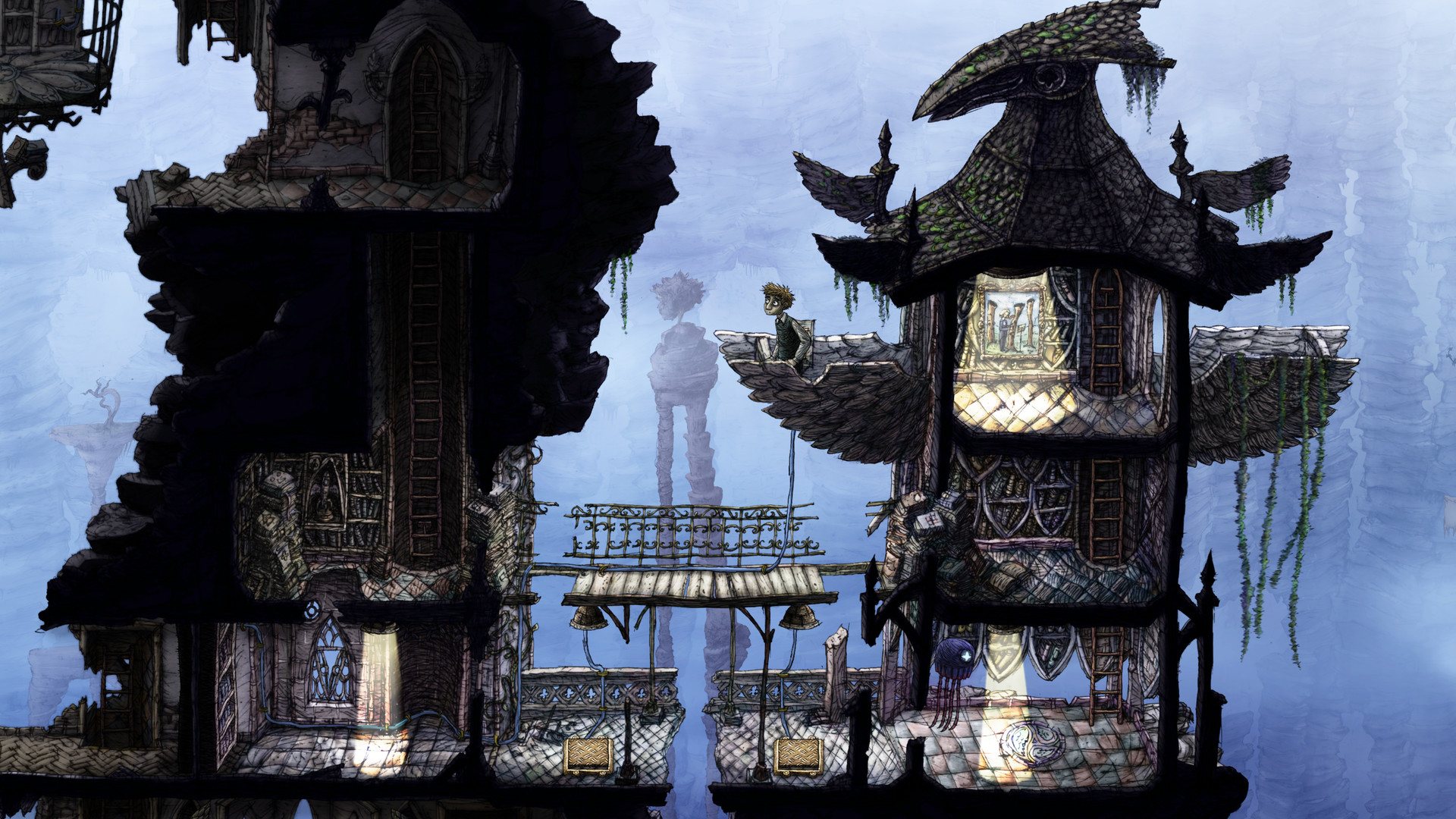
Paintings scattered through the mansion form both collectibles and interactive scenes. Some have a cord that the player can pull to animate the picture and bring in music. Eleven paintings become playable mini-games, including short puzzles and a duel between two knights. Their content draws on the birdfolk's dreams, wishes and legends. Finding one is optional and does not replace the main descent; playing it turns wall art into a brief activity. These diversions give the player a way to engage with the inhabitants' culture beyond the physical dangers of the house.
Creaks uses hand-drawn environments assembled from ink illustrations, while the paintings began as oil works and were later scanned and animated. The lead artist drew background elements in ink across multiple sheets of paper, scanned them and assembled them digitally. He returned to an older scanner because its imperfections preserved the texture of the paper better than a sharper replacement. The process gives the mansion a visibly handmade surface even where its room mechanisms require precise, readable shapes. Joe Acheson, also known as Hidden Orchestra, composed the music. This handmade approach keeps the mansion's surfaces expressive without obscuring the clear silhouettes needed to read an enemy's current form. Amanita Design developed and published the full single-player puzzle platform adventure. The Steam edition is the PC release; the studio also lists Nintendo Switch, PlayStation, Xbox and Apple Arcade versions. Controls vary by platform, while the mansion, creature behaviors and light-based transformations define the central experience. There is no conventional combat progression or character upgrade system: the protagonist advances by solving rooms and reaching the next area.
- Developer
- Amanita Design
- Genre
- Puzzle platform adventure