
About Company of Heroes 3
Company of Heroes 3 is a real-time strategy game set across the Mediterranean fronts of World War II. Lead Allied operations in Italy through a branching campaign map or command the Deutsches Afrikakorps in a focused North African story. Tactical battles emphasize squads, terrain, combined arms, and decisions that connect each encounter to a wider campaign.
Company of Heroes 3 moves the series to the Mediterranean theatre of World War II, pairing battlefield missions with operations across Italy and North Africa. Its two main single-player campaigns have different structures. In the Italian Dynamic Campaign, the player takes the role of an Allied commander directing a broader advance through the peninsula, with battles and decisions shaping the route. The North African Operation follows the Deutsches Afrikakorps in a more linear narrative against British forces in desert terrain. Both eventually bring the player into the same close, squad-level real-time battles, but they frame those engagements differently: Italy connects tactical encounters to a larger campaign map, while North Africa presents a more authored sequence of story missions. This Mediterranean focus distinguishes the game from Company of Heroes 2 and its Eastern Front campaign setting.
The Italian campaign opens onto a strategic map where the player directs the Allied effort across towns, roads, ports, and enemy positions. Companies move through the region, and their actions can initiate tactical battles or affect how the advance develops. The map layer includes ground, air, and naval forces, supply lines, and Partisans; these elements give the player ways to reinforce a route, interrupt enemy movement, or prepare for a difficult engagement. The choices made on this broad map influence the battles that follow, so moving a company is not just a marker shift between missions. The player weighs which objectives to pursue, which threats to remove first, and how to use support capabilities across several fronts. The campaign’s branching paths and variable sequence make its strategic layer a separate activity from the moment-to-moment command of troops in an RTS battle.
Companies also provide a bridge between the strategic map and the battles. The Italian campaign begins with several kinds of company, and each can be developed along different paths so that it performs a distinct role in the operation. Veteran units can gain experience as the campaign continues, while damage and limited actions make preservation relevant between engagements. Relic’s campaign documentation describes companies with movement and action points, and adjustments that encourage the use of aircraft, abilities, and detachments to handle obstacles rather than simply pushing the largest force forward. The player chooses where a company should move, what it should attempt, and whether it can reach or recover from a target. Capturing or holding towns changes the operational picture, while enemy emplacements and other map features can make a direct approach costly. These decisions set up the next battle and shape which forces can take part.
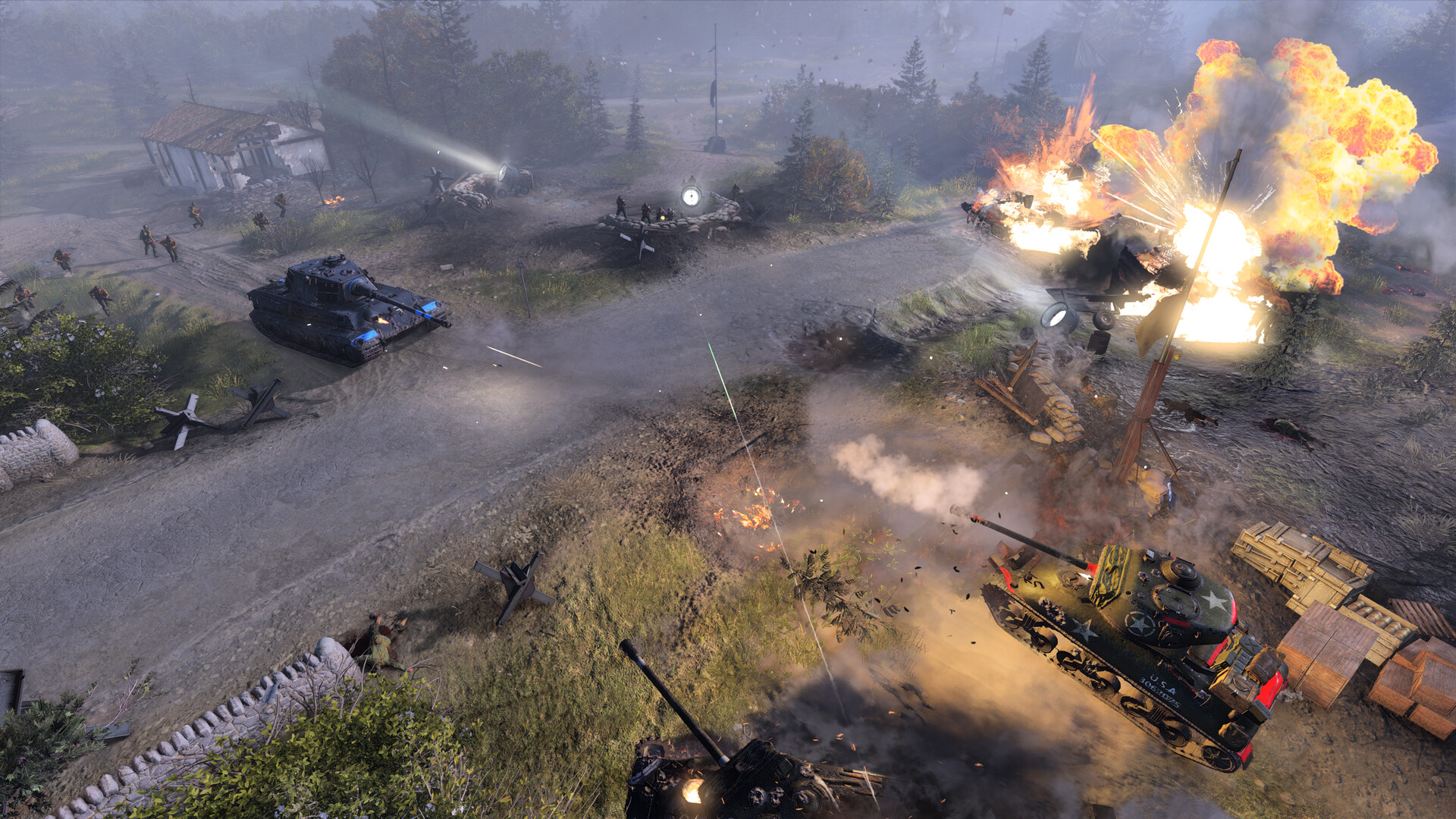
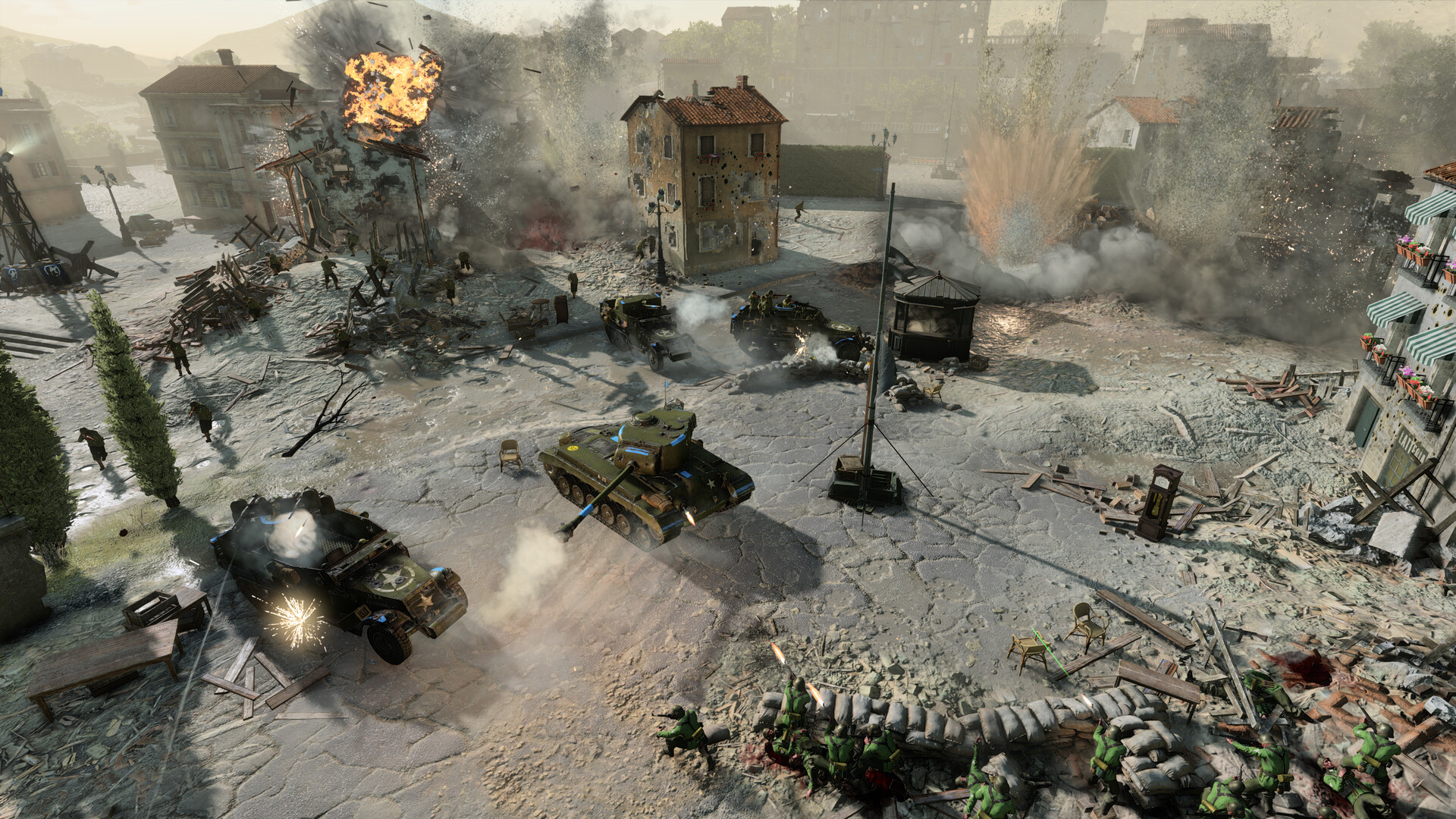
When a tactical encounter begins, the player commands squads and vehicles in real time, issuing movement, attack, capture, and ability orders while the opposing force responds. Position matters: infantry can use cover and buildings, high ground affects engagements, and line of sight limits what a unit can see. The official feature list also describes destructible structures that can open routes, breaching attacks against occupied buildings, and side armour that rewards attacking a vehicle from a flank. These systems make battlefield geometry part of the fight. A squad that approaches a machine-gun position through open ground faces a different risk from one advancing under cover, while a tank exposed to an enemy’s side presents an opportunity for an anti-armour team. The Full Tactical Pause lets players stop single-player action, assess threats, and queue orders before resuming the fight.
The combined-arms roster includes infantry squads, support weapons, and vehicles whose different roles affect how a position can be taken or held. Engineers can clear obstacles or breach buildings, while larger team weapons can be towed and repositioned as the front changes. Infantry can ride tanks for rapid movement, and vehicles can pass over trenches; both systems create options for crossing a contested area with support. Reconnaissance units and abilities can detect threats beyond the ordinary fog of war, helping the player avoid sending a force blindly into an ambush. In the campaign and skirmish battles, the job is to coordinate those tools rather than rely on one unit type: infantry can capture and occupy terrain, heavy weapons can cover approaches, and vehicles can pressure enemy armour or support an advance. Destruction may remove obstacles and reshape paths, making the map itself change during combat.
For skirmishes and multiplayer, four factions define different army identities: US Forces, Wehrmacht, British Forces, and the Deutsches Afrikakorps. Battlegroups add another layer of choice by letting players specialize a force with distinct squads, specialist units, and abilities. The system offers branching selections, with exclusive choices in each branch, so investing in one set of options closes off another within that Battlegroup. This gives players a way to build an army around a preferred battlefield role without changing the faction they selected. Relic’s launch description lists Victory Point and Annihilation conditions for skirmish and custom matches: one asks a team to control objectives until the opposing ticket count is depleted, while the other calls for destroying the enemy base. These objectives change the pace of a match, from repeatedly contesting territory to assembling enough force for a decisive attack.
The North African Operation supplies a different campaign rhythm from the Italian map. Its story follows the German Afrika Korps and its vehicle-heavy forces through battles against British troops in desert settings, with missions arranged as a focused narrative rather than an open operational map. Elsewhere, the scenario and modding tools extend the structure beyond the built-in campaign and skirmish setups: creators can make maps, scenarios, game modes, and tuning packs. The player’s experience therefore spans three related scales: broad operational decisions in Italy, authored mission progression in North Africa, and real-time control of squads and machines in each encounter. Across all of them, the central task is to read a battlefield, preserve useful forces, and choose how terrain, supporting abilities, and unit roles can turn a local engagement into progress toward a larger objective.
- Developer
- Relic Entertainment (Steam indexed store listing)
- Genre
- Real-time strategy