
About Command & Conquer Red Alert 3
After facing defeat, Soviet leaders use a time machine to rewrite history. Their altered victory leaves the Allies weakened but allows the Empire of the Rising Sun to emerge as a third power. Red Alert 3 turns that alternate-history crisis into a real-time strategy campaign built around three factions, base construction and land, air and naval warfare.
Red Alert 3 begins with the Soviet Union on the verge of defeat. General Krukov and Colonel Cherdenko turn to an untested time machine and alter the past, changing the balance between the Soviets and the Allies. The result is not a settled victory: the weakened Western powers have left room for the Empire of the Rising Sun to expand, and Emperor Yoshiro now brings a third army into the conflict. The story follows this revised world through Allied, Soviet and Imperial campaigns. It keeps the series’ comic-book military tone, but the change to history gives the three sides a new reason to collide and makes the war’s outcome depend on how each faction handles the new balance of power.
The leaders and field commanders give each campaign its own political character. Cherdenko becomes the Soviet premier after the changed timeline, while Krukov is a powerful general unsettled by the consequences of his own plan. Dr. Zelinsky, the scientist behind the time technology, has to confront the personal costs of altering history. The Allies answer through commanders such as General John Bingham and their commando Tanya; on the Imperial side, Yoshiro and his son General Tatsu represent different generations and approaches to modernization. Intelligence officers and co-commanders carry briefings and battlefield exchanges between missions, while the returning Tanya and the game’s eccentric military cast keep the story anchored to the Red Alert series’ heightened alternate history.
In a mission, the player begins with a base or a small force and must turn limited credits into an army capable of completing orders. Ore is gathered from mines by Collector vehicles and converted into credits at an Ore Refinery, so placing the refinery close to a deposit speeds collection. Those credits pay for structures, units and upgrades; if a construction or production queue runs out of funds, it pauses until more credits arrive. Power is a second limit on expansion. As a base grows, it needs additional generators, because low power disables defenses and slows unit production. Protecting collectors, refineries and power sources therefore matters alongside building the next group of combat units.
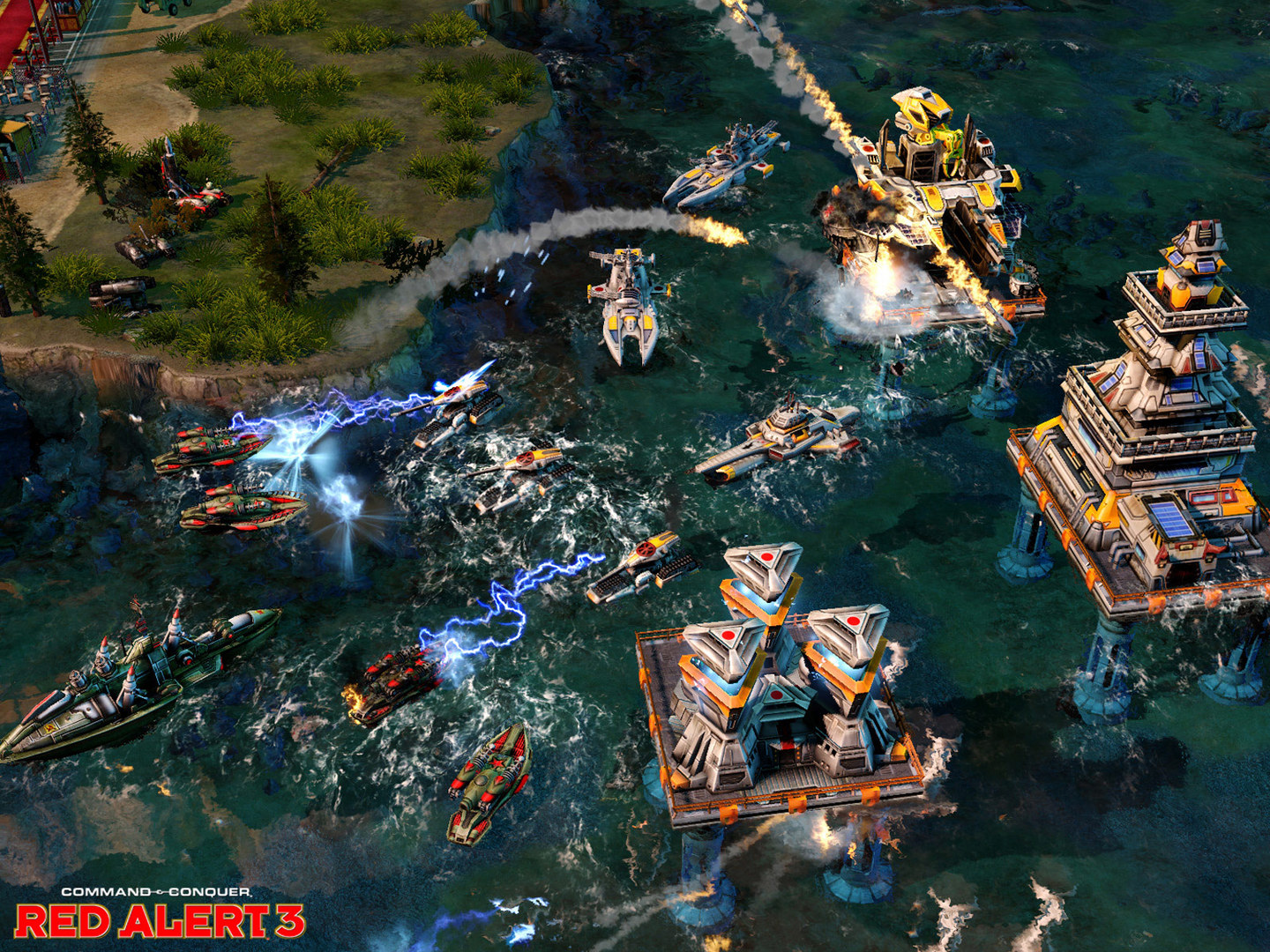
The factions use different construction and technology systems, which changes how a base develops. The Allies follow a familiar Construction Yard approach: buildings are prepared in a menu and placed once ready, while Command Hubs can extend construction and apply clearance upgrades to nearby production. Soviet structures rise from their foundations after being placed, and new technology tiers come from constructing higher-level facilities; the Super Reactor adds power and opens a new tier. The Empire of the Rising Sun creates Nanocores that travel to a location and unpack into buildings. It upgrades production structures individually, so a commander can improve selected parts of an army without advancing every factory at once. Boot Camps, Soviet Barracks and Imperial Instant Dojos serve as each side’s first infantry-training structure.
Army composition spans land, air and sea, with faction-specific units built to support or counter the others. Allied forces include Peacekeepers, Tanya, the Multigunner IFV and aircraft such as the Vindicator, while the Soviet roster includes Tesla Troopers, Hammer Tanks and Kirov airships. The Empire fields units such as the Imperial Warrior and transforming Mecha Tengu. Naval forces are part of the same battle plan: Sonic Dolphins and Hydrofoils give the Allies dedicated sea units, while Soviet subs and the Empire’s own ships contest water routes. Amphibious units, transports and aircraft can cross between land and water, so shorelines are active fronts rather than empty borders. A force sent toward a target may need anti-air cover, transport capacity and naval support as well as armor.
Individual units also bring special abilities that can change how an engagement unfolds. Some switch weapons or transform into a different unit type; the Allied Multigunner IFV changes its weapon according to the infantry passenger it carries. Attack-move orders let a group engage enemies or base defenses on the way to a destination, while stances determine whether troops pursue, guard a position or hold fire. Infantry can occupy some civilian buildings for protection and longer firing range. Units that survive combat gain veterancy, improving their damage resistance and attacks, with the highest level also healing outside combat. These systems reward grouping units by role, watching the approaches to a base and timing abilities instead of sending every unit forward in one undirected mass.
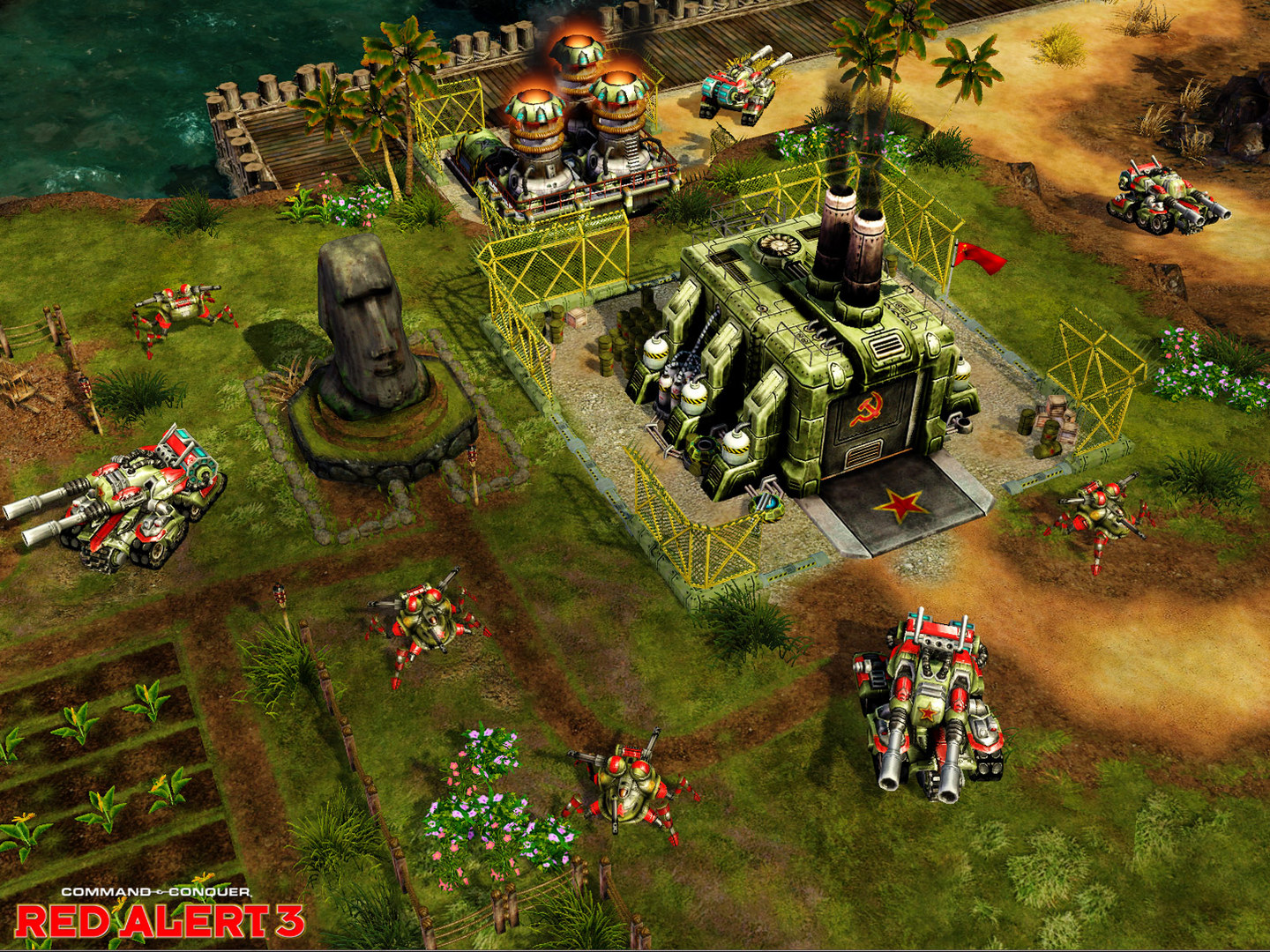
Campaign missions define primary objectives that must be completed to win, with optional objectives that can provide extra resources or other rewards. A co-commander accompanies the player through campaign operations and can be a computer-controlled character or a human partner; orders can direct that companion to build an attack force, strike a target or hold a position. The campaign therefore frames each battlefield as a shared command problem, while skirmish offers self-contained matches against computer-controlled opponents on selected maps. Special protocols unlock as battles progress, providing faction support powers with their own cooldowns; superweapons and offensive ultimate weapons add further options for breaking a fortified line. These layers sit alongside the core cycle of collecting ore, expanding a powered base and coordinating an army across all three theaters of war.
- Developer
- EA Los Angeles
- Genre
- Real-time strategy