
About Command & Conquer 3 Tiberium Wars
In 2047, the Third Tiberium War erupts as the Global Defense Initiative and the Brotherhood of Nod fight over a crystal that sustains economies while making much of Earth hostile to life. Command armies, build bases, harvest Tiberium and follow opposing faction campaigns through a conflict that reaches beyond the planet.
Command & Conquer 3: Tiberium Wars opens in 2047 with a nuclear explosion that signals the start of a new global conflict. The setting is already shaped by Tiberium, a green crystalline substance of alien origin that has spread across the planet. It is valuable enough to power industrial and military economies, yet dangerous enough to make large areas difficult for ordinary human life. The Global Defense Initiative treats the expanding contamination as an existential threat; the Brotherhood of Nod, led by the enigmatic Kane, sees Tiberium as a source of power and as part of humanity’s future. Their opposing beliefs turn the resource into both the reason for the war and a symbol of what each side thinks should happen to Earth.
The campaign follows the conflict through different command perspectives rather than a single soldier’s journey. GDI missions place the player within a formal military organization responding to attacks and trying to contain the spreading crisis. Nod missions put the player in command of the Brotherhood’s forces, where secrecy, mobility and Kane’s influence shape the campaign’s identity. The base game also includes a Scrin campaign that becomes available after completing the GDI and Nod campaigns. The Scrin are an alien force with a direct relationship to Tiberium; their structures and units use alien technology and give this faction a different battlefield identity. The three sides share the battlefield, but their story material and military methods make each perspective distinct.
Every mission is also an economy and construction problem. Tiberium grows in fields across the map; harvesters gather it and return it to refineries, where it becomes credits for buildings, troops and upgrades. A Construction Yard provides the starting point for a base, while power plants supply electricity to its expanding network. Adding production, research and defensive structures increases what the base can do, but also increases its demand for power. If power becomes insufficient, systems such as defenses and superweapons are affected, so expansion has a cost beyond the purchase price. Harvesters and Tiberium fields are exposed to attack, making it important to defend the supply chain or disrupt the opponent’s.
Base growth follows construction prerequisites and faction technology. The sidebar shows structures that can currently be built; an unavailable icon signals either a shortage of resources or a missing prerequisite. Barracks train infantry, war factories produce ground vehicles, and airfields support aircraft. Research structures unlock upgrades and faction support powers, adding new weapons or abilities to forces already in the field. Support powers consume resources and have cooldowns, while unit upgrades must be researched at the appropriate faction structure before they can be applied. These links between buildings, power, technology and battlefield production make the order of construction consequential: a base must fund its army while opening the next tier of tools.
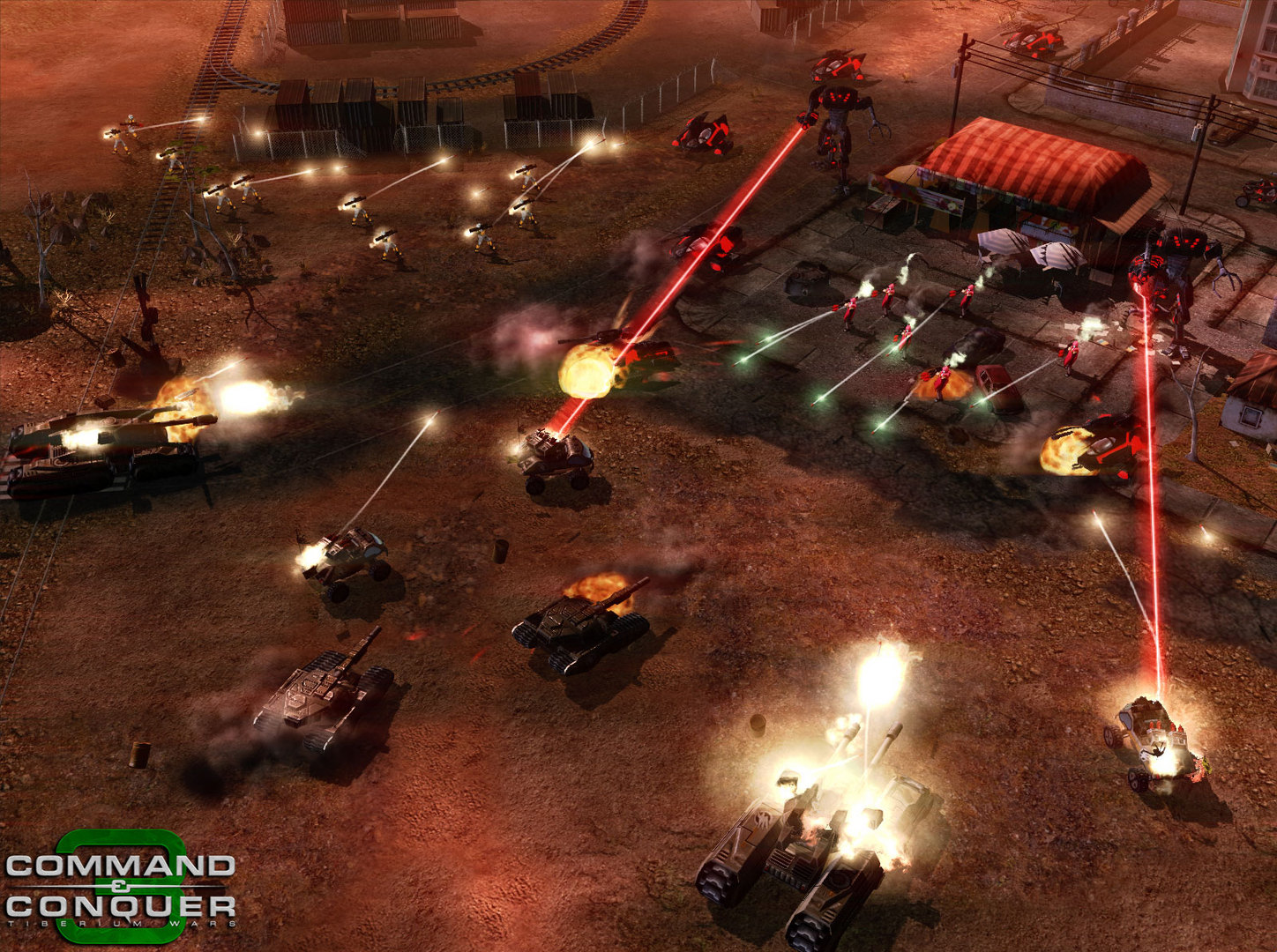
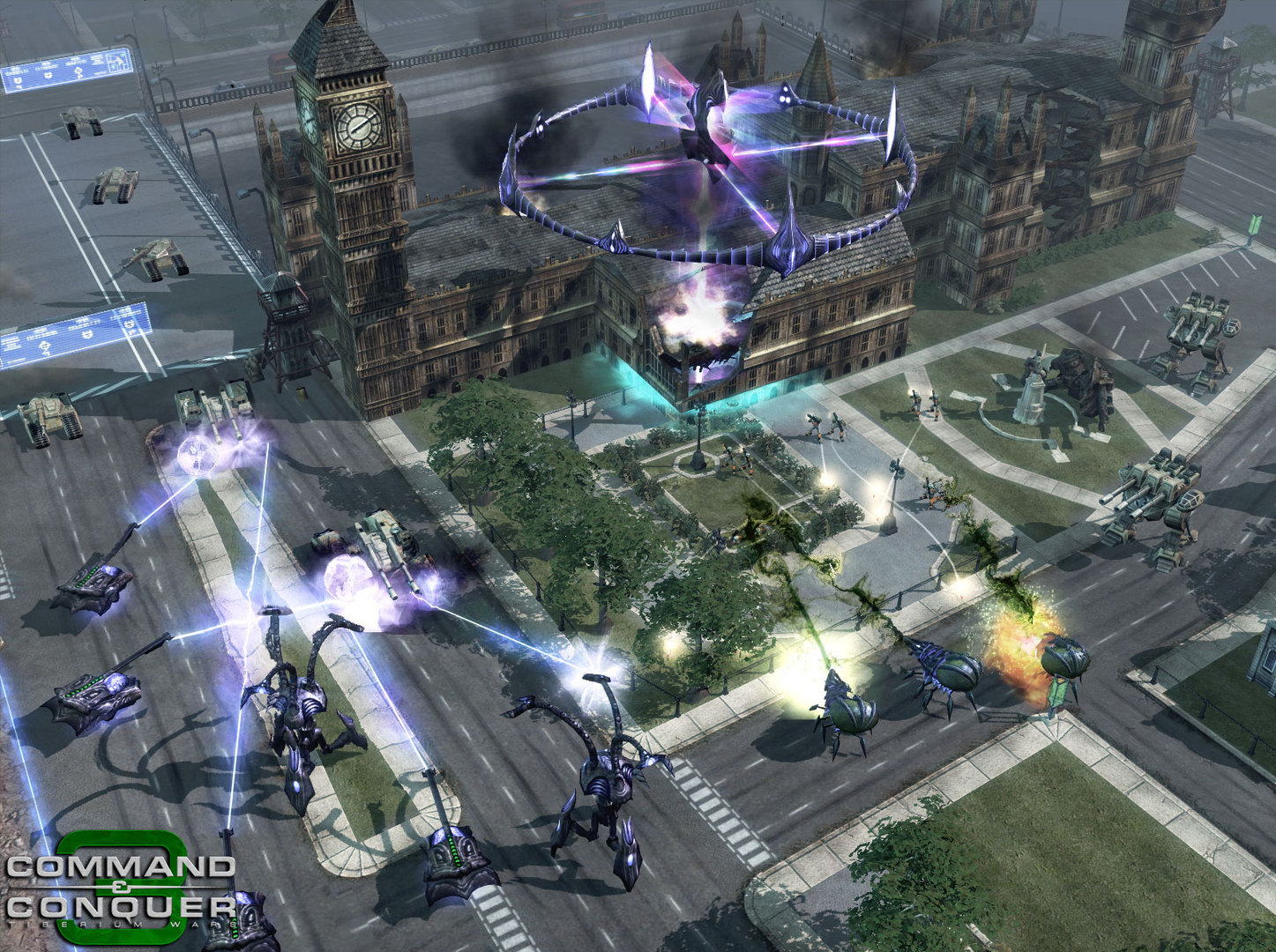
GDI, Nod and the Scrin take different approaches to fighting. GDI fields conventional combined arms, including the heavily armoured Mammoth Tank and the long-range Juggernaut artillery unit. Nod relies on speed, concealment and specialised attacks; its stealth units and flame weapons can pressure exposed forces or make a direct approach risky. The Scrin bring alien technology, including the floating Stormrider aircraft and the Mastermind, which can seize control of enemy units. Each faction has its own structures, unit roster, upgrades and support powers, so a familiar role such as scouting, anti-air or siege can be handled with different tools. Units can gain combat veterancy, improving their performance as they survive and fight.
The battlefield rewards issuing more than simple move and attack orders. Attack-move tells selected troops to engage enemies they encounter along a route, while assault-move also directs them to attack hostile structures. Infantry can use cover beside civilian buildings and obstacles, gaining protection in exchanges with opposing troops. Engineers, Nod Saboteurs and Scrin Assimilators can capture neutral technology buildings, which provide benefits such as extra income, reinforcements or control over nearby buildable territory. Those objectives make map position matter: a force can protect its own harvesters, contest valuable fields, capture a strategic structure or use terrain to bring infantry closer without exposing them to open fire.
Campaign missions are arranged through a Theater of War interface, with each faction’s objectives carrying the larger conflict forward. Missions can ask for base construction and defence, a rescue, an attack on a position or the protection of an allied force; completing the primary objectives is what advances the operation. Optional objectives and discoveries in the Intel Database add mission-specific context and can affect the medals and ribbons awarded after a mission. Outside the campaigns, Skirmish sets one faction against computer-controlled opponents on a selected map, with up to seven opponents available. The same base, harvesting and unit-command systems therefore support both authored operations and self-contained battles, while the campaigns show how the GDI, Nod and Scrin understand the war differently.
- Developer
- EA Los Angeles
- Genre
- Real-time strategy