
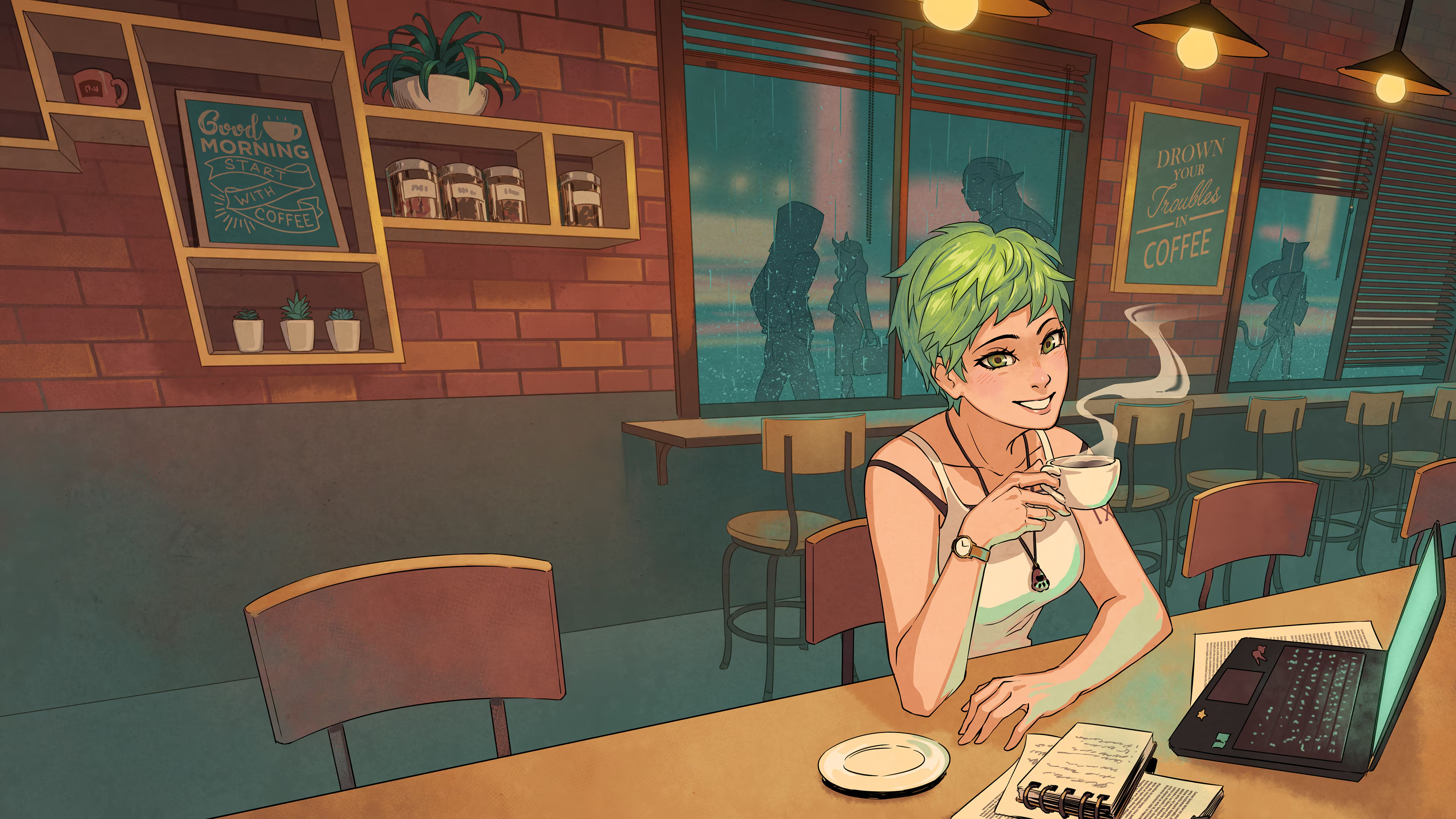
About Coffee Talk
In an alternate Seattle where humans and fantasy peoples share the city, you run a late-night café and listen as regulars talk through work, family, romance and identity. Prepare drinks from a small set of ingredients, learn recipes in the Brewpad, and see how the way you serve customers shapes their connected stories.
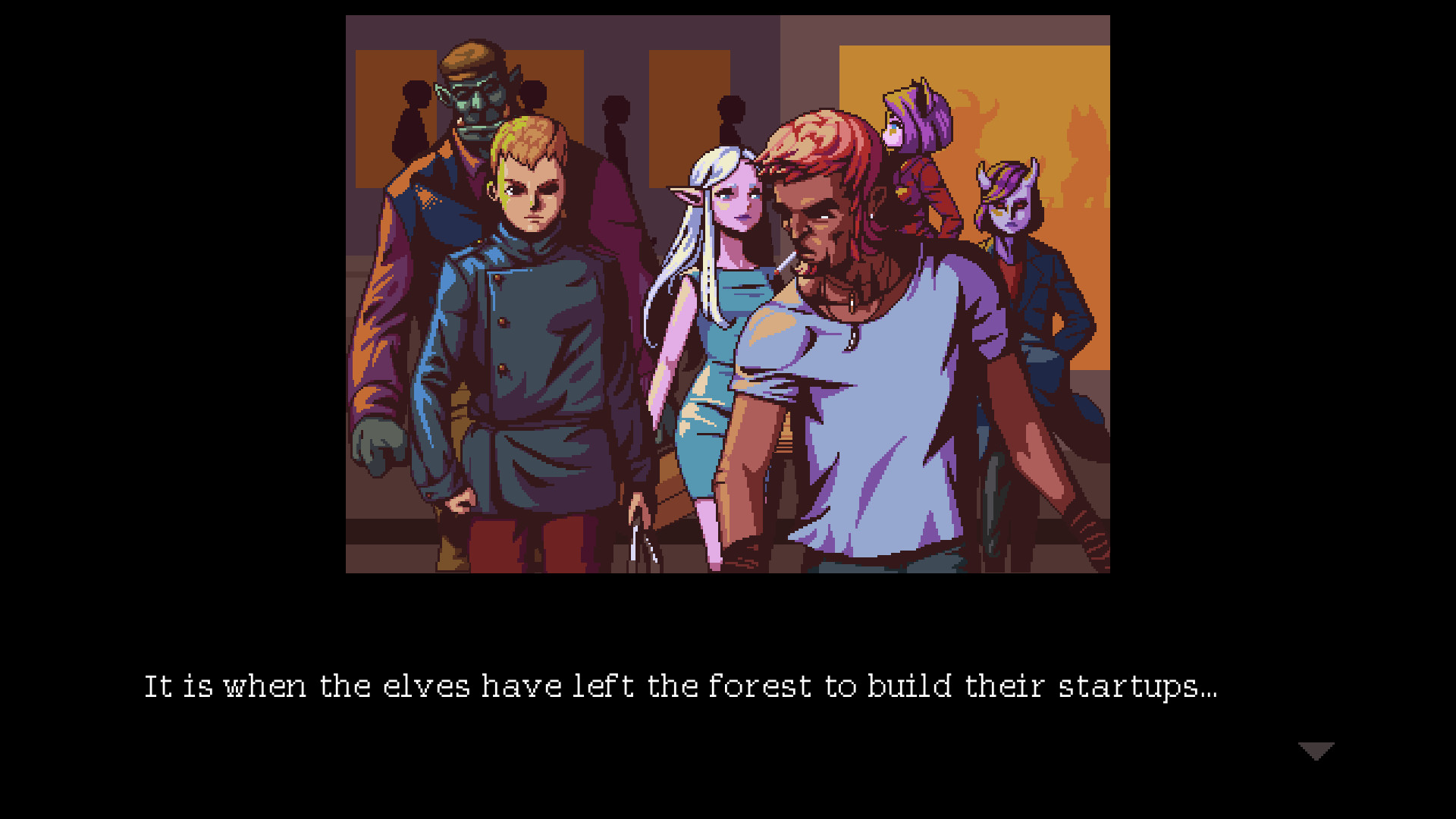
Coffee Talk takes place in a version of Seattle where humans live alongside elves, orcs, werewolves, vampires, mermaids and other fantastical peoples. The café is open during the late hours, when its regulars come in to talk about problems that continue beyond the counter. The story unfolds across a two-week stretch, with writer Freya among the customers: she has a deadline to produce a novel, and the conversations she witnesses become entangled with that work. The barista, whose identity remains unspoken, is the player’s point of view. There are no dialogue-choice trees for the player to steer each exchange. Instead, customers speak to one another and to the person serving them, while the café provides a steady place for those relationships to cross. Its fantasy premise gives familiar pressures a different surface: prejudice between groups, family expectations, uncertainty about work and the difficulty of making a life on one’s own terms. The focus stays with ordinary decisions and personal ties rather than a city-wide adventure or a threat to defeat.
Several regulars form the story’s central circle. Baileys is an elf and Lua is a succubus; their relationship faces disapproval from families who expect them to pair within their own peoples. The game follows their private uncertainty as well as the social pressure around them, and their conversations sometimes include the people close to them. Freya’s writing deadline gives her a reason to pay attention to the café’s patrons, but the other stories do not reduce to material for her book. Jorji, a human police officer, is part of the café’s familiar evening rhythm. Hyde, a vampire model, and Gala, a werewolf who works in hospital administration, bring friendship and professional life into the same shared space. Their different backgrounds matter to how they are treated and what choices seem available, yet the game gives each a personal concern beyond their species. Other regulars include Myrtle, a half-orc involved in game development, Aqua, a shy sea creature pursuing independent creative work, and Rachel, a pop performer whose father Hendry is anxious about her career. Neil arrives from beyond Earth with an unusual interest in human life. These stories overlap through repeat visits, so characters become part of one another’s conversations rather than appearing only for isolated episodes.
The player’s main active task is making drinks. Orders can be direct, such as naming a familiar beverage, or indirect, describing a taste, temperature or mood. The machine uses three ingredients in sequence: a base and two additions. The available pantry includes coffee, tea, green tea, chocolate, milk and flavouring ingredients such as ginger, mint and honey. The order matters, so entering the same ingredients in a different sequence can produce another drink. A finished recipe is recorded in the phone’s Brewpad for later reference; experimentation is how the player discovers unlisted combinations. Some customers ask for their usual order, while others ask for something surprising or describe qualities rather than providing a recipe. When the request is unclear, the player interprets what the person has said and chooses a mixture. The barista can discard a prepared drink and try again a limited number of times during a shift. Before serving, the brewing screen shows the selected base and two additions, leaving the barista to decide whether the result fits the request. Once served, the customer responds, making the result part of the conversation. The task is compact, but it connects listening with action: the order is one of the few ways the silent protagonist can answer what a patron has shared. The Brewpad is useful because drink names become a growing reference rather than a fixed menu handed to the player at the start. Discoveries persist there, making a later request easier to interpret if its ingredients have already been worked out. The game also teaches by implication: a customer can hint at a flavour or kind of drink, but does not always state the full sequence.
A correct or especially relevant drink can affect how a customer’s story proceeds. The game does not ask the player to select spoken responses, so the serving decision becomes its main form of branching input. Regulars may return across several nights, and successful service can strengthen a relationship and reveal further scenes; a missed order can change what the player sees without stopping the whole narrative. This progression depends on attention and recipe knowledge rather than character levels, equipment upgrades or a café-management economy. The phone gathers several kinds of reference material alongside the Brewpad: customer profile pages add information about the people who visit, Freya’s short fiction appears in the fictional newspaper, and the player can choose music from the playlist. Those details accumulate over the schedule of visits, linking each night’s conversations to people met earlier. The story mode is the central framework, while the game also offers a free-mixing mode for trying recipes and a timed challenge that tests how many orders can be handled. These modes give drink preparation space outside the conversations, but the main story remains the place where a served cup can carry meaning for a character. Customer profiles give the barista a way to recall details between orders, while each new evening brings back familiar faces with fresh conversations.
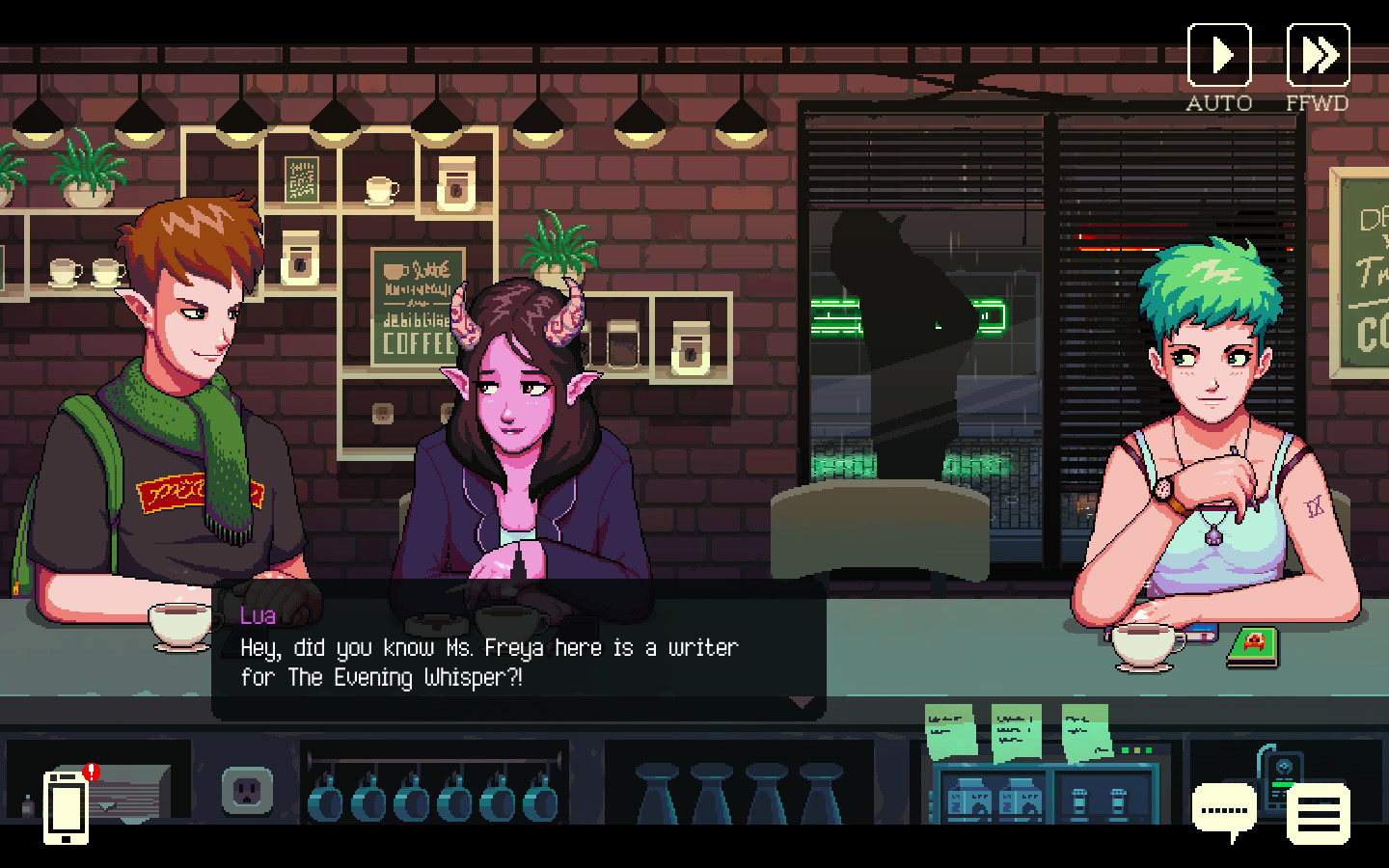
Coffee Talk keeps movement and spatial exploration narrow. The barista works from behind the café counter; play does not involve walking through Seattle, navigating a map, or searching rooms for objects. The environment is presented as a fixed café scene, with customer sprites and dialogue occupying the foreground while rain and the night outside establish the setting. Progress is organised by visits and dialogue rather than by routes through a physical world. There is no combat system: conflict appears in conversations about relationships, family, identity and work, not in battles or player-controlled confrontations. The player’s interpretive work instead comes from recalling what people have said, recognising a returning customer’s situation and using that context to decide what to serve. The Brewpad supports this process by keeping discovered drinks available for review, while the limited discard attempts create a small constraint when experimenting during a shift. Between story scenes, free mixing and the timed challenge change the immediate objective without adding exploration or combat. This focused structure keeps the player close to the conversations and makes the café itself the recurring stage for a cast whose lives extend beyond it.
The visual and audio presentation reinforces that intimate frame. The game uses detailed pixel-art characters and interiors with a palette of warm lights against a rainy, dark city outside. Customers’ expressions and poses provide a visual counterpoint to dialogue, while the mostly fixed café composition gives the conversations room to lead. When a drink is finished, certain beverages allow the player to draw latte art by guiding a pour on the cup; it is an optional flourish rather than a separate craft campaign. Jazzy and lo-fi tracks accompany the shift, and the phone’s playlist allows the player to choose what plays in the café. Together, the rain, music, customer sprites and repeated counter scene make the passage of evenings legible without requiring traversal. Developed and published by Toge Productions, this first Coffee Talk game follows the café’s original cast. Coffee Talk Episode 2: Hibiscus & Butterfly returns to the setting in a separate adventure.
- Developer
- Toge Productions
- Genre
- Narrative visual novel / café simulation