
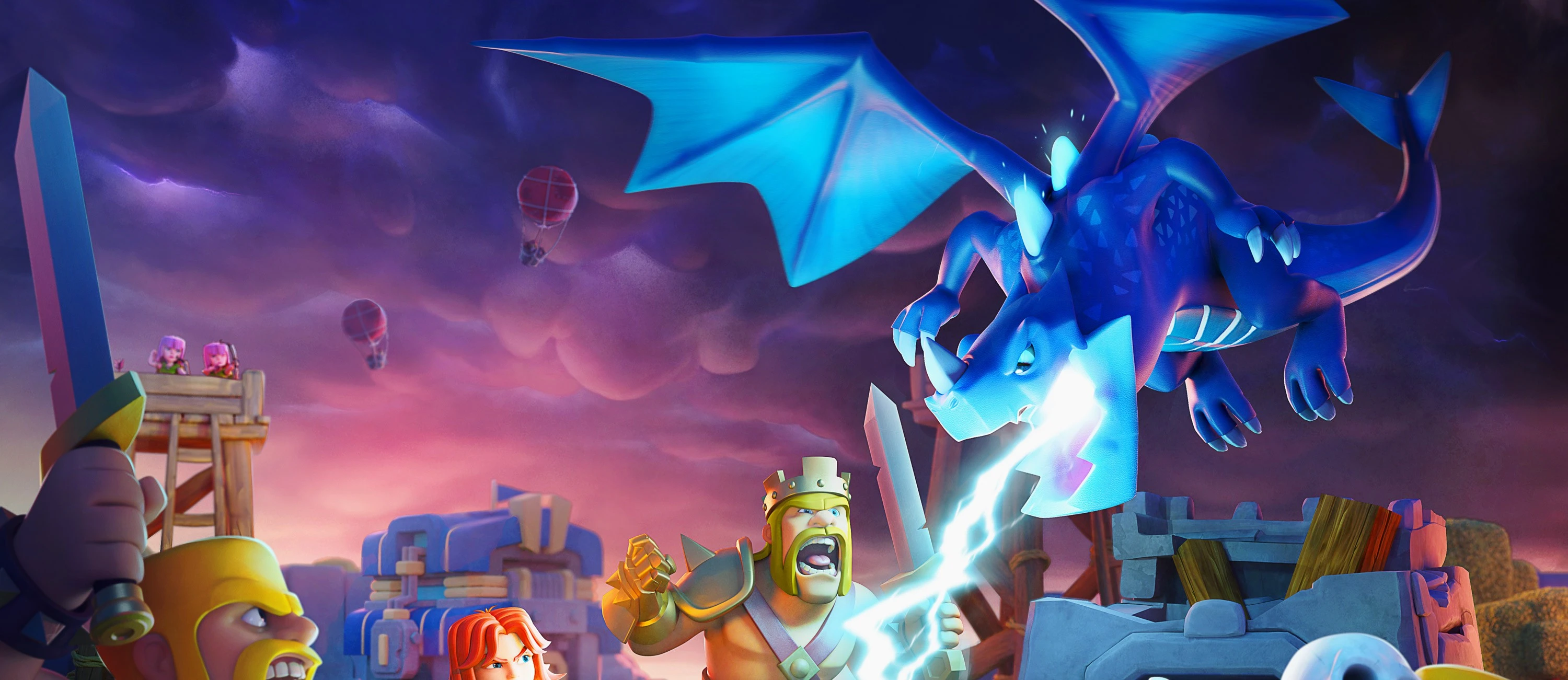
About Clash of Clans
Clash of Clans is a village-building strategy game about designing defenses, training armies and raiding other settlements. Town Hall upgrades unlock more buildings and troops, while Clans add wars and shared Clan Capital raids. Its long progression links construction, research, hero development and attack planning across the Home Village, Builder Base and cooperative clan systems.
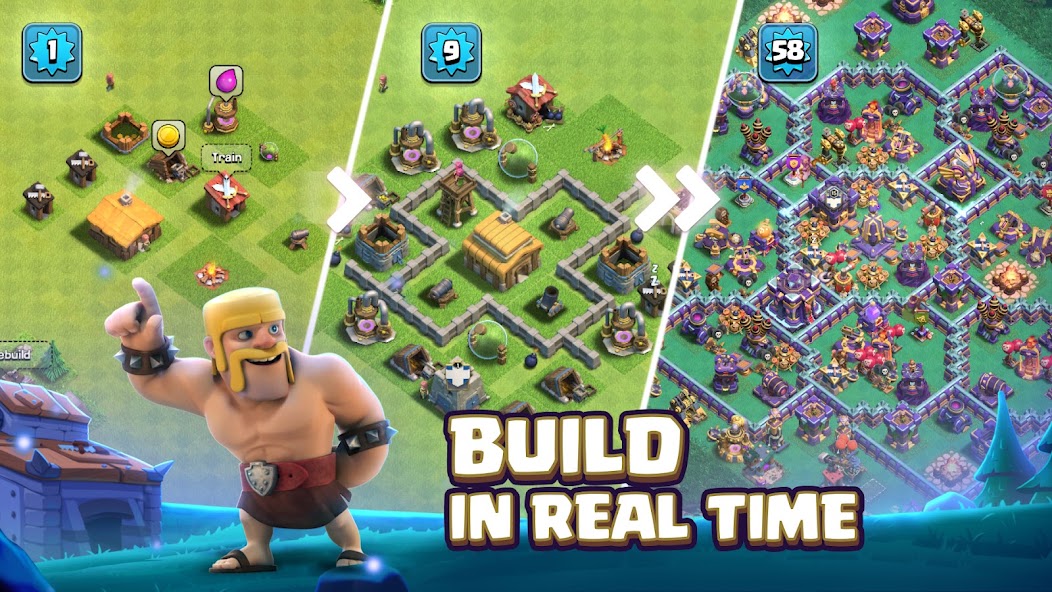
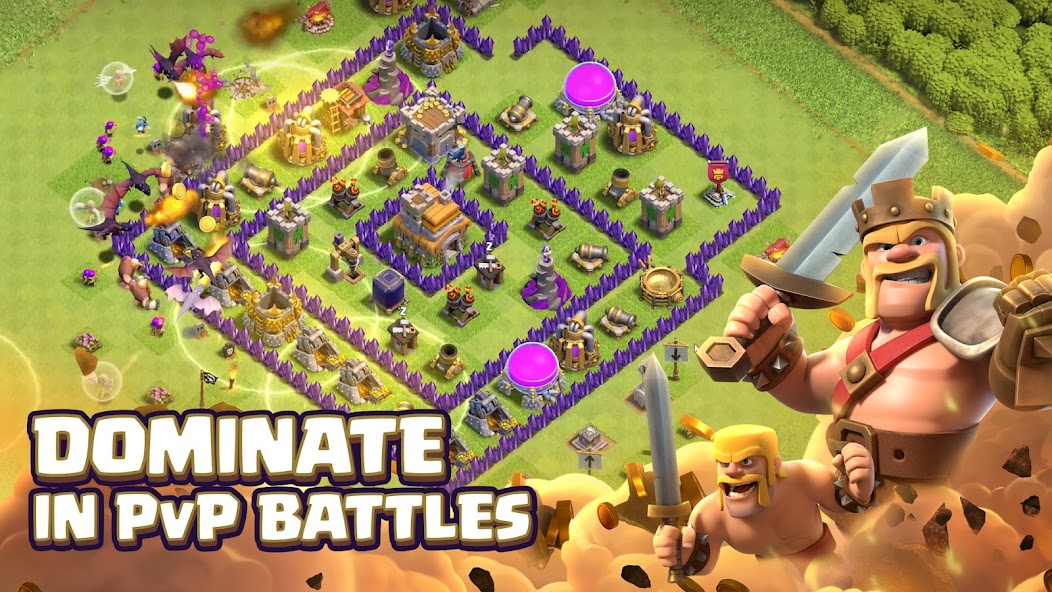
Clash of Clans places the player in charge of a growing village in a fantasy kingdom. The Home Village is both a working base and a defensive puzzle: buildings produce or store resources, army structures unlock offensive options, and defensive towers protect the Town Hall and surrounding assets. Walls, traps and building placement shape the paths an invading army can take. Rather than directly controlling troops once an attack begins, the player selects an army, chooses deployment points and watches units follow their targeting rules. This separates the two halves of play: construct a layout that can withstand other players, then study enemy bases and assemble an attack capable of reaching important defenses and earning stars.
The Town Hall acts as the main progression gate. Upgrading it opens new buildings, troop levels and defensive options, but development also depends on resource collectors and storages, builders, and laboratory research. Gold and Elixir fund many structures and upgrades, while Dark Elixir supports other advanced units and heroes. Army Camps determine how much force can be brought into a raid, Barracks and related buildings provide troops, and the Laboratory improves units and spells over time. Choosing what to upgrade shapes the next stage of play: a stronger offense can improve raids and war attacks, while a layered defense can protect accumulated resources. Long construction and research timers make the village’s queue a persistent strategy layer between battles.
Attacking requires reading a layout before committing troops. Units have preferred targets and movement behaviors: some seek defenses, some attack nearby structures, and others can fly over walls. Deployment around the perimeter can remove outer buildings and create a funnel, steering the main force toward a selected objective instead of letting it circle the edge. Spells alter the assault through damage, healing, concealment or movement effects, while siege machines can carry troops toward a target. Heroes provide distinctive high-impact units with abilities and equipment options that change how they perform. The attack is therefore an exercise in sequencing: clear outer structures, create a route, deploy the main army, then time spells and hero abilities as defenses activate.
The Clan Castle connects a player’s village to a team. Clanmates can donate troops and spells, which may be used in attacks or defend the village; donated reinforcements can provide a unit that is absent from the player’s own army. Clan Wars organize coordinated attacks against another group’s war bases, where stars and destruction contribute to the team result. The separate Clan War League format gives clans a seasonal competitive structure. These activities make base scouting and army preparation social: members can discuss defensive layouts, donate useful compositions and compare attack plans rather than treating every raid as an isolated resource run.
The Builder Base offers a separate settlement reached by rebuilding the boat from the Home Village. It has its own Builder Hall, buildings, resources and Builder Battles, with a two-stage layout introduced as the base develops. Attacking earns Builder Gold, while defending earns Builder Elixir. Each attack also opens the base to a defense from another player; the two results are separate rather than a head-to-head contest. Compact layouts and efficient deployment therefore affect different parts of the economy. The Master Builder character guides this area, and some Builder Base progression connects back to the wider account. Its distinct economy and battle rules make it more than a second copy of the first village.
Clan Capital turns clan progression into a cooperative multi-attack assault. Members contribute Capital Gold to build up Districts from ruins, expanding the shared base and unlocking more structures, defenses, troops and spells. During Raid Weekends, attackers work through Districts before they can assault Capital Peak. Damage persists from one attack to the next, and spells can remain for a subsequent attack, so one member can weaken defenses or open deployment space for another. The deployment zone grows as a District is conquered, gradually changing the available entry points. Clan members share access to the Capital army regardless of their individual Home Village level, while Home Village and Builder Base heroes do not join these battles. Contributions are made with Capital Gold, which clan members can create through the Forge or earn in relevant activities. Restoring a ruin reveals the building type it will become, and enough contributions upgrade it instantly. District Halls gate local building strength, while the Capital Hall opens additional Districts; leaders can mark priorities, but members remain free to contribute elsewhere.
The Blacksmith gives hero development a separate set of decisions. Each hero can carry two pieces of equipment, combining abilities that activate during an attack with passive effects that remain in force. Earthquake Boots allow the Barbarian King to damage walls and buildings, while Vampstache restores health as he attacks; the Archer Queen’s Giant Arrow sends a projectile across the village. Choosing between those functions changes what a hero contributes to an army, rather than simply raising the same unit’s damage. Equipment is upgraded with Ore, distinct from the resources used for ordinary village construction. Common and Epic items have different acquisition and upgrade requirements. The resulting preparation happens before deployment: select the army, assign hero equipment and plan how those abilities will interact with the route through the target base.
You start with a Town Hall and two Builder's Huts, and the game is honest about the shape of it: almost everything you improve takes time and one of a handful of builders, so the queue you line up between sessions does a lot of the deciding.
Two villages, one account
The Home Village is the main game. You raise a Town Hall to unlock more buildings and higher levels of the ones you own, spend Gold on defences and town upgrades, and spend Elixir on offensive buildings and troop research in the Laboratory. Dark Elixir appears at Town Hall 7 and feeds the darker troops, the heroes and their upgrades.
The Builder Base is a second village with its own rules, reached by boat, and its attacking works differently in two ways. First, it is not head to head. You attack other people's bases on your own schedule and your own base is attacked separately, whenever somebody else finds it, with trophies settling on both sides from those two fights — which is why you can keep attacking as soon as your own battle ends instead of waiting on an opponent. Second, from Builder Hall 6 a base is split into two stages. Only the first is visible until it is completely destroyed, and if you clear it you get the remains of your army, reinforcements from your Reinforcement Camps and a second planning minute to finish the job. Stars are scored on each stage rather than once across the whole base, which is how a single Builder Base attack can be worth up to six.
Training costs nothing, which changes the whole rhythm
This is the change that matters most to returning players. Training costs were removed in 2022, so an army no longer eats Elixir before it leaves the barracks, and the 2025 Clash Anytime update went further and removed troop, spell and siege machine training times along with the wait to heal a hero. Your troops are simply there when you want them. What is left as your constraint is camp capacity: you can attack whenever you want, but you can only bring what fits.
Attacks are rated on three stars and run to a three minute limit. Fifty percent destruction is one star, taking the Town Hall is another, and flattening the base is the third. With the waiting gone, more of the pressure sits on the plan: which army you cooked, where you commit it, and whether the second half of the attack still makes sense once the first half has told you the layout.
Heroes are half of the army
Heroes are managed from the Hero Hall, which unlocks at Town Hall 4 and is where the Barbarian King arrives with it. The current line-up runs Barbarian King, Archer Queen, Minion Prince, Grand Warden, Royal Champion and Dragon Duke; the Builder Base has its own two, the Battle Machine and the Battle Copter. Each hero brings an ability you fire during the attack, which is why an army without its heroes behaves nothing like the same army with them.
Hero Equipment, added in late 2023, sits on top of that. The Blacksmith unlocks at Town Hall 8 and is where you change what a hero's abilities actually do, with each hero carrying two pieces at a time on attack, and the equipment levels up using three kinds of Ore: Shiny, Glowy and Starry. That makes heroes a long-term project with its own currency, separate from the Elixir and Dark Elixir you spend on their levels, and it means two players with the same heroes can be running quite different abilities.
Clans, wars and the Clan Capital
Clans hold up to fifty players, and Clan Wars are the reason to be in one. Each member gets two attacks against the opposing clan, stars are scored the same way they are in a normal raid, and the clan with more stars at the end of War Day takes it. A tie is decided by which clan caused more destruction overall, which is a real incentive to finish bases rather than farm easy stars.
The Clan Capital is the group's shared base, built and upgraded by everyone, and its Raid Weekends are a separate weekend activity where you attack other clans' Capitals for Capital Gold and Raid Medals. Capital Gold goes back into the Capital itself, while Raid Medals are spent on things for your own village, so a weekend of raiding pays both the group and the member.
Above the wars sit the competitive layers. Clan War Leagues put clans into monthly leagues against each other, and they change the shape of a war: each player gets a single attack per war day rather than the two of a normal war, so every attack carries more weight. Clan Games ask the whole clan to hit milestones for magic items, and Ranked Mode and Legend League are where individual players climb a public ladder. There are practice routes too: Friendly Challenges let you test a layout or an army against a clanmate, Friendly Wars run a whole war between two clans by arrangement, and replays let you watch how your defence actually performed rather than guessing from the score.
Current state of the village
The game has moved to Town Hall 18, which landed in late 2025 and has since picked up extra supercharge levels and a new pet tier. The Dragon Duke hero and the Greedy Raven pet arrived in a separate update early in 2026, so do not expect to find them waiting the moment you hit the new Town Hall. If you are returning from an older account, the things to re-learn are probably Hero Equipment from Town Hall 8, Super Troops at Town Hall 11 — boosted with Dark Elixir, with two types able to be active at once — pets from the Pet House at Town Hall 14, and siege machines from the Workshop at Town Hall 12.
Should you play it
Yes, if you want a long game with a short daily ritual. Logging in to move a builder, cook an army and take two war attacks is a satisfying loop, upgrades are permanent, and the free-training change means the account you left behind is still worth coming back to rather than a fresh start.
Skip it if you want to be competitive this month. There are three more builders to buy with Gems once the tutorial is done, a sixth that has to be earned through Builder Base progress, and an upgrade ladder long enough that the queue becomes a project of its own. Gems and shop bundles are what turn that queue into a shortcut. It is the oldest kind of mobile strategy game, and it is still running because that structure works.
Go deeper with V4mp
- Developer
- Supercell
- Genre
- Strategy
Explore Clash of Clans further
Explore the wiki for detailed reference pages on the game's world, systems, items and locations.