

About Sid Meier's Civilization VII
Guide a civilization from Antiquity through Exploration and into the Modern Age, balancing settlement growth, diplomacy, conflict and research. Lead with figures such as Augustus, Ada Lovelace or Alexander, pursue flexible Triumphs, and shape how your empire carries its identity and achievements across a multi-age campaign.
Sid Meier’s Civilization VII is a turn-based strategy game about developing a society across successive historical Ages. The player begins with a small settlement, explores a procedurally generated map, meets rival leaders and Independent Powers, and allocates food, production, science, culture, gold and influence toward a long-term plan. Every turn asks what to build, research, negotiate or contest. The campaign’s broad structure links Antiquity, Exploration and the Modern Age, while individual matches remain shaped by geography, available resources and the choices of other civilizations rather than a fixed historical narrative.
A major part of the current design is that a civilization no longer has to change at an Age transition. At game setup, players can choose a Time-Tested civilization and carry it across all three Ages, or follow the more historically themed progression where the empire can adopt another civilization as the world changes. Leaders are selected separately from civilizations, so an enduring leader’s ability can guide multiple cultural identities. Age transitions remain important: they introduce new rosters of units, buildings and civic options, let the player review the empire, and create a moment to decide which strengths should continue into the next phase.
The map is divided into Homelands and Distant Lands, encouraging both local development and overseas expansion as a campaign advances. Settlements grow around a capital, with cities and towns serving different roles in the empire’s network. A city uses production to construct buildings and train units, while towns support expansion and specialization. Improvements, resources and buildings are placed across settlement tiles, so the surrounding land can influence what a site produces. Natural features, navigable waterways and access to resources make map-reading relevant to economic planning as well as military movement.
The empire’s civic and scientific development is managed through separate research tracks. Technologies unlock practical advances such as new military capabilities or production options, while civics open traditions, policies, diplomatic choices and government adjustments. Wonders and unique buildings give civilizations and settlements specialized benefits. The player’s choices affect how a city’s tiles develop and how the empire uses resources; assigning resources through the Commerce Screen can alter yields, and trade routes connect settlements and rival powers. These systems tie exploration to internal management: discovering a distant source of goods matters only if the empire can claim, transport and use it.
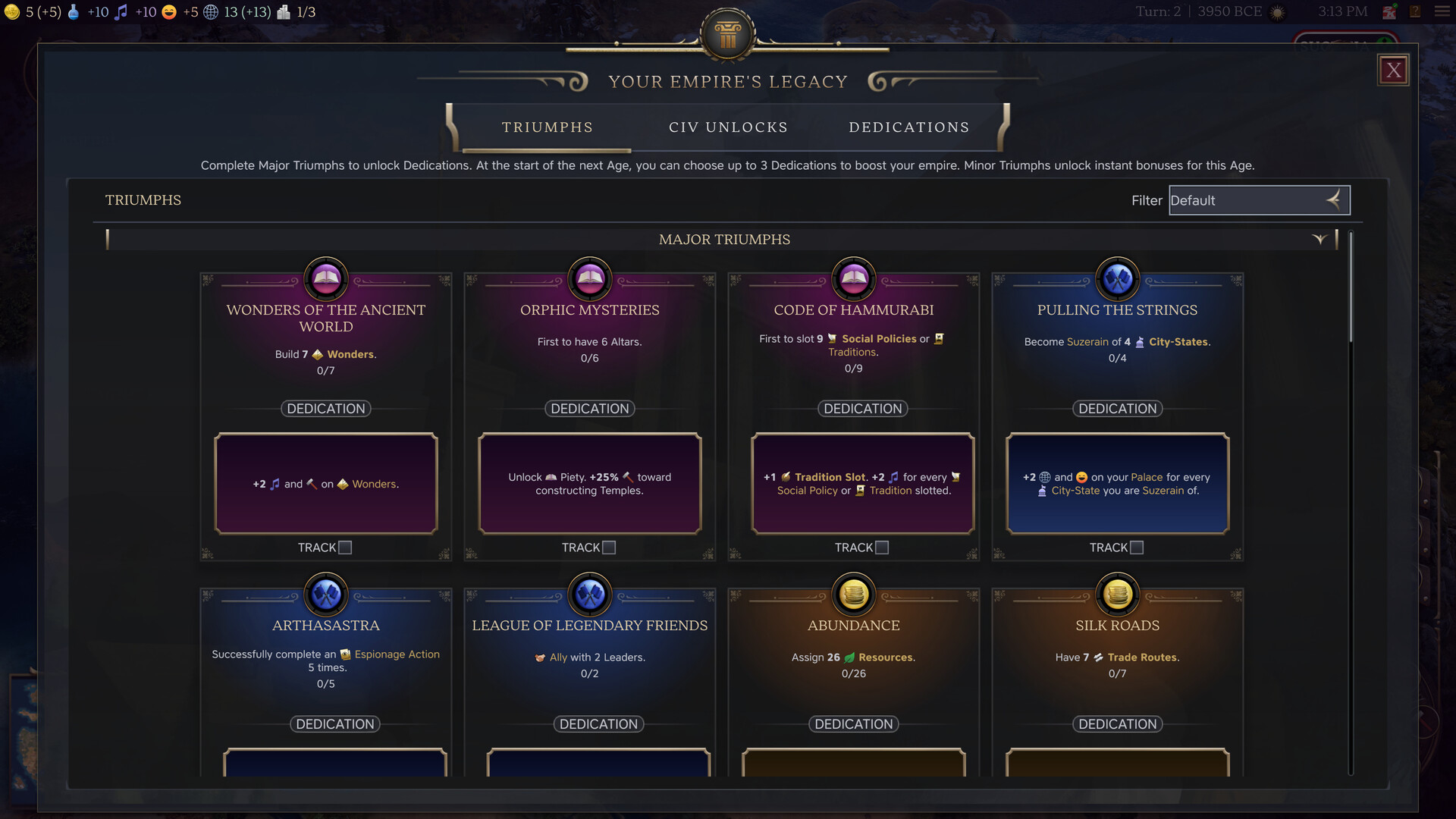
The former Legacy Paths have been replaced by Triumphs, optional objectives organized around Militaristic, Cultural, Scientific, Economic, Diplomatic and Expansionist goals. Some reward broad development, while others ask for more deliberate commitments, such as expanding influence, securing wonders or pursuing conflict. Minor Triumphs can provide immediate advantages; Major Triumphs contribute Dedications that may be selected after an Age transition. The player chooses which goals matter rather than needing to complete every track, and can also select a curated Triumph Set before starting a game to emphasize a particular kind of campaign.
Victory now develops across the whole campaign instead of being confined to a final-age checklist. Military, Cultural and Economic victories track different forms of dominance over rival empires, while Scientific victory centers on accumulating Innovation and completing a space-race objective. Military progress can come from controlling settlements and capturing important capitals; cultural progress draws on tourism from wonders, artifacts and distinctive improvements; economic progress involves resources, gold buildings and treasure convoys. Scientific advances build through technologies, Codices and special projects. Rivals remain able to answer a growing lead, so a player must defend a victory position instead of merely reaching one isolated threshold.
The daily work of ruling is distributed across diplomacy, commerce and warfare. Influence can support diplomatic actions and relationships with Independent Powers; trade relations create routes whose availability depends on requirements between settlements. Commanders organize military units and bring their own promotions to field operations, while settlement defenses, war weariness and the cost of expansion shape the timing of conflict. A leader’s attributes progress over a campaign and can unlock Dedications between Ages. Together, these layers let players pursue a chosen strategy while still reacting to rival empires, shifting borders and the demands of a changing global map.
Empire logistics make every new settlement useful only if its yields and connections are managed. Resources can be assigned to settlements to alter output, while trade routes link eligible settlements and diplomatic partners. The Commerce Screen separates active routes from routes that are possible but still locked by unmet requirements, helping the player see what must change before opening a connection. During Exploration, Treasure Convoys turn overseas holdings into a distinct economic system: the interface shows which settlements hold treasure, convoy value and progress, and what conditions are still missing. Returning convoys contributes to Economic Victory scoring, so expansion across the map can support a victory plan without being reduced to ordinary city income, and the Commerce Screen previews yield changes before players confirm an assignment or shift a trade connection.
Civ VII asks you to plan a campaign in chapters rather than one long arc, and the free Test of Time update added the option to stop changing at all. Three Ages, four victory routes, and a set of decisions waiting at every transition.
Ages, and what they mean for your empire
A campaign runs through Antiquity, Exploration and Modern. Each Age brings its own playable civilizations, units, resources and problems, and at the end of one you decide what your empire becomes next: keep going, evolve into a different civilization from the options your leader and your play have opened up, or take a hybrid route that borrows from both.
What always stays is the leader. Leaders were decoupled from civilizations for the first time here, so a pairing that never existed historically can be built on purpose, and each leader's unique ability is designed to carry across the whole campaign rather than one Age of it.
The Test of Time update added the third path properly. A Time-Tested civilization plays as one civ from Antiquity to Modern. Syncretism lets it adopt another civilization's Unique Units or Infrastructure, and Affirmation doubles down on its own identity instead. That matters more than it sounds, because for a lot of players the appeal of the series was never having to change at all, and the game now supports that as a real path with its own building blocks rather than a compromise.
Each Age also hands you a set of commitments for the next one. Completing objectives earns Dedications, and you can activate three of them, so a campaign becomes a series of small choices rather than one long build order.
Cities, towns and the shape of an empire
Settlements are no longer all cities. Your first is your capital, and the ones after it begin as Towns. A Town has no production menu at all; it turns its Production into Gold instead. You can keep it as a Town with a specialised role or pay Gold to upgrade it into a full City.
Improvements work differently too. Builders are gone, and creating an improvement is tied to population growth rather than to a unit. Accruing enough food earns Population points, and a Growth Event then asks you to spend each one on either an improvement or a specialist. An improvement brings a tile into the settlement's workings. A specialist occupies an urban tile and changes the yields around it, and the number you can place is capped. The panel spells out what each option does to the numbers before you commit, which is the difference between a real decision and a guess.
Four ways to win, and how they are measured
Victory here is a race against the other players rather than a checklist you finish alone. Culture, Military and Economic victories are all measured against the score of whoever is in second place: you have to pull clear of that player by a margin, and the margin you need starts high and drops as the Age runs on. Military Victory runs on Dominion, from controlling and capturing settlements and settling in Distant Lands. Cultural Victory runs on Tourism, built from Wonders, Great Works, Natural Wonders and Celebrations. Economic Victory runs on GDP, from slotted Resources, Treasure Convoys and Gold Buildings.
Science is the odd one out, because it is not measured against anyone. A Scientific Victory needs 100 Innovation and an active Launch Pad in the Modern Age. Once you have both, a countdown starts and you have to hold the requirements until it finishes. Break them and the countdown pauses rather than resetting, so a near miss is recoverable.
Snowball hard enough and a Transcendent Victory opens up in the Exploration Age, so a runaway campaign can be finished early. A score victory covers anything that runs all the way to the end. The Test of Time update replaced the old Legacy Paths with Triumphs, optional objectives grouped by the six attributes, with sets you choose in Advanced Settings. The Classic set rebuilds the old path structure for players who miss it, and the Trailblazer set is aimed at multiplayer.
War command and diplomacy
Commanders are what hold an army together. Other units stack onto a Commander, so a whole force moves as one and then deploys onto adjacent tiles on arrival, and army experience and promotions are concentrated in Commanders, with discipline trees rather than separate promotion trees for each soldier. Combat also rewards position: flanking bonuses mean where an attack comes from matters, not just how many units are in the fight. Sieges are fought district by district, with defenders walling off what they can and attackers bringing specialised Siege Units to break those walls.
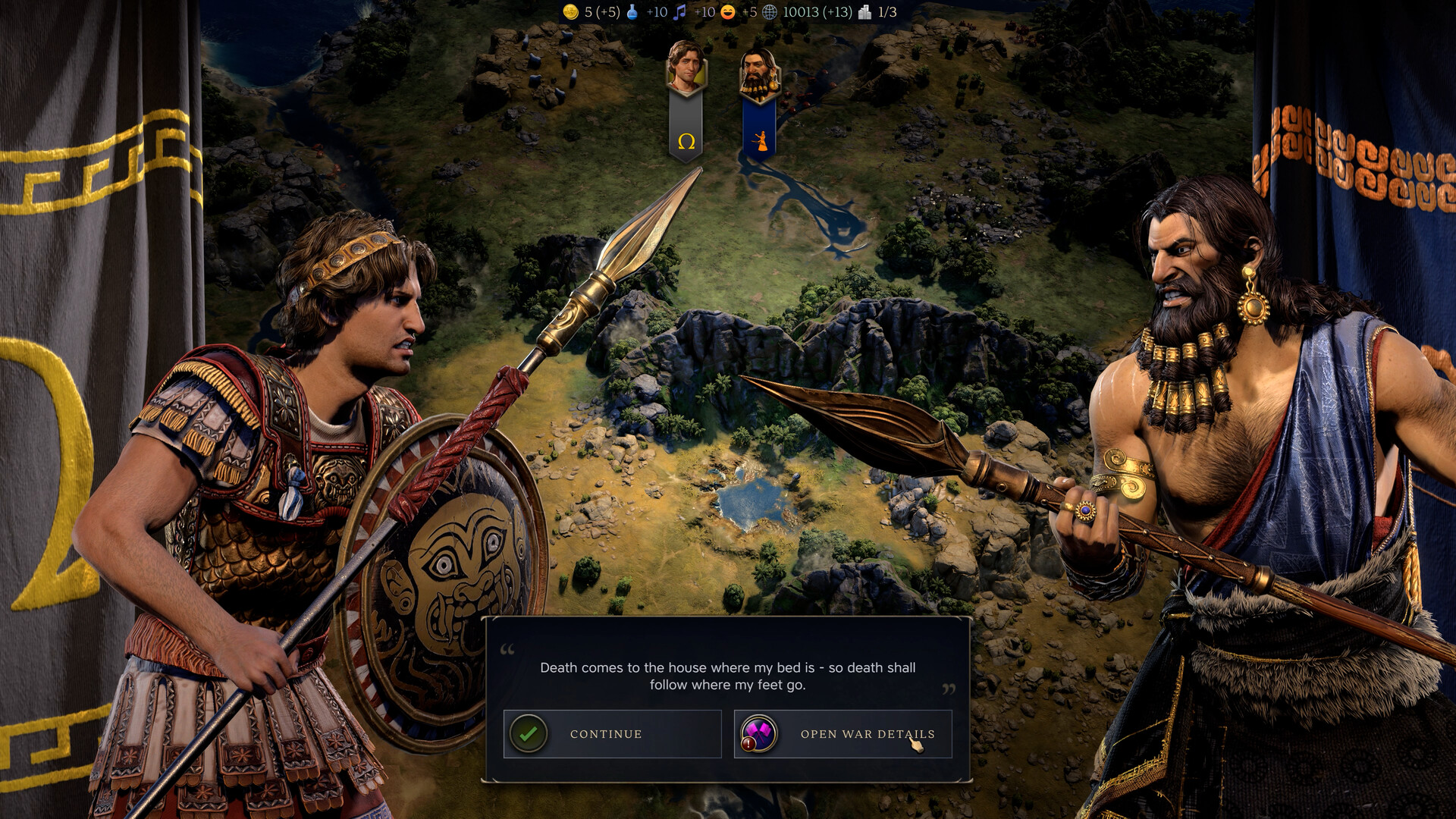
Diplomacy runs on Influence, a resource you accumulate and then spend on actions toward other leaders. War Support and War Weariness decide who pays for a war they did not want, and Influence can be put toward your own position or into conflicts between other empires. Update 1.5.0 added a way to sit a war out: when an ally drags you into a conflict you can pay Influence to stay neutral, and every ten turns on Standard speed you get the choice again, either joining or paying to keep the peace. The one case with no way out is two of your own allies going to war with each other, where neutrality is off the table.
Multiplayer and platforms
Multiplayer uses cross-play between PC and consoles with a linked 2K Account, and a match can be a full multi-Age campaign or a single Age if you want something shorter. Player counts depend on the platform and the Age: up to five in Antiquity and Exploration and up to eight in Modern on PC, Xbox and PlayStation, four and six on Nintendo Switch, and five and eight on Nintendo Switch 2.
Owning DLC is not required to play alongside people who own it, though you do need to own a leader or civilization to play as it yourself. The platform spread has quirks worth knowing before you choose a version. The original Switch handles the smallest map sizes only, while the Switch 2 edition supports the rest. There is no hotseat, though PC supports LAN and Switch supports local wireless. The VR edition has no cross-play and omits the Legends system and the Civilopedia, and the Apple Arcade edition has no cross-play with PC or console and does not receive the DLC sold elsewhere.
Paid content, free updates, and the difference
Free updates go to everyone here. The Test of Time update was free, Update 1.5.0 was free, and Arc of Tomorrow, announced for 2027, is free as well and is set to add a fourth Age. Paid Content Collections add leaders, civilizations, Wonders and cosmetics, and Hall of History arrived alongside 1.5.0 as the first collection released all at once instead of in staged packs. Civilization VII: Earthrise is announced as the game's first paid expansion, with a 2027 window and no firm date.
There are free routes into the roster too. Alexander the Great arrived as a free leader with the Test of Time update, and linking a 2K Account adds Napoleon Bonaparte with his Emperor persona. One caveat if you are playing on an older console: the True Start Location Earth map shipped on Steam, Epic, Mac, PlayStation 5, Xbox Series X|S and Switch 2, and is not available on Switch, PlayStation 4 or Xbox One.
What we actually think
The decision that shapes a campaign is the one you make at each Age transition. Keep your civilization and you spend three Ages deepening one set of abilities, borrowing another civ's Unique Units or Infrastructure through Syncretism when you want a different edge. Change and you collect a new set of bonuses each Age, at the cost of steering a fresh build with whatever the map has given you. Both are supported paths with their own unlocks now, and that is what makes the choice interesting.
The other thing to expect is the volume of small decisions. Three Dedications per Age, a Growth Event every time a settlement fills its food bar, Triumph sets to choose before the game starts if you want them, and a settlement type you can convert for Gold whenever you can afford it. Update 1.5.0 spent its time making those choices more legible, with plot tooltips that call out appeal and whether a tile is part of an island, unit tooltips that surface combat strength and movement, and a Radial Ruler overlay for the map. That is the right direction, because visible yields and unit statistics give you a clearer basis for those decisions.
What we would tell a new player is to turn the tutorials on and treat the first campaign as a tour rather than a test. Pick a Time-Tested civilization if you would rather not change, an evolving one if the transition sounds like the fun part, and settle on a victory route somewhere in the Exploration Age instead of at the start. The interesting question in Civ VII is when to commit, and the game gives you more than one good place to change your mind.
Go deeper with V4mp
- Developer
- Firaxis Games
- Genre
- Turn-based strategy
Explore Sid Meier's Civilization VII further
Explore the wiki for detailed reference pages on the game's world, systems, items and locations.