
About Chivalry 2
Chivalry 2 is a multiplayer medieval first-person slasher about large battles between the Agatha Knights, Mason Order and Tenosian Empire. Choose a class and subclass, then fight through objective-driven sieges, team battles or free-for-all matches using directional melee attacks, blocks, counters and feints.
Chivalry 2 is a multiplayer medieval first-person slasher set in a fictional medieval universe inspired by historical films and television. Its conflict continues the rebellion that began in the first Chivalry: Malric Terrowin’s Mason Order rose against the Agatha Knights, and the sequel takes place two decades later. Agatha’s blue-and-gold knights claim the right to rule, while the red-and-black Masons frame power around strength and dominance. Tenosia, an empire from the south, becomes a third combatant in the conflict. Battles place players among those armies on fields, at city walls and in sieges, where multi-stage objectives carry the battle from one location to the next.
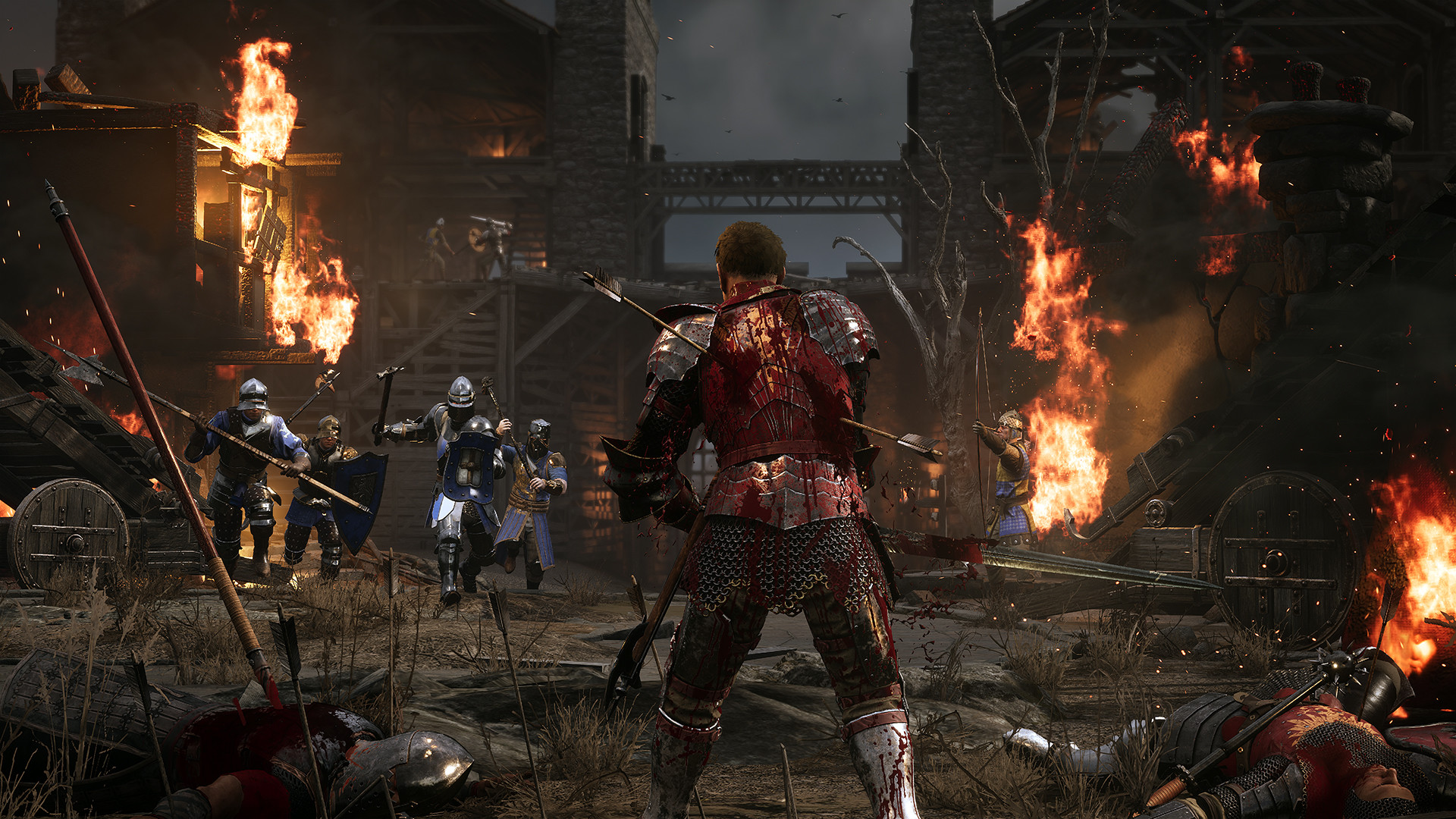
Team Objective is the mode most directly built around that battlefield progression. Attackers and defenders move through a sequence of goals: a force might breach a gate, capture a district, destroy siege equipment or complete another map-specific task, while the opposing side tries to stop the advance. The official maps include castle assaults, forest battles and urban attacks such as the Tenosian assault on Baudwyn’s bulwark, where attackers push siege ramps, seize the market and town hall, then move bombards into position. Other maps ask Masons to damage the port city of Askandir and its library. Team Deathmatch instead measures two sides against each other in a shared battle, while Free-for-All removes the allied team structure. Map stages vary: teams may clear obstacles, capture an area, interact with siege devices and push the battle toward a final objective.
Class choice shapes how a fighter contributes to the press of combat. Knight, Footman, Vanguard and Archer each branch into three subclasses, with different roles and equipment. Knights include the Officer, Guardian and Crusader; Footmen can select the Poleman, Man-at-Arms or Field Engineer; Vanguards choose between Ambusher, Devastator and Raider; and Archers specialize as Longbowman, Crossbowman or Skirmisher. The subclasses distinguish reach, mobility, support or weapon loadout, so the class selection determines more than appearance. Team Objective battles can contain up to 64 players, meaning a player’s role operates within a crowded frontline where allies may be fighting at arm’s length and incoming strikes can arrive from several directions. A class can level separately toward cosmetic unlocks, while the subclass defines a narrower battlefield role; the available mix lets squads combine melee fighters, support and ranged specialists.
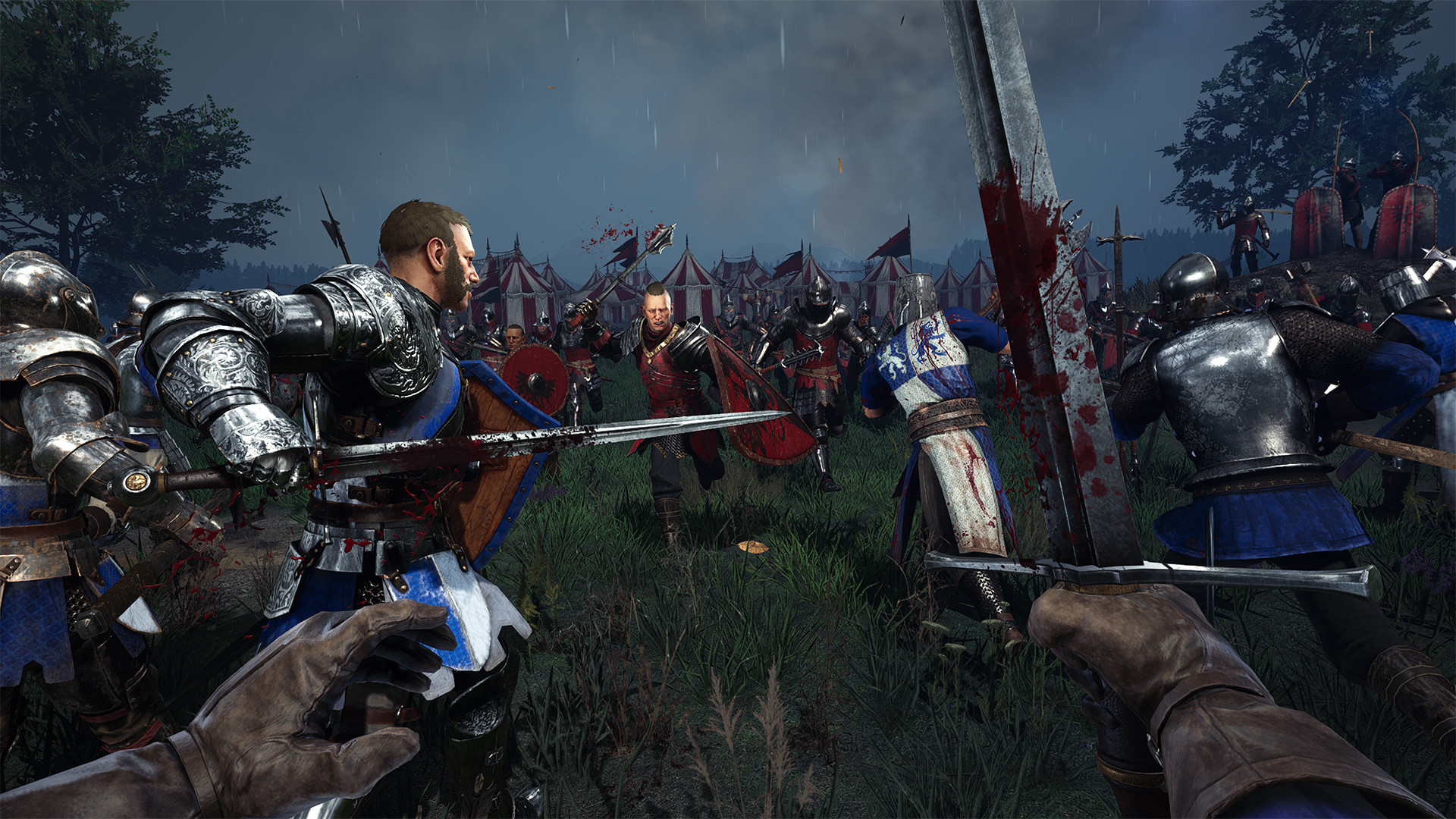
Combat is built around reading attack timing and direction. The basic attacks are slashes, stabs and overheads; each can be held for a heavier strike, and attacks can flow into combos. A defender raises a block to meet an incoming attack, while a riposte begins an attack immediately after a successful block. A counter instead matches the type of strike coming in—such as answering a slash with a slash—to deflect it. Attacks can also be feinted into another attack during their wind-up, changing what the opponent has to read. Movement and aim remain active while weapons swing, allowing a player to adjust the arc and timing of a strike through acceleration or slowing. The battlefield also offers improvised weapons and props: a chicken can be set alight and thrown, and objects such as pitchforks or tomatoes can be picked up in the fight.
Defense also depends on distance and facing. Holding a block drains stamina, so it is not a permanent shield, and an attacker can use a kick to pressure someone who remains guarding. A jab is a quick close-range interruption, while ducking under a swing, leaping into a strike or changing position can alter the exchange; blocking is aimed toward the direction from which an attack is coming. These interactions make a duel a sequence of short decisions about whether to commit, defend, counter, feint or move around an opponent. Defense extends to projectiles: a timed weapon strike can deflect an incoming arrow, while a shield carried on the back can intercept arrows approaching from behind. The damage model also allows a fighter to keep fighting with missing limbs or while downed and gasping their last breath.
Matches also provide room for customization and different scales of play. Alongside the large team modes, Arena resolves smaller fights over rounds, Last Team Standing asks a team to survive until the opposing side is eliminated, Brawl turns combat toward fists and improvised objects, and Volley pits archers against one another. Class levels make cosmetic equipment available for purchase with earnable gold, while premium Crowns can also buy cosmetic items; both currencies are cosmetic-only and do not affect gameplay. Players can select faces, armor appearances and weapon skins. Mounted combat adds another battlefield option. Riders can direct a horse through changing speeds; once it reaches a gallop, it can knock down opponents, while melee strikes gain damage from the horse’s speed. On horse-enabled objective maps, a cavalry wave may provide mounted spawns, and horses can also be found on the battlefield. Riders can use kicks or jabs against nearby opponents while mounted.
- Developer
- Torn Banner Studios
- Genre
- multiplayer first-person slasher