

About Chinatown Detective Agency
In 2037 Singapore, former INTERPOL agent Amira Darma opens a private detective agency as the global economy falters. She accepts cases, travels from Chinatown to international locations, and solves research-driven puzzles while balancing deadlines, travel costs and office expenses. Her clients’ separate problems gradually place her inside a wider political crisis.
Chinatown Detective Agency is a cybernoir point-and-click adventure set in Singapore in 2037, against a decade-long global economic collapse. The city remains a refuge of order, but its government is under strain and everyday stability is not guaranteed. Amira Darma, formerly a rising INTERPOL agent, has left that institution to open a private detective agency in Chinatown. Her first clients bring problems that lead beyond the neighbourhood and eventually connect to a much larger case. The story gives the player a working investigator’s perspective: Amira must find clients, gather information and decide what to do with what she learns, while the agency’s money and time remain limited resources. Singapore is the operational base, but the investigations can take her abroad. The world is built from individual illustrated locations, offices and meeting places reached as a case requires, rather than a seamless city map. This frame connects private detective work with a setting in which public institutions and the economy are weakening. Amira’s role as an ex-cop shapes her dealings with clients, law enforcement and people who operate outside formal authority.
Cases begin through the agency and its clients, whose motives are not always transparent. Amira chooses whom to work for, and cases lead her through conversations with witnesses, suspects, officials and other people connected to the job. The game describes dozens of voiced characters, each with an agenda, so a meeting is not just a neutral exposition stop. A person’s account can point to a lead, while the case may require the player to interpret a reference independently before acting. Singapore’s Chinatown serves as home base between outward trips, and the story also visits cities including London and Shanghai. Each destination has its own rendered scenes, from wet riverside settings to brighter urban districts, rather than a continuous map. Travel links location to investigation: when a case points outside Singapore, Amira must use the flight-booking interface to reach it. The player’s work remains focused on specific meeting scenes, documents and questions. Following the people attached to a client’s problem moves the story across both the city and the wider international network of leads.
The game’s distinctive deduction often takes place outside its interface. A clue may refer to an airport code, a quotation or another fact that the player must research in the real world before entering an answer. This differs from matching an inventory object to a door: the game supplies a prompt and context, while the player looks up the external reference and judges which result fits. An answer can move the case forward, making the player responsible for checking details rather than relying only on an in-game database. Airport codes and mysterious quotations are examples of clues that can require outside checking. Research clues appear alongside traditional adventure interactions such as examining a location and speaking with a character, so external lookup is one part of the investigation rather than the whole game. Other tasks involve code-breaking and small interface challenges, including hacking sequences. A case may move from reading a conversation to interpreting a reference and then acting at a location. Practical research is tied to Amira’s progress, and each answer needs to fit the current case rather than function as trivia without context.
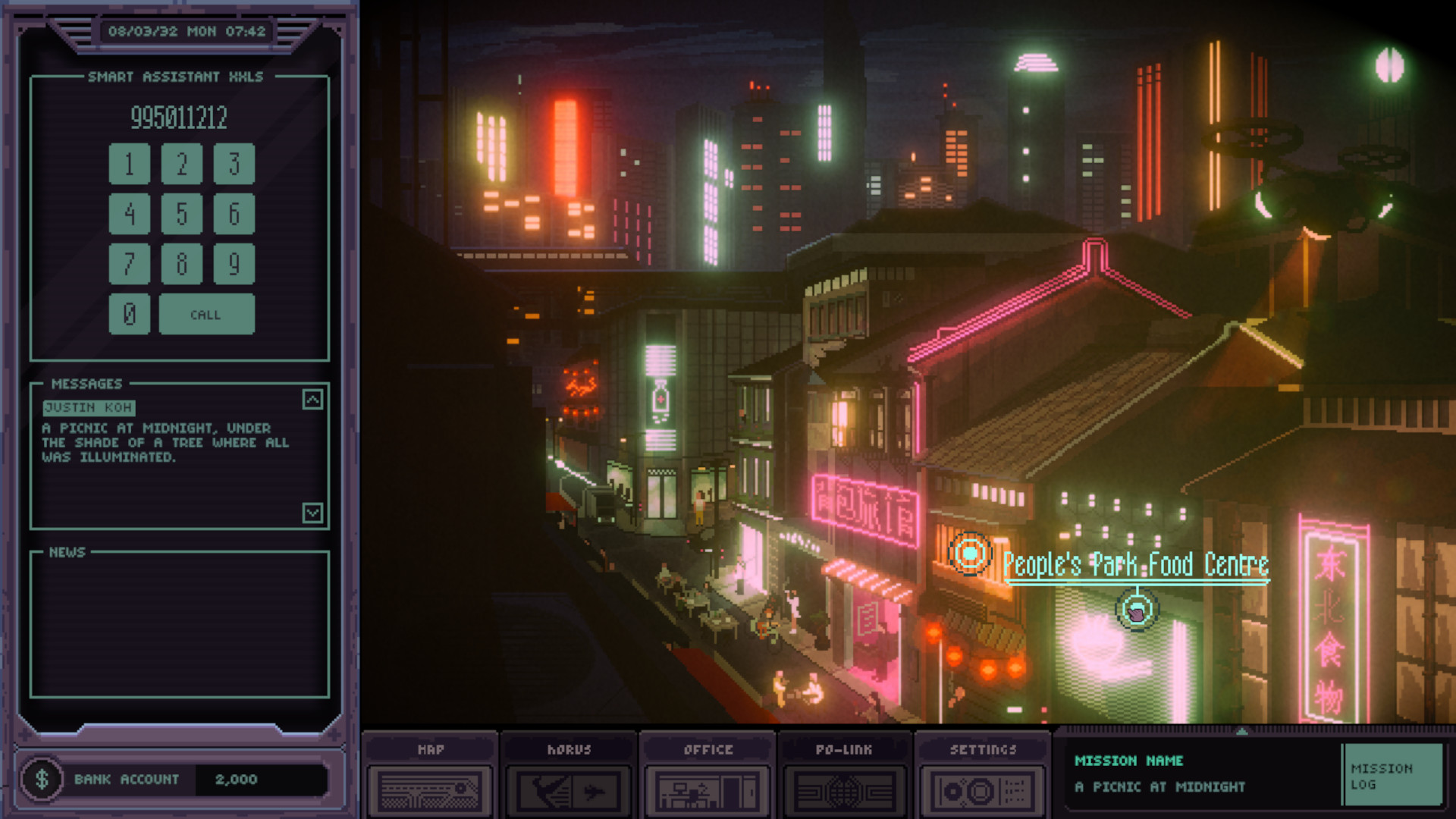
Time and money affect how Amira manages her agency. The game warns that deadlines matter, so a case can be missed if the player delays a scheduled meeting or fails to act before a due point. Travel consumes time and money, and the office has recurring expenses such as rent and utilities. Case payments give Amira income, while flights and other business costs draw on her funds. Using time on an optional hint or a detour may compete with meeting a client or following a lead before it expires. At the office, Amira can use her computer to manage parts of the business and consult Mei, an assistant who offers clues or more direct puzzle help for a fee. This creates a support route with an economic cost, letting the player decide when assistance is worth paying for. The balance between budgets, deadlines and investigation is presented through interface actions and case timing, not detailed staff management. Office and travel tasks sit around the main work of solving client problems, connecting the detective story with the ordinary costs of keeping an independent agency open.
HORUS, the in-game flight-booking system, is how Amira travels outside Singapore. Choosing a location on the itinerary uses money and advances the case schedule. The player must consider whether the next lead calls for travel and whether there is enough time to meet the people involved. Some appointments are relevant at particular points, and failing to arrive by a deadline can have consequences for a case. The world map and booking interface present international movement as part of detective work, while fixed locations contain the point-and-click exploration. At a destination, Amira examines the surroundings and talks to people to learn how a clue applies there. Routes through Singapore, London and Shanghai contrast the home base with other urban settings, and the travel system links them into one campaign. Money connects movement to the agency’s operating costs, since a fare competes with recurring expenses and the help available at home. An answer may identify where to go, and the trip must still fit the case’s timing.
As the campaign develops, Amira’s work branches around a choice of main clients. Taking one client on full-time leads into a distinct storyline and its own investigations, so the player’s choice determines which major branch of cases to pursue. These assignments vary the people, locations and puzzles Amira encounters while preserving the shared framework of field investigation, research and office management. Smaller cases establish the agency’s routines before the larger narrative draws them into a more consequential conflict. Decisions can affect Amira’s story and the world around her, and clients may ask her to operate in morally complicated situations. The point-and-click structure organizes movement between scenes, but progression is not simply a linear sequence of doors: selecting work and keeping appointments shapes which leads are available. In addition to external research puzzles, some scenes use short hacking or aiming interactions. They are discrete tasks within an adventure campaign rather than the foundation for a combat or upgrade system. Progress comes from completing jobs, following leads and choosing which client’s path to continue, with office and travel interfaces supporting that structure.
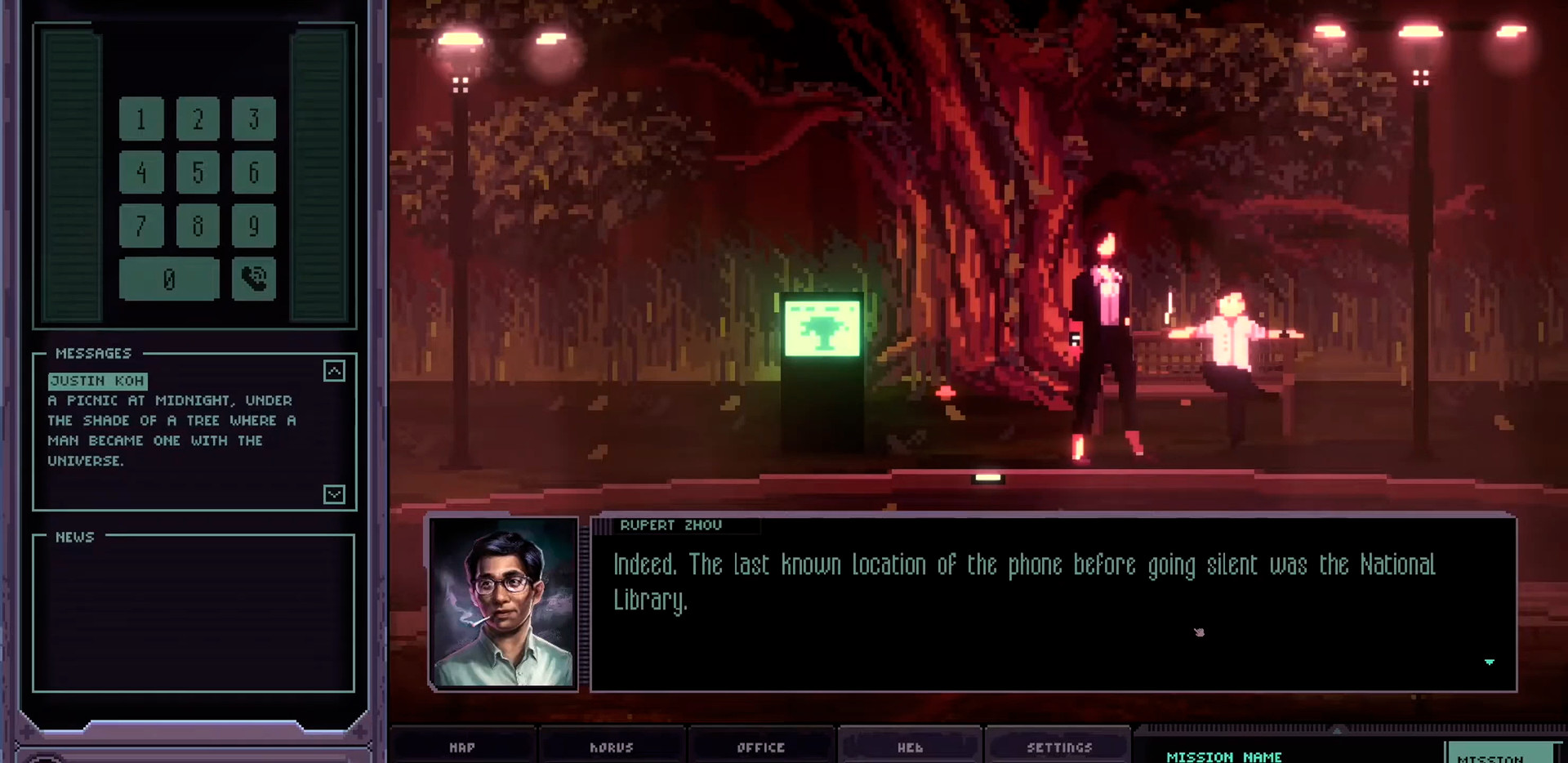
The game pairs pixel-art characters and environments with cybernoir details, including neon reflections, rain and signs of a society under pressure. Artist Ricardo Juchem’s scenes range from Chinatown streets to international locations, using shifts in light, density and architecture to distinguish settings. Characters are voiced, including talent from Singapore, grounding the cast’s speech in the place that anchors the story. The soundtrack includes “A Walk Through Chinatown” and “In the Shade of a Bodhi Tree.” Chinatown Detective Agency was developed by General Interactive Co.; its Steam listing identifies Balor Games and WhisperGames as publishers, while the developer’s site links PC, Xbox and Nintendo Switch editions. Steam lists Windows and macOS. Across editions, the defining loop remains Amira’s casework: accept a client’s problem, question people, interpret clues, research facts when prompted and travel where evidence points. Time, fares and office costs create a practical frame around that work, while separate client branches provide the campaign’s larger progression.
- Developer
- General Interactive Co.
- Genre
- Cybernoir point-and-click adventure