
About Chants of Sennaar
As the Traveler, climb a tower divided among five peoples whose languages and customs have grown apart. Observe conversations, signs and daily life, record glyphs in a notebook, test deductions, and solve environmental puzzles that open routes upward. Translation and careful observation gradually create bridges between communities.
Chants of Sennaar is a single-player puzzle adventure built around the work of understanding people whose words are initially unreadable. The Traveler moves through a vast tower inspired by the myth of Babel, where five Peoples live in separated communities and no longer communicate easily. The tower is both a route through the game and a record of those divisions: each level has its own architecture, visual language, culture and technological character. Rather than opening with a dictionary, the game asks the player to infer meaning from the routines, objects and conversations encountered along the way. A sign above a doorway, a gesture between two residents or a repeated phrase can all become evidence, so progress comes from watching how a society functions as much as from solving a marked puzzle.
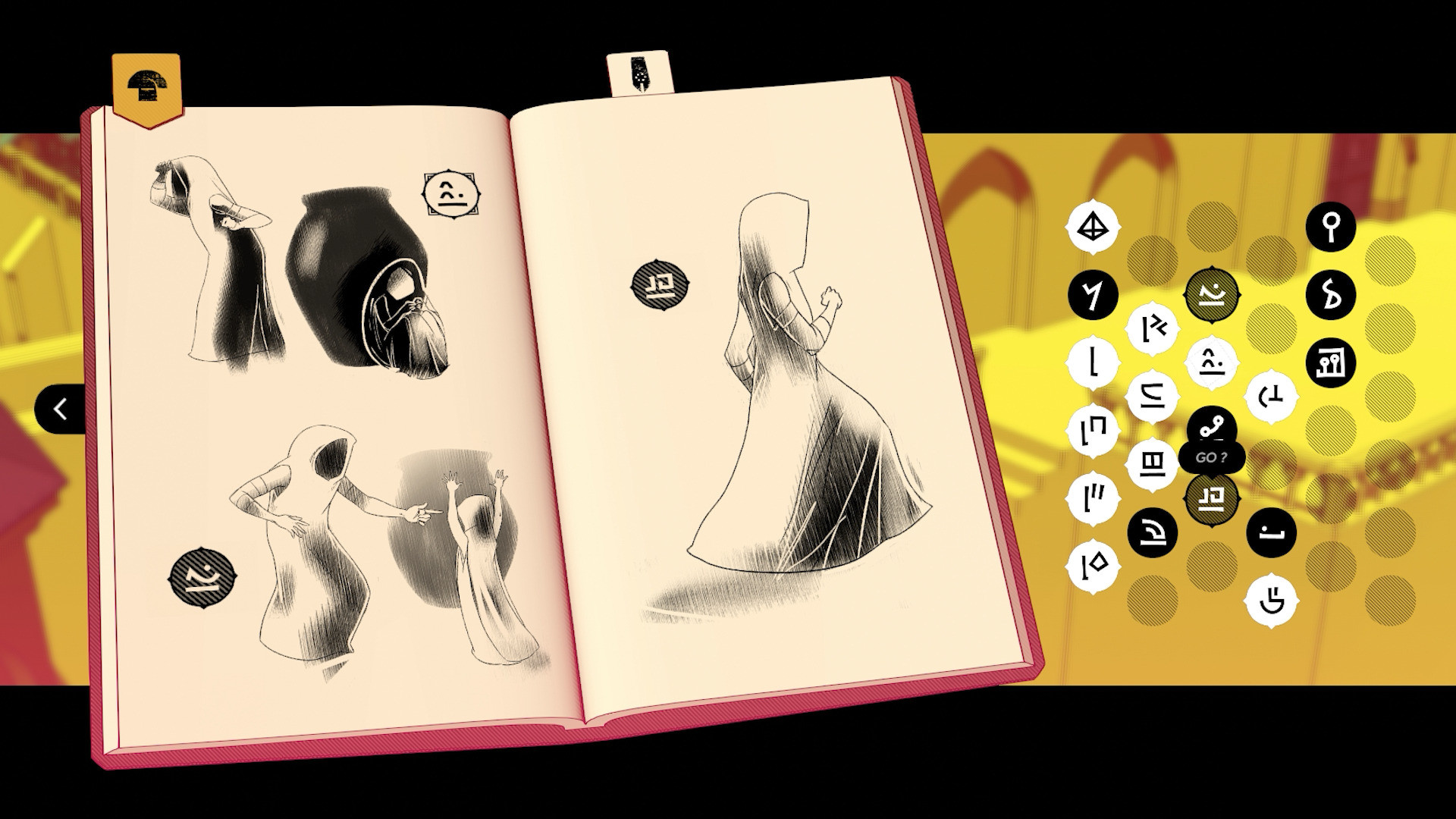
The notebook is the central instrument for turning that evidence into working knowledge. New glyphs are recorded as the Traveler encounters them, and the player can add a tentative meaning or clue without needing to be certain immediately. Those guesses then appear beside glyphs in the world, making it possible to test an interpretation against later signs and exchanges. The game deliberately gives words more than one context: a symbol seen once may remain ambiguous, while its next appearance beside a familiar person, object or action can narrow the possibilities. This makes note-taking active rather than archival. Players compare their own hypotheses with what the people do, revise them when a new scene does not fit, and gradually turn scattered visual clues into a vocabulary that can be used to read the tower.
A language’s words become confirmed through a notebook exercise that asks the player to match glyphs with illustrated meanings. Completing the matching correctly confirms the deductions and lets the notebook translate those words when they appear again. The distinction between a provisional guess and a confirmed reading matters: the Traveler can carry uncertainty forward, but a confirmed glyph becomes a dependable tool for interpreting signs and sentences. Each language also has its own visual and grammatical habits, so a solution learned in one community cannot simply be applied everywhere. Rundisc’s design uses repeated appearances, annotation and sentence translation to give players a way to handle that growing complexity. The notebook records the evidence; the player still has to decide what it means and recognise when the surrounding scene supports the answer.
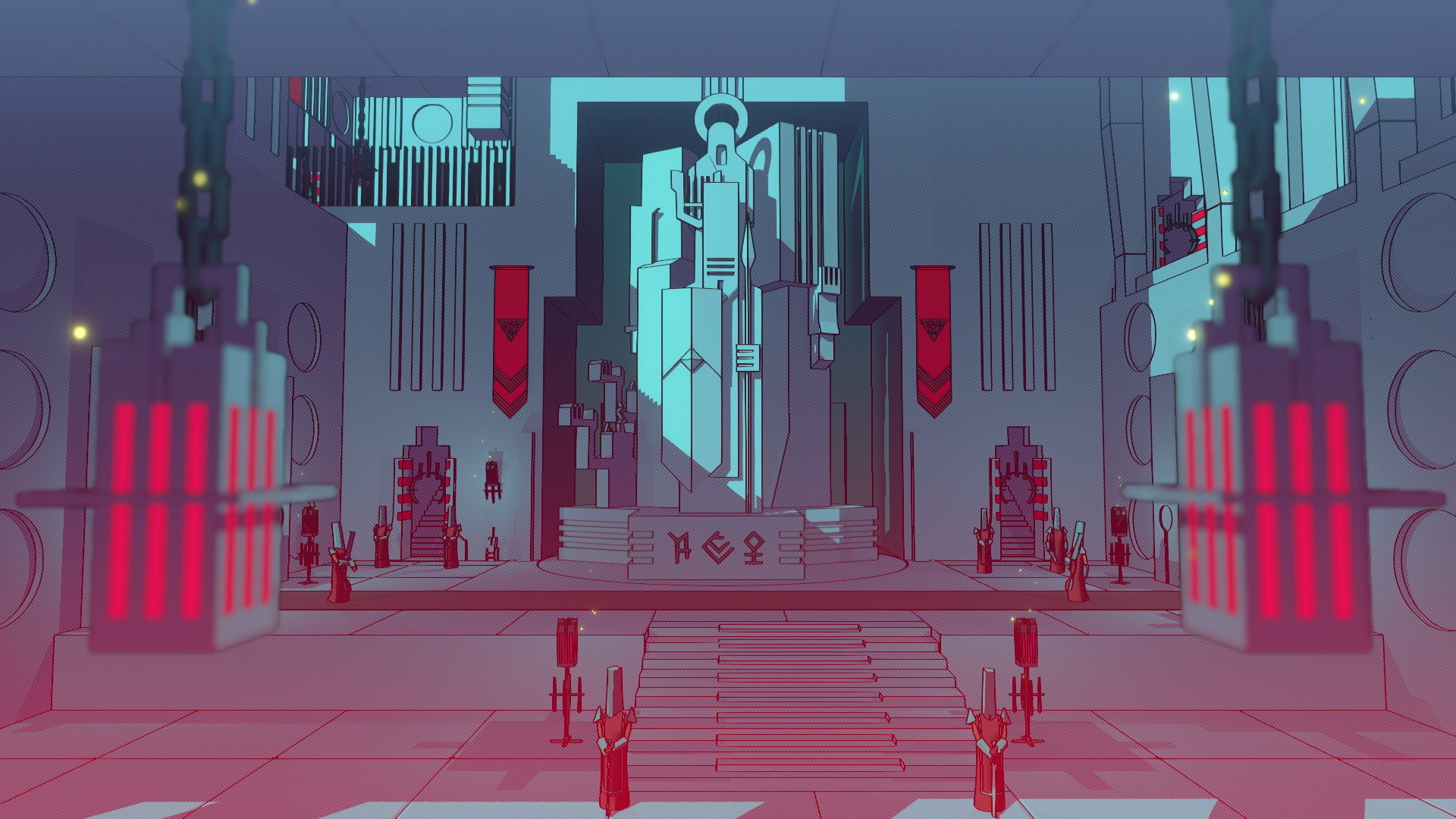
The people of the Tower include the Devotees, Warriors, Bards, Alchemists and Anchorites, each associated with a distinct script and social world. The differences appear in more than the shape of written symbols: clothing, architecture, everyday objects and the way people relate to one another all provide context for unfamiliar speech. The Bards occupy the third floor, while the broader climb moves between communities whose customs are not interchangeable. A word’s use can reveal what a group values or how it regards another people, which means translation also changes the Traveler’s understanding of the social landscape. Conversations are therefore small acts of interpretation. Even before every glyph is clear, facial expressions, repeated exchanges and the placement of objects can indicate what matters in a scene and suggest which assumptions deserve another look.
Language puzzles sit alongside environmental challenges that use the spaces of the Tower as part of their clues. The player explores rooms and corridors, inspects signs and objects, follows visual patterns, and solves obstacles that control access to the next area. Some problems depend on recognising a word or phrase; others ask for observation of the physical environment or a sequence of actions. Stealth sections add moments of moving through guarded spaces without being noticed, changing the immediate task from interpreting a conversation to reading movement and cover. These interludes do not replace the central language work, but they give the climb a varied rhythm and make the Traveler’s physical route matter. Across both kinds of challenge, noticing a repeated detail can be as useful as trying a new answer in the notebook.
The larger progression links successful understanding to restored contact between groups. Learning a word can clarify a sign or instruction, open a route, or make a conversation legible enough to act on; solving those local problems carries the Traveler farther through the tower. At points, knowledge from one community can help interpret a situation involving another, so earlier discoveries remain useful as the journey introduces new scripts. That connection gives translation a practical purpose beyond completing a glossary: it lets the player recognise shared needs and carry meaning across barriers. The Tower’s floors remain distinct, but the notebook gives the Traveler a growing record with which to compare what each group says and does. The goal is not simply to reach the summit by navigating a labyrinth; it is to assemble enough understanding for its separated peoples to meet across their differences.
- Developer
- Rundisc
- Genre
- Single-player puzzle adventure