
About Call of Juarez: Gunslinger
Bounty hunter Silas Greaves recounts his pursuit of notorious outlaws in a series of Wild West tales. Play through his stories as first-person gunfights across mines, towns, trains and frontier country, earning experience for skilled shooting and developing abilities for pistols, rifles or shotguns. His recollections can reshape the action as the tale changes.
Call of Juarez: Gunslinger follows Silas Greaves, an aging bounty hunter who tells the story of his past to listeners in a saloon. The campaign moves through episodes about his encounters with notorious figures of the American West, including Billy the Kid, Pat Garrett, Jesse James, Butch Cassidy and the Sundance Kid. These names and the broad frontier setting draw on Old West history, but Silas is a storyteller who spices up and revises his accounts. The game presents his adventures as tall tales, not as a documentary record of what these historical figures did. When a listener challenges a detail or Silas corrects himself, the scene can change with the narration: a route, encounter or group of enemies may be rewritten in front of the player.
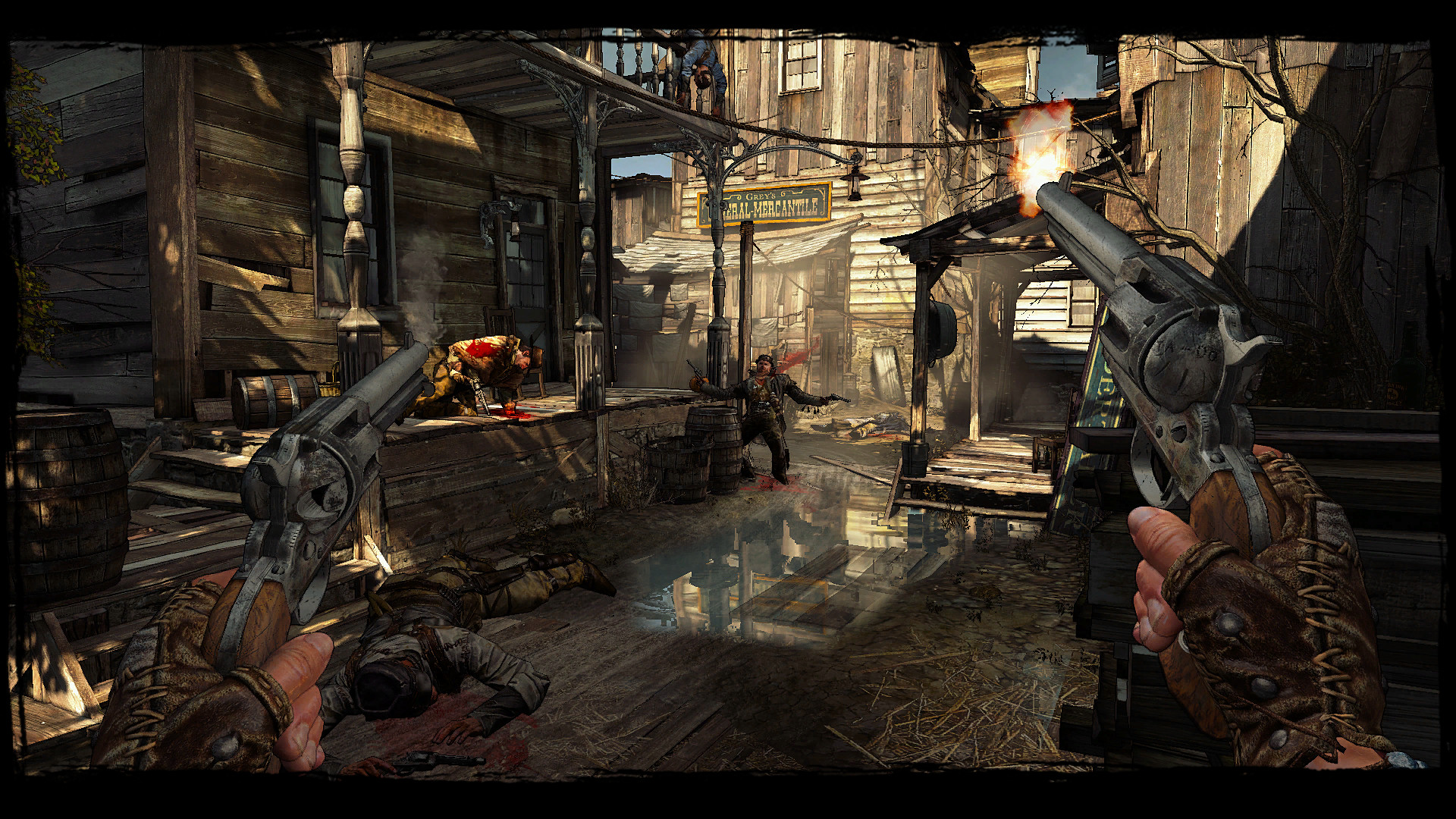
The story is played as a linear first-person shooter, carrying Silas through mines, saloons, towns, forests, caves, trains and other frontier locations. Most of the time the player advances through an area, uses cover and height to locate enemies, and shoots through groups of armed opponents. Revolvers, rifles, shotguns and dynamite give different ranges and effects: a rifle supports deliberate shots across an open lane, a close-range shotgun can clear a tight encounter, and explosive sticks can disrupt several enemies at once. Weapons are picked up or switched as the fights develop, so the player continually chooses whether to hold distance, close in or reposition behind cover. The campaign’s forward momentum comes from moving between authored shootouts and the next part of Silas’s account.
Accurate, fast kills feed the scoring system. Headshots and other skilled shots award more points, while defeating enemies in quick succession builds a combo multiplier. Keeping the chain alive rewards continued movement and target switching; waiting too long or taking cover for an extended pause breaks that run. Stylish kills, such as hitting a fleeing enemy or landing a shot while a target is falling, also award experience. Points earned during story missions convert to experience, which Silas spends on new abilities and improvements. This links the way each fight is played to longer-term character development: the player can invest in stronger weapon handling, faster reloading or abilities that change how shooting works. Three skill paths let that investment favor close-range shotguns, mid-range dual pistols or longer-range rifles. The tracks give experience a clear combat purpose: points from the chapter’s firefights can strengthen the weapon style the player is using, while the other approaches remain available as alternatives. The score-and-experience loop gives optional rewards for precision and pace while the chapter objectives continue to lead toward the next encounter.
Silas’s Concentration meter fuels brief stretches of slow-motion shooting. Activating it makes it easier to pick out and line up several targets while a group is exposed, but the effect is temporary and must be charged again through combat. A separate near-death response can slow an incoming fatal shot and give Silas a chance to dodge it, turning a dangerous hit into a short directional reaction. The player is therefore balancing ordinary aim and movement with a limited window for controlled rapid fire, while watching for attacks that need an immediate dodge. These abilities complement rather than replace cover: exposed positions still invite enemy fire, and a powerful ability is most useful when it creates enough space to keep fighting.
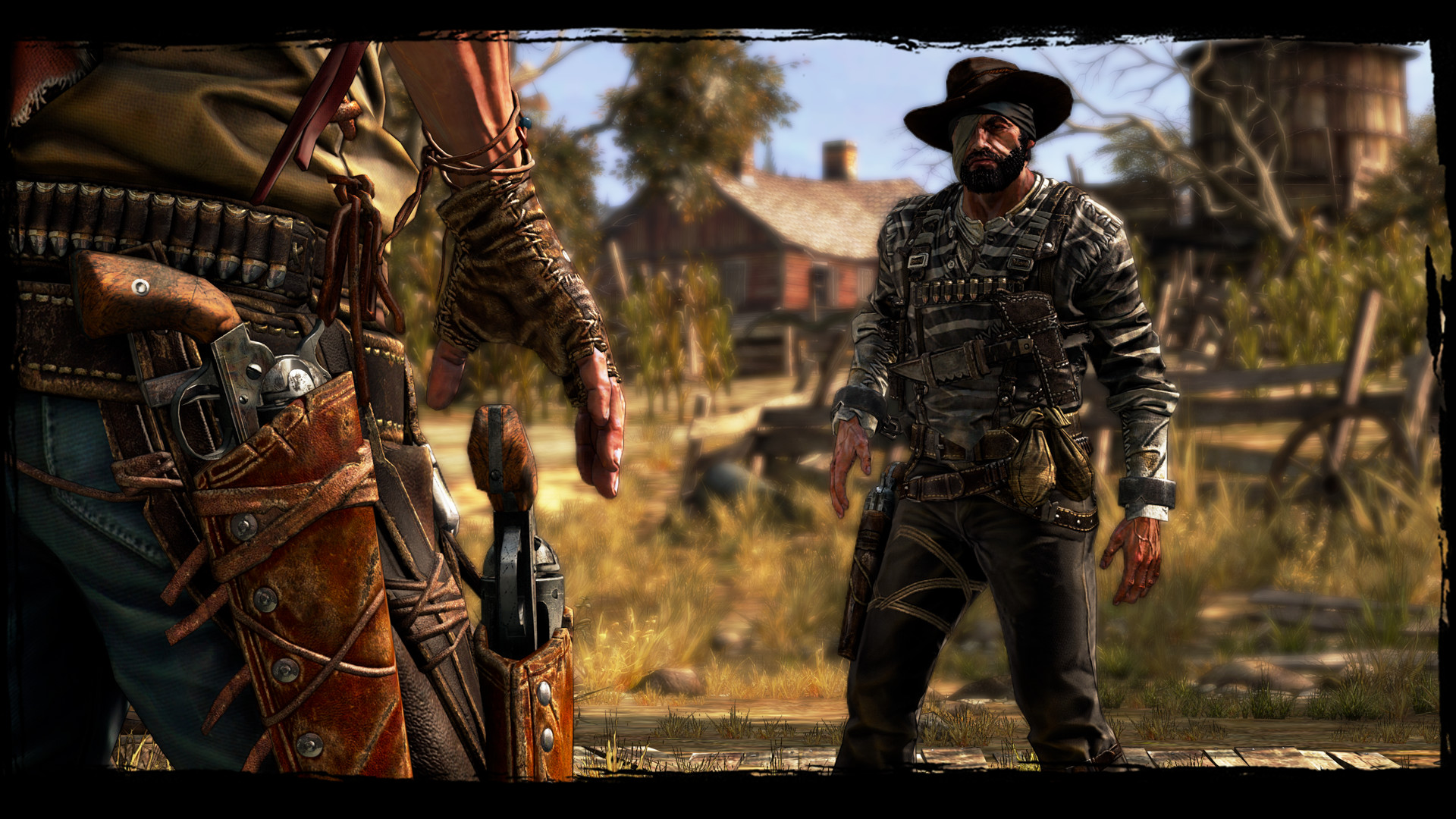
Quick-draw duels provide a distinct encounter between the larger gunfights. Silas and an opponent face each other at close range; the player keeps the rival inside a focus reticle while holding a hand near the holster to prepare a fast draw. Focus and draw readiness pull against one another, so the player tracks the opponent without reaching too early. Once the rival moves, the draw becomes a timing test that ends with a precise shot. These showdowns interrupt the usual rhythm of aiming at several enemies and make one target the center of the scene. The same duel encounters can also be revisited through a separate Duel mode, while Arcade mode strips away much of the story interruption and emphasizes score, combos and successive shootouts.
The tale’s narration is part of the level structure as well as its plot. When Silas corrects an account, the world can visibly revise itself: enemies can appear, disappear or change, and a passage can be replaced by another version of the event. The mechanism makes his point of view unreliable inside the fiction; it does not turn the game’s depictions of real outlaws into historical evidence. As the episodes continue, the player hears Silas shape a personal legend for his audience while the action supplies the changing images behind it. The comic-like presentation reinforces that heightened Western style, with strong outlines and illustrated transitions between scenes. The result is a campaign where the narrator’s memory determines what the player sees next, and where the sequence of frontier battles belongs to Silas’s version of the Old West.
- Developer
- Techland
- Genre
- First-person shooter, action