
About Brotato
After a spaceship from Potato World crashes on an alien planet, Brotato is left alone to survive until rescue. This top-down arena roguelite puts the player in control of the potato’s movement while its weapons fire automatically by default. Short enemy waves are separated by shops where gathered materials become experience and buying power.
Brotato begins with a crash that leaves its title character, the sole surviving potato from Potato World, stranded on an alien world and waiting for rescue. The premise gives the action a simple objective: endure the hostile planet’s attacks for long enough to be found. Each attempt places one potato-shaped fighter in a compact arena and sends alien enemies in from around the field. The top-down, wave-based action roguelite centers each run on positioning, weapon coverage and the choices made between attacks. The standard control scheme separates movement from firing: weapons shoot automatically, while the player steers around enemies and incoming projectiles. A manual-aim option can be enabled in the settings for players who want to direct attacks themselves.
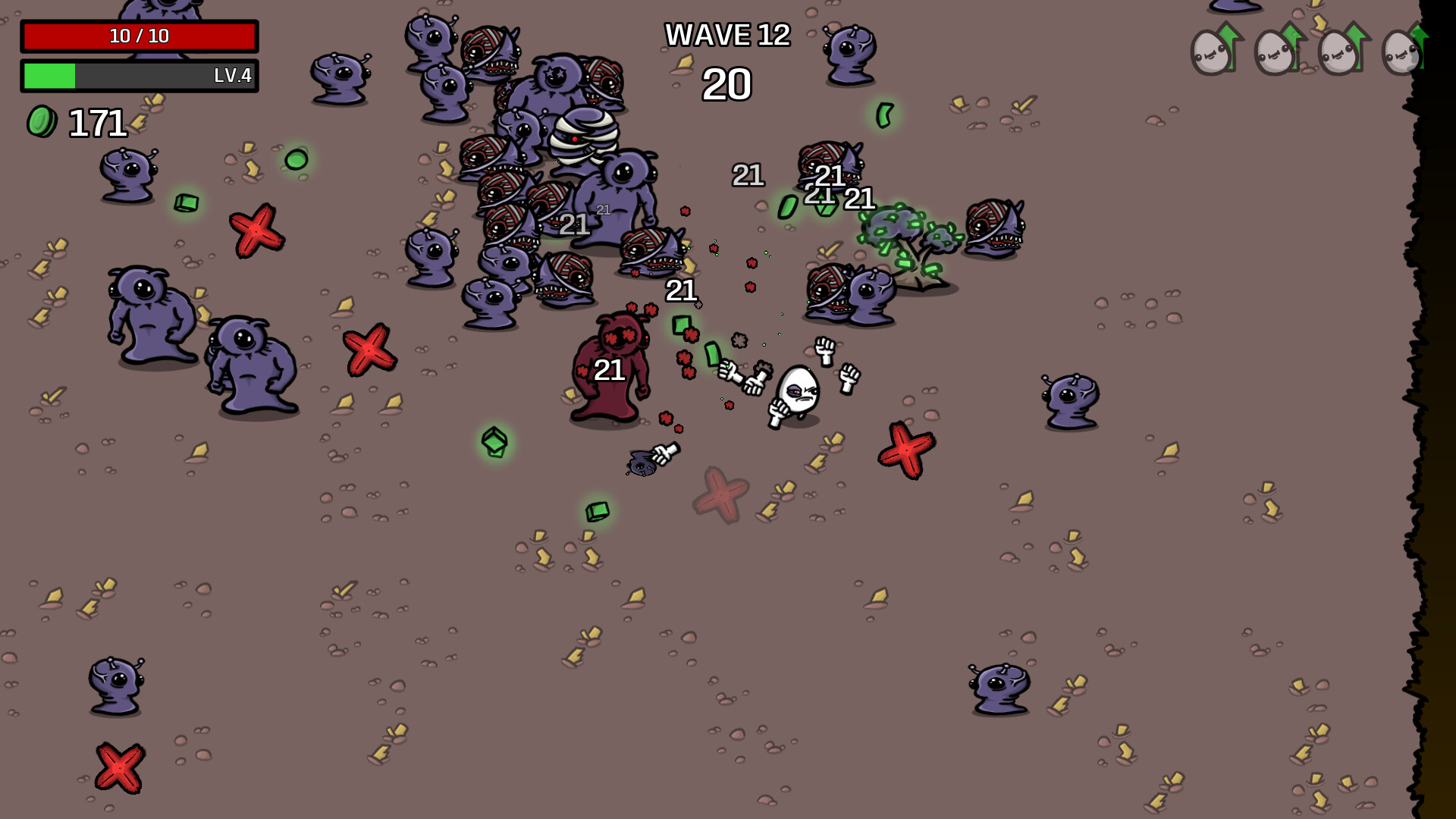
Each wave is a timed survival encounter, lasting between 20 and 90 seconds according to the Steam description. Enemies continue to arrive while the timer runs, so staying alive and collecting what they leave behind are linked tasks. The arena stays small enough that movement matters constantly: circling a crowd can create space, while a corner or a dense group can limit escape routes. The default auto-fire system takes aiming out of the moment-to-moment routine, leaving the player to read the swarm, steer through gaps and move toward useful drops. Different weapons cover different patterns and distances, so a loadout may clear nearby threats in another way from enemies farther away. The optional manual-aim setting changes who chooses the target; it does not remove the need to move through the arena. Between waves, the game pauses the pressure and shifts attention to the next set of decisions.
Defeated enemies drop green materials that serve two purposes: collecting them provides experience and also builds the funds used in the shop. A wave therefore asks the player to balance the danger of approaching drops against the value of leaving the arena stronger. The shop opens between waves, offering weapons and items to buy for the run. If an offer looks useful but the current material total is short, it can be locked so that it remains available through a reroll or the return from the next wave. Rerolling changes the other choices, making the break a small planning phase rather than a fixed reward screen. The store’s mix is not a predetermined upgrade path; the player selects from the options that appear and shapes a build around what is affordable and what the chosen character can use well.
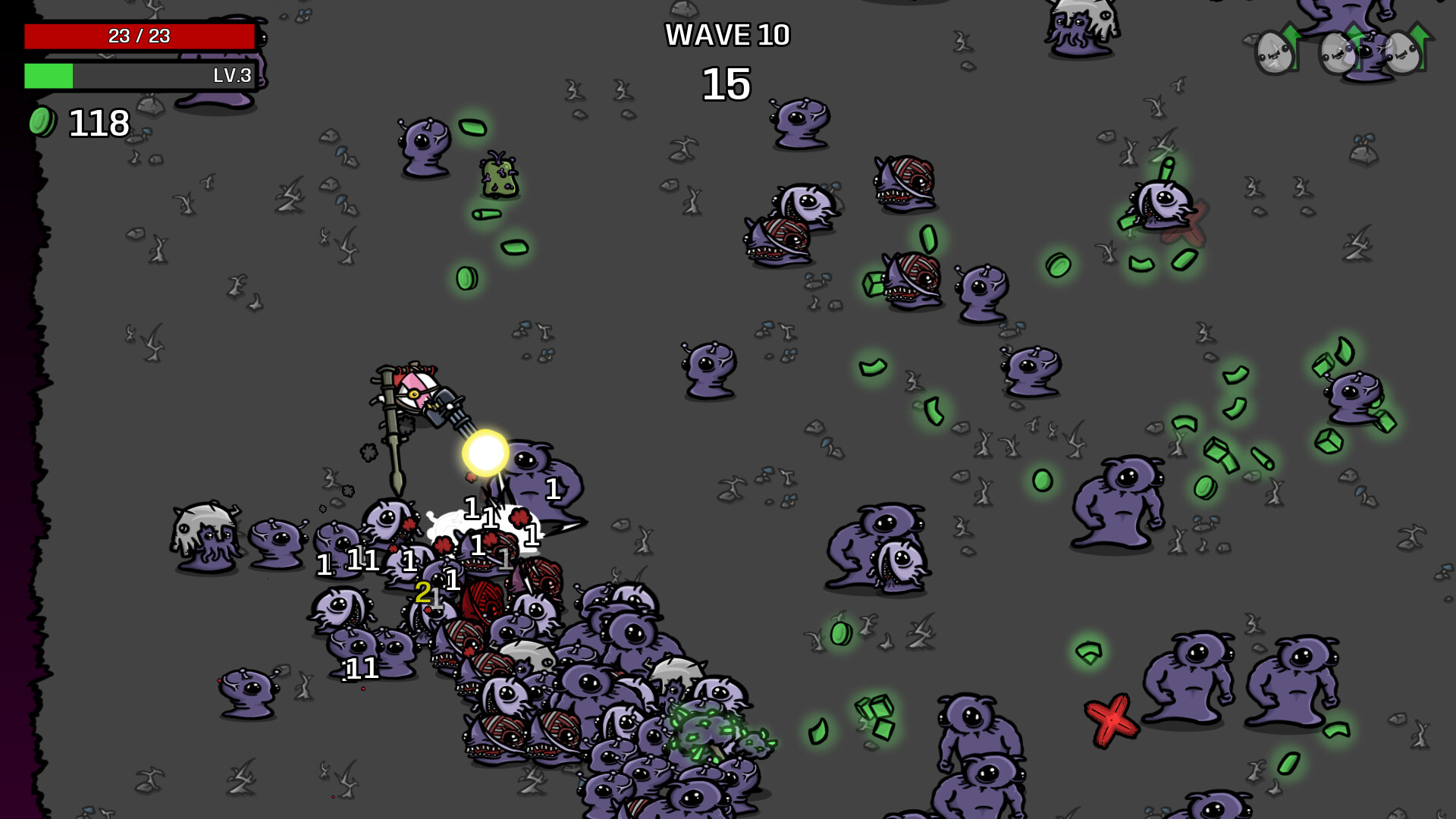
A Brotato can carry as many as six weapons at once, and the weapon selection determines how attacks cover the arena. The available examples range from sticks and stones to flamethrowers, submachine guns and rocket launchers, so a run can lean toward close-range, ranged or mixed damage. Weapons of the same type can be combined into a higher tier, trading two copies for a more developed one; weapons that no longer fit can be recycled for materials to spend elsewhere. That makes inventory management part of the shop loop: holding duplicate weapons can strengthen a line, while replacing a weak fit can free resources for another need. Level-ups and purchased items can improve statistics such as melee damage, ranged damage and range, allowing the armory and its supporting attributes to develop together. Because the same resources can support either attack or survival, each purchase involves a trade-off within a limited run budget.
The selectable characters, called potatoes or Brotatoes, give each run a different starting shape. The Steam listing names archetypes such as One-Armed, Crazy, Lucky and Mage, alongside dozens of other characters; their distinctive traits change which weapons or statistics are natural priorities. Some make a particular approach easier to develop, while others impose a restriction or turn one part of survival into a sharper problem. Character choice is therefore a mechanical decision, not just a change in appearance. Across repeated runs, additional characters can be unlocked, expanding the set of starting conditions for later attempts. Each run still builds its own combination of weapons, items and improved attributes from the shop and level-ups encountered along the way. A character’s starting advantages and limitations interact with those random offers, so the same set of purchases does not make every potato behave alike.
The main structure is designed for quick attempts, with the Steam listing describing runs as lasting under 30 minutes and individual waves as short bursts. The normal run can be played alone or in local cooperative play for up to four players, where the same arena survival premise becomes a shared fight. Difficulty options also let players adjust enemy health, damage and speed, changing the pressure without replacing the basic wave-and-shop rhythm. These settings sit alongside a range of characters and hundreds of items and weapons, giving the game multiple ways to vary an attempt while keeping its central space compact. Rather than a campaign of missions and locations, progression comes through improving a build during each run and opening more character choices across attempts. The run tests whether the developed build can withstand the aliens’ increasingly difficult attacks, with weapon and stat choices determining how well the setup holds together.
- Developer
- Blobfish
- Genre
- Top-down arena action roguelite