
About Bravely Default II
Sailor Seth is drawn into a journey across Excillant after meeting Gloria, the displaced princess of Musa. With scholar Elvis and mercenary Adelle, he seeks the stolen elemental Crystals. Turn-based battles revolve around spending or saving Brave Points, while Asterisks let the four heroes build flexible job combinations.
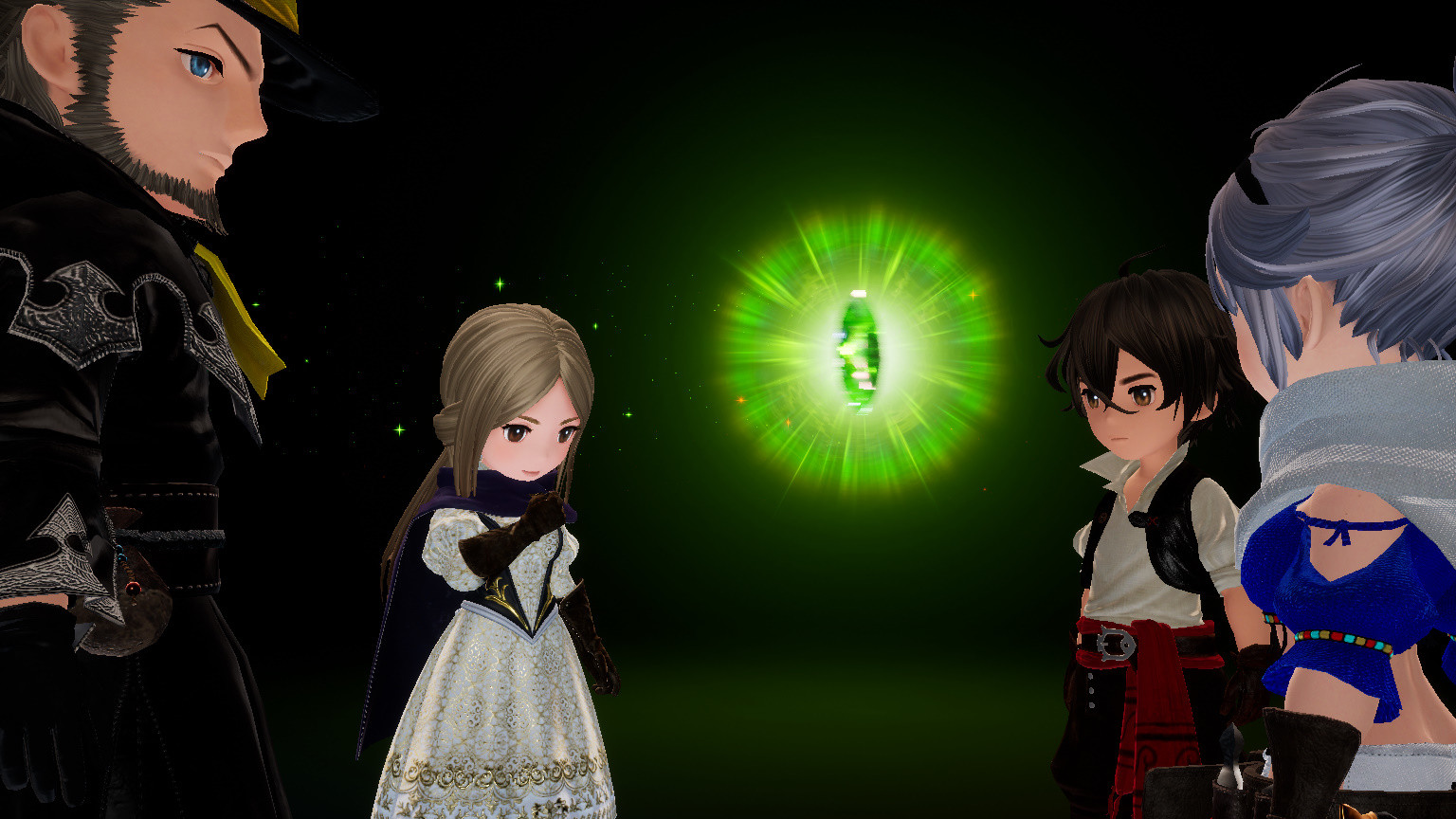
Bravely Default II introduces a new cast and a new setting for the series: the continent of Excillant, where the elemental Crystals are tied to the balance of the natural world. Sailor Seth is washed ashore in the kingdom of Halcyonia and meets Gloria, the princess of Musa, whose homeland was destroyed after its Crystals were taken. Their journey brings them together with Elvis, a travelling scholar trying to decipher the last spellbook left by his teacher, and Adelle, the mercenary who serves as his bodyguard. Each has a separate reason to travel: Gloria wants to recover Musa's Crystals, Elvis is pursuing Asterisks connected to his research, and Adelle accompanies him as a professional and personal ally. The four become the new Heroes of Light and travel through Excillant as natural disasters and disorder threaten its people. The central quest gives the party two intertwined tasks: trace the Crystals through the continent's kingdoms and confront the Asterisk holders whose powers stand in their way. The story uses a self-contained group and world, so its conflict can be followed without relying on earlier Bravely Default characters.
Excillant is explored through an overworld where monsters appear directly on the route rather than only through unseen encounters. The player can decide whether to approach a foe or continue past it, but stronger enemies may pursue the party; if one catches the heroes from behind, it begins battle with an advantage. That makes the angle of approach a practical consideration while moving between a town, a field and a dungeon. When the next objective is unclear, a yellow marker on the world map points toward the current story destination, while detours can lead to town conversations, side quests and additional rewards. Dungeons add enclosed paths with enemies and treasure chests, and their floors may require the party to manage equipment and healing before a boss. The rhythm of exploration therefore alternates between choosing engagements on the field, navigating a contained dungeon and returning to settlements to talk with inhabitants or prepare. The player can pursue the central Crystal route while also deciding when to stop for optional tasks or additional encounters that help the party develop.
Towns contain a second activity alongside their role as places to resupply and speak with residents: B 'n' D, a tactical card game played with characters marked by a card icon. Each round is a contest for territory on a small board, with the player and opponent placing cards to claim spaces and disrupt one another's control. Winning can add the opponent's cards to the collection, which is tracked in a binder. This makes a conversation in town capable of leading to a distinct, turn-based contest rather than another monster battle. The broader journey also includes optional errands from residents, sending the party to find an item, visit a location or defeat a foe; some side activities lead to a dungeon or an optional boss. Between these diversions, the game's map provides a clear marker for returning to the main objective. B 'n' D supplies a rules-driven change of pace, while quests encourage the player to revisit the explored routes and make contact with people outside the four-person party. Both activities sit alongside the Crystal journey without replacing its main turn-based battles.
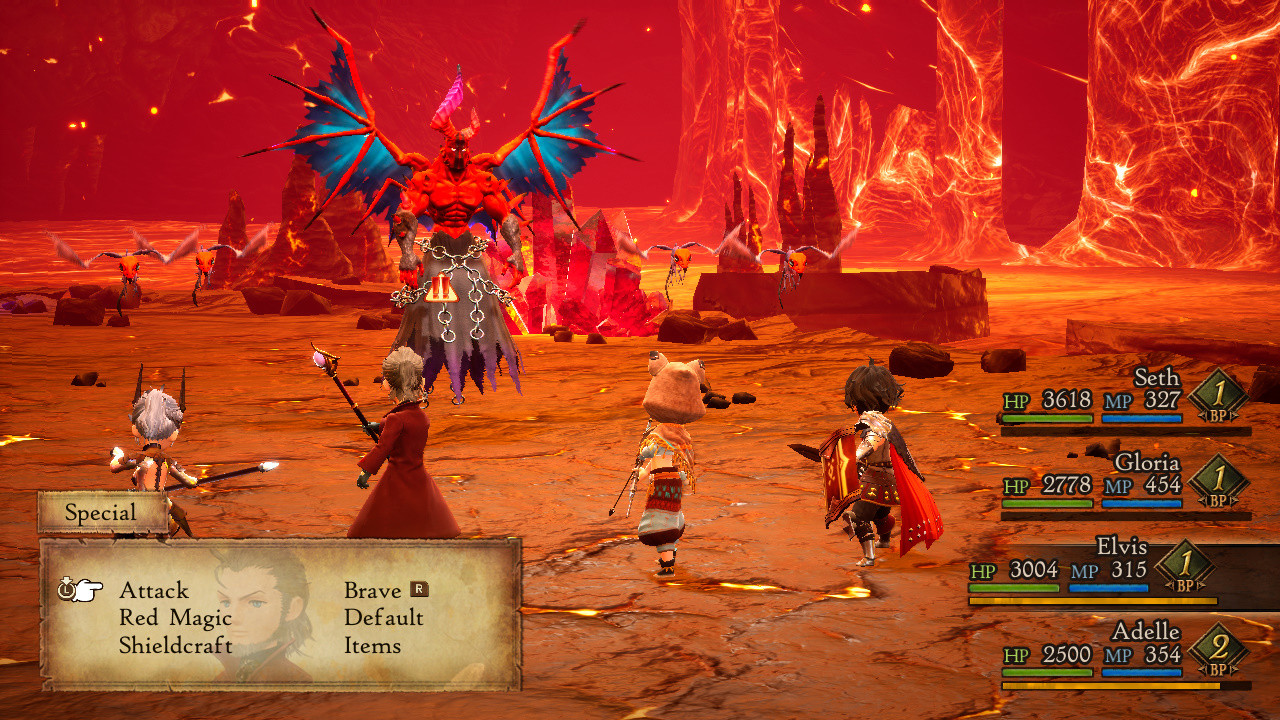
Combat uses individual turn-based commands, with Brave Points determining how many actions a character can take. A character normally receives one action when their turn comes around. Choosing Default puts that turn toward defense and stores BP, up to three additional points, for later. Choosing Brave spends BP to add actions immediately, with up to four actions available in a single turn; a character can also borrow against future turns by taking their BP below zero, then must wait for it to return before acting again. This creates a timing decision for every hero: hold a defensive turn to build resources, or spend stored BP for a burst of attacks, healing or support. Enemies also use the same system, so a party that empties its reserves at the wrong moment may be exposed while it recovers. The rhythm of turns is affected by character speed, equipment weight and status conditions, which makes the timing display useful when deciding whether to spend BP or preserve a guard. Stronger opponents often require the party to observe their responses and adjust the order of attacks rather than repeating one pattern. The system's name describes its central choice, but its practical effect is to make turn economy, defense and burst damage inseparable parts of the same strategy.
Asterisks unlock the jobs that shape each hero's role. Defeating an Asterisk bearer lets the party claim that job and use its abilities; examples include the Freelancer, Black Mage, White Mage, Monk and Vanguard. Each character can equip a Main Job and a Sub Job, combining abilities from two classes at once. A mage can pair offensive and restorative magic, while another hero might combine a defensive role with theft or physical attacks. Jobs gain experience through use and provide increasingly useful benefits as a character develops them. Active abilities from a job can be selected in battle, while learned passive abilities can be equipped alongside a different current job, allowing a build to retain useful effects after changing roles. This creates a long-term progression loop: win battles to improve jobs, acquire a new Asterisk from an important foe, then reconfigure the party to meet the next challenge. Equipment, weapon proficiencies and job abilities also interact, so changing class can affect a character's statistics and what arms they can use effectively. The party is not locked into fixed character classes; experimentation with job pairs is a main way to tailor offense, defense, healing and support around the boss or enemy group ahead. Because each hero can combine two job sets, the same four-person party can shift from a durable formation to a more aggressive one as the next enemy demands.
Equipment selection gives the job system a practical layer between battles. Weapons and armour come from shops, enemies and dungeon chests, and the party can compare their properties before committing to a setup. A weapon's elemental affinity matters against foes that resist or are vulnerable to particular elements, so the highest displayed attack value is not always the most useful choice for a boss. Job assignments also affect the characters' appearance in battle: each role supplies its own outfit, while weapons are visible in attack animations. Special attacks have dedicated music and can grant temporary benefits to the party, making them a resource to time around a difficult encounter. Turn order also responds to a character's speed, equipment weight and status conditions, so changing armour or accessories can affect when a hero acts as well as how much damage they take. The player can use automatic equipment selection as a starting point or choose manually when a specific enemy calls for a different weapon or defensive balance. These preparations happen alongside job and subjob changes, turning the menu phase into a final tactical adjustment before the next fight. For repeated encounters, the player can raise battle speed as high as four times normal; the ultimate-ability animations retain their full sequence. These presentation controls affect how the fights are read and paced without changing the BP decisions underneath.
- Developer
- Claytechworks
- Genre
- Turn-based role-playing game