
About Bound by Flame
Bound by Flame follows Vulcan, a mercenary possessed by a fire demon during a war against the seven Ice Lords and their Dead-Army. Fight across Vertiel with switchable weapon styles, pyromancy, traps and companions, while developing three combat trees and choosing whether to resist or embrace the power claiming Vulcan’s humanity.
In Bound by Flame, Vulcan is a mercenary drawn into a desperate struggle against seven Ice Lords and the Dead-Army that is ravaging Vertiel. A failed ritual leaves a flame demon sharing the hero’s body, giving Vulcan a source of power as the undead advance and changing the terms of the campaign. The world is a grim fantasy setting where human groups face a supernatural invasion, and the player moves through its threatened settlements and battle zones alongside companions. The central conflict has both an outward and inward direction: Vulcan must take on the forces spreading across Vertiel while deciding how much influence the demon may exert. The journey follows this pressure between survival and humanity, with the Ice Lords providing the larger threat and the demon shaping how the protagonist develops. The campaign is an action RPG built around real-time encounters, character growth and choices.
The demon is woven into Vulcan’s abilities and appearance rather than being only a voice in the story. Choices can express resistance or acceptance of the power, and greater demonic influence is reflected in increasingly altered features. That development has a mechanical cost and benefit: embracing the entity strengthens access to fire magic, while the transformation can affect protective equipment such as helmets and armour. Vulcan’s appearance changes from ashen skin and glowing eyes to horns and cracked, burning flesh as the demon gains influence. The story includes decisions beyond the inner demon, but its defining player-facing question is whether to draw on the source of strength at the cost of remaining fully human. The game keeps that choice attached to a visible character arc, so progression changes what Vulcan can do and how the hero looks as the war continues.
Fights are real-time and tactical, with Vulcan able to switch quickly between Warrior and Ranger stances as enemy positions change. The Warrior style uses two-handed weapons such as swords, axes and hammers for heavier strikes and breaking an opponent’s defence. Ranger combat uses paired daggers for faster attacks and stealth approaches, with a crossbow and traps adding ways to prepare for or interrupt an engagement. The player can block, parry and dodge, then use openings to attack rather than treating every encounter as a simple exchange of blows. Pyromancy supplies a third layer: fireballs, flame-enhanced weapons and other demonic spells give Vulcan ranged and area options. Foes vary in behaviour, including enemies that use poison, long-range attacks or heavy melee pressure, so stance, spacing and timing all influence how an encounter unfolds.
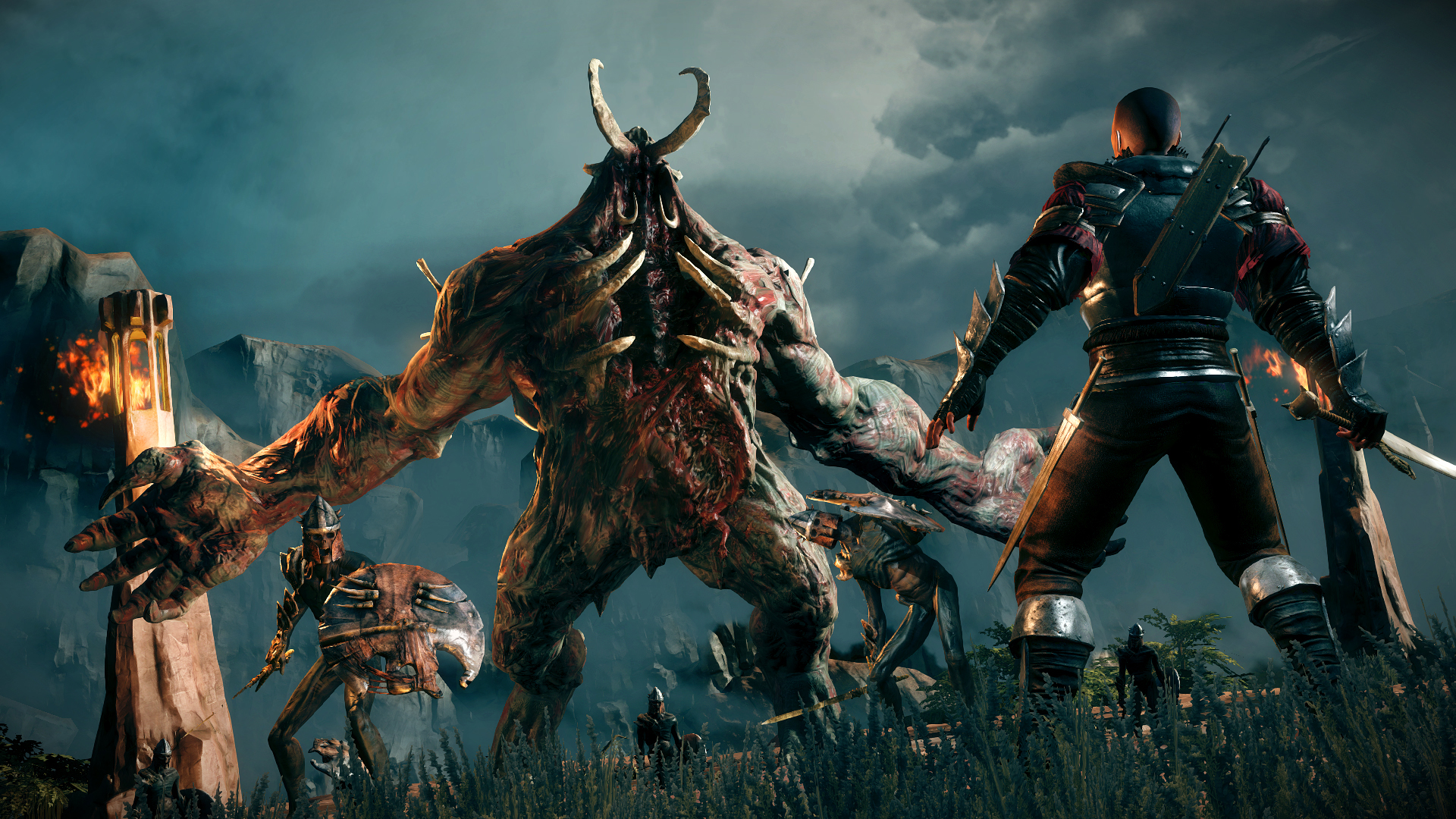
Character growth is organized around three skill trees: Warrior, Ranger and Pyromancer. The first develops heavy-weapon fighting, the second supports daggers and stealth, and the third expands the demon’s fire abilities. Vulcan is not locked into one class, so points can be spent across the available approaches to build a mixed combat style. The relationship between these trees and the demon choice lets progression carry a thematic trade-off as well as a tactical one: stronger access to pyromancy comes from accepting more of the power that is changing the hero. Equipment customization adds another layer. Weapons and much of the armour can be upgraded with crafted components that alter performance and add bonuses; a sword pommel, for example, may improve damage while slowing attacks. Materials and components therefore invite a choice between different combat properties rather than a single automatic upgrade path.
Companions fight beside Vulcan, with one party member accompanying him at a time. Their roles include a defensive healer, a tank, an aggressive sorcerer and an elusive archer. The player chooses among these kinds of support before a fight: a healer focuses on recovery, a tank draws enemy pressure, and the sorcerer or archer contributes offence through different attacks. Vulcan performs the attacks and defence directly, switching between Warrior and Ranger stances, casting pyromancy, blocking, parrying or dodging while the companion supports him in real-time encounters. Sybil, a scholar, is among the party members, alongside a mage, an undead ally and a knight. The companions react to Vulcan’s decisions about embracing or resisting the demon; some question whether he remains in control. Their responses give the demon choice a visible effect on the people fighting with Vulcan, as his appearance and fire abilities also change with the possession.
Sybil’s scholarly role leads to a specific campaign task: later, Vulcan accompanies her to collect three books. The objective has the player find those volumes and hear Sybil relate information tied to them, making knowledge gathering a clear action alongside the battles. Each companion also has a personal story the player can hear by asking Vulcan to speak with them. Those conversations add character background while the party is travelling through the war against the Dead-Army; they can be revisited when the player wants to learn more about the recruited allies. The book task gives Sybil a concrete reason to travel with Vulcan and connects her interest in scholarship to the campaign’s movement through Vertiel.
- Developer
- Spiders
- Genre
- Action RPG