
About Borderlands: The Pre-Sequel
Set between Borderlands and Borderlands 2, Borderlands: The Pre-Sequel follows a group of Vault Hunters on Pandora’s moon, Elpis, as they become entangled in Handsome Jack’s struggle against the Lost Legion. Its first-person shooting and loot-driven character building take place in low gravity, where oxygen gear powers both survival and movement.
Borderlands: The Pre-Sequel shifts the series’ shoot-and-loot action from Pandora to Elpis, a moon where open space and damaged facilities make oxygen part of ordinary combat. Framed as a story told by Athena, one of the Vault Hunters, the campaign looks back at events between the first Borderlands and Borderlands 2. The expedition begins in the aftermath of a Lost Legion attack on the Hyperion station Helios. As the group works with Handsome Jack, missions draw the player through lunar settlements, industrial installations and exposed terrain while the account traces how Jack’s position changes. The setup supplies context for the later game without requiring the campaign to retell Borderlands 2’s central conflict. Athena’s account keeps the focus on the Hunters’ changing relationship with Jack as they pursue the Lost Legion.
The player chooses one of four base-game Vault Hunters, each with a distinct action skill and three skill trees to develop: Athena, Wilhelm, Nisha, or Claptrap. Athena’s Kinetic Aspis absorbs damage from the front and stores energy before she throws it toward enemies. Wilhelm deploys two drones: Wolf attacks while Saint supports him with health recovery. Nisha’s Showdown rapidly targets opponents, and Claptrap’s VaultHunter.EXE selects a temporary combat routine when activated. Experience from missions and combat raises levels, grants skill points and opens deeper branches of the trees. Class mods and equipment can reinforce a selected direction, while each tree’s tier gates require sustained investment rather than allowing every ability at once. That makes the four Hunters mechanically distinct, whether a player wants Athena to hold a line, Wilhelm to use his drones, Nisha to clear targets quickly or Claptrap to work with a changing action program.
Elpis’s low gravity changes movement as well as the view. An Oz Kit supplies oxygen in vacuum and can spend that reserve to extend jumps; holding the slam input in the air drives the character down into an area attack. Kits occupy an equipment slot and can bring additional bonuses, making their capacity and effects relevant alongside shields and guns. Oxygen drains outside pressurised spaces, but can be replenished at atmosphere, oxygen stations, natural vents, or from dropped pickups. Running dry begins to cost health, so a fight can become a route-planning problem: look for a refill point, use a jump boost to cross a gap, or keep enough air for a slam and escape. The equipment choice therefore affects both traversal and fighting: different Oz Kits can trade oxygen reserve and movement utility for bonuses. The slam is a repeatable area attack whose effect some skills can alter. Jump pads and gaps make air control matter, while enemies or environmental refill points can turn a depleted meter back into a usable resource.
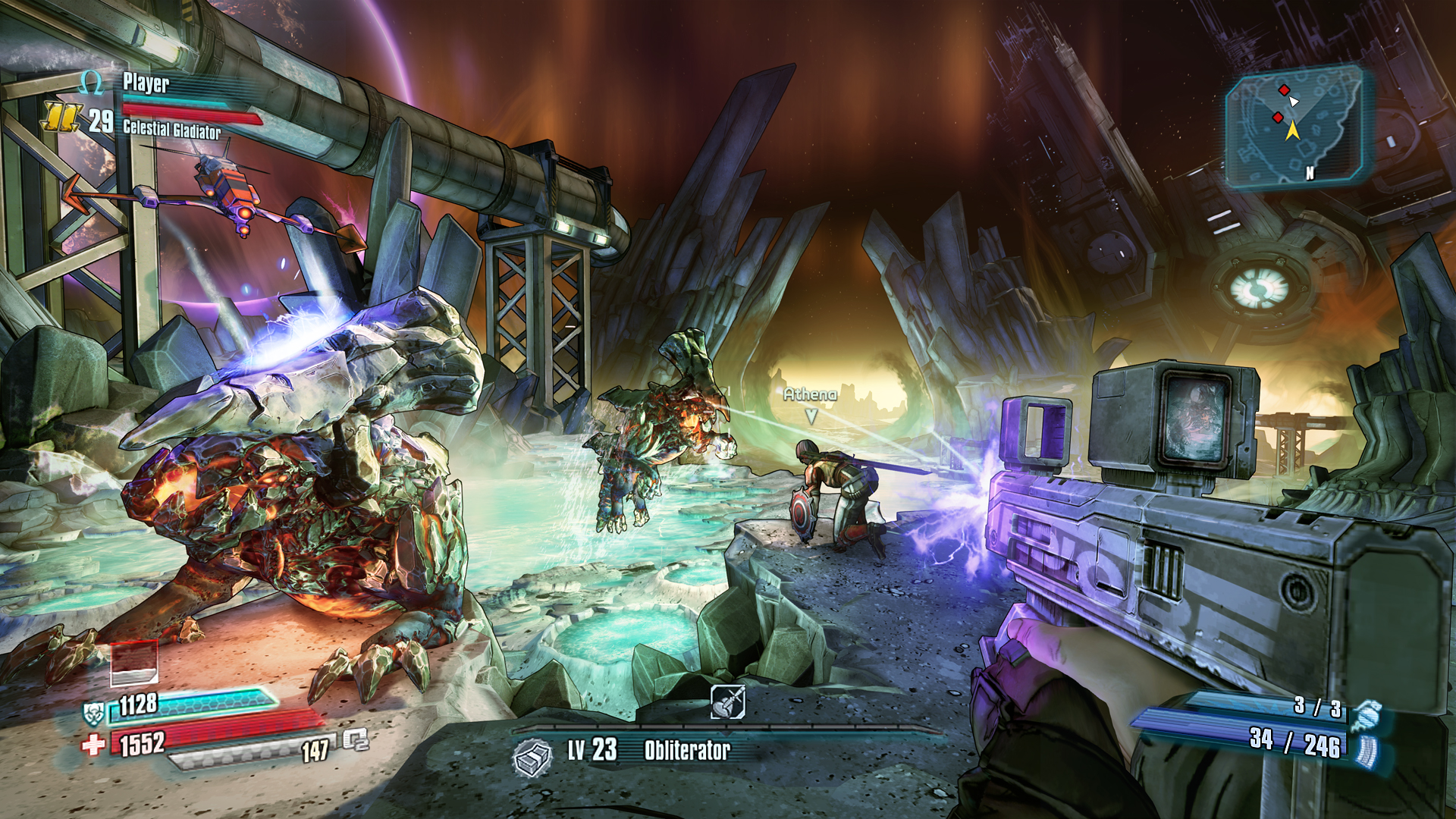
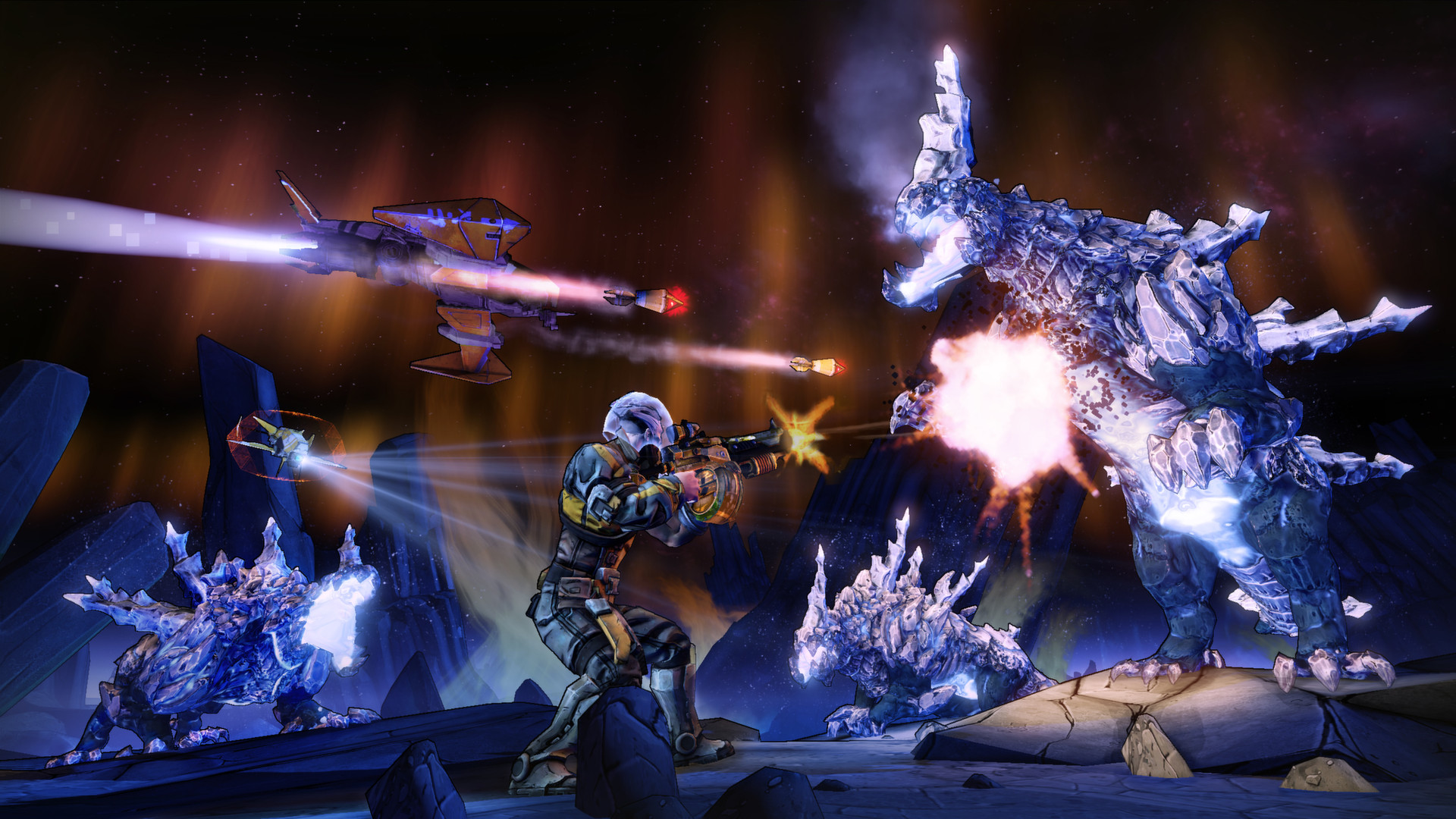
Combat keeps Borderlands’ first-person shooting, elemental damage, enemy drops and mission rewards, while adding cryo and laser weapons to the arsenal. Cryo slows targets and can freeze them, giving the player a window to concentrate fire or exploit the opening with other attacks. Laser guns vary in how they deliver damage: some fire discrete bolts, while others maintain a beam, so weapon handling and ammunition demands differ. Enemies include the Lost Legion forces occupying lunar facilities and other hostile inhabitants of Elpis. Swapping among weapon types, managing ammunition, and matching damage effects to a threat remain central; the movement system makes elevated positions and landing attacks part of those encounters. Weapon pickups still ask the player to compare damage, capacity, rarity and elemental matchups instead of treating every new drop as a straight upgrade. Frozen targets are especially vulnerable to follow-up attacks, so cryo can control a cluster while the player changes weapons or closes distance.
The campaign alternates story missions with optional jobs, exploration and loot collection. Mission objectives send the crew through connected lunar zones, while side quests add local characters and smaller conflicts that can reward experience, money or equipment. Fast-travel stations and vehicles help move between discovered points and broader outdoor routes. In safe or pressurised hubs, vendors and mission givers offer a break from oxygen management; once outside, the player returns to shooting, looting, navigation and skill use. Cooperative play lets the group tackle these activities together, with enemy encounters and loot supporting the same character-building loop across the story and optional missions. The Stingray hover vehicle supplies another way across Elpis: its boost lifts it over short chasms, letting the player use marked routes and ramps to reach adjoining areas. Concordia acts as a major return point during the campaign, with characters and services tied to the mission chain. Fast travel then links discovered stations, limiting repeated travel through already cleared stretches while leaving the player to handle new objectives and threats on foot or in a vehicle.
Combat also has a distinct recovery state. When shields and health are exhausted, the Hunter enters Fight For Your Life and can earn a Second Wind by killing an enemy before the downed timer expires. If that attempt fails, the character respawns at the last autosave station and loses some money. A nearby teammate can help with a revive, giving the co-op group a reason to manage enemy pressure around a fallen player rather than simply scatter. Nearby enemies become both an immediate threat and the route to self-recovery; the remaining players can reduce that pressure while the downed Hunter tries to finish a target. This system makes the shift from ordinary gunfights to a limited recovery window a meaningful part of the moment-to-moment combat.
- Developer
- 2K Australia with Gearbox Software; Aspyr for Linux is shown in Steam search listing only
- Genre
- First-person shooter with role-playing and loot progression