
About Blasphemous
In Cvstodia, a land shaped by a mysterious curse called the Miracle, the Penitent One carries the Mea Culpa through a non-linear pilgrimage of combat and discovery. Explore connected regions, learn enemy patterns, unlock sword techniques, and combine prayers, rosary beads, relics, and sword hearts while seeking a way to end Cvstodia’s suffering.
Blasphemous takes place in Cvstodia, a gothic world transformed by a force known as the Miracle. Its manifestations are treated as religious wonder and catastrophe: people bear strange bodily changes, hostile creatures roam the roads, and communities have developed rituals around suffering. The Penitent One, sole survivor of the Silent Sorrow, travels through this landscape carrying the Mea Culpa, a sword with a history bound to the world’s penitence. Rather than explain everything through constant exposition, the game presents fragments in conversations, item descriptions, architecture, and encounters. The player gradually assembles the setting while moving between settlements, ruined sanctuaries, caves, and monumental religious spaces. The premise gives exploration a strong sense of place while leaving many mysteries unresolved.
The world is arranged as a connected map of regions rather than a sequence of isolated stages. From the early hub of Albero, paths lead toward surrounding territories, and many routes can be approached in different orders. Locked passages, hazards, and inaccessible ledges mark possibilities to revisit when the Penitent One gains a needed relic or movement ability. Prie Dieu shrines serve as rest and save points, while later hubs and warp connections shorten return journeys. Enemies repopulate after resting, so a shortcut changes the cost of retracing a route. The map records explored rooms and their connections, but it does not turn every secret into a marked objective. Progress combines forward movement with backtracking: a newly acquired ability can make a familiar branch traversable, and an overlooked doorway may connect distant regions.
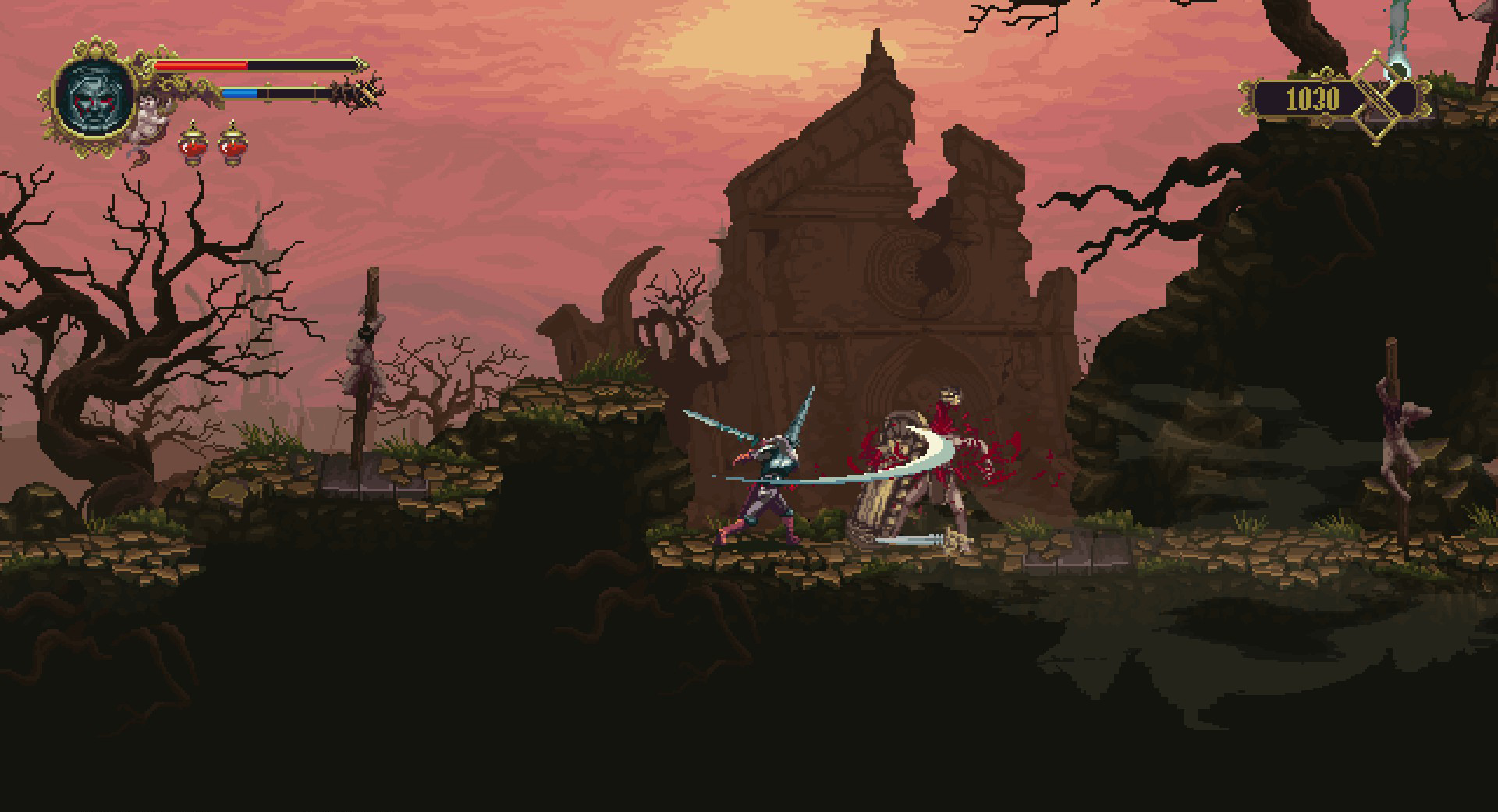
Combat centers on the Mea Culpa, a single sword whose moveset grows through upgrades at special shrines. Basic slashes chain into combos; later techniques add a rushing strike, a downward blow, and other ways to answer enemies at different heights or distances. The Penitent One can dodge and parry, with a well-timed defensive response opening some opponents to retaliation. Many foes telegraph attacks through distinct stances and windups, so spacing and timing matter as much as attacking repeatedly. Certain staggered enemies can be finished with an execution, a short contextual animation that rewards the encounter. Bosses use their own attack patterns and arenas, asking the player to recognize safe windows, avoid hazards, and decide when an attack is worth the risk. Death returns the character to a shrine and leaves a guilt fragment in the world.
A second resource, Fervour, is generated through melee combat and spent to cast Prayers. These abilities range from direct attacks to protective or supportive effects, so the blue meter represents another use for openings created in close combat. Bile Flasks provide healing, while upgrades can increase health, Fervour, and flask capacity. The combat loop asks the player to manage more than the health bar: landing sword hits can refill power needed for a prayer, but standing close enough to do so carries risk. Enemies and bosses inflict heavy damage, which makes learning their tells useful even with a defensive loadout. Shrines let the player spend Tears of Atonement on new sword techniques and improvements. That currency is also used in the world, so upgrades and equipment choices compete with other purchases.
Equipment changes how a run feels without replacing the core sword. Rosary Beads occupy slots on a cord and provide passive effects, including resistance or adjustments to combat. Knots of Rosary Rope expand the number of beads that can be worn, making capacity itself a progression reward. Relics grant passive abilities that alter how the Penitent One interacts with parts of the environment; these are often the key to reaching paths that were previously out of reach. Mea Culpa Hearts modify the sword with a benefit that can carry a drawback, creating a tradeoff rather than a universally stronger setting. Prayers use Fervour and have distinct functions. The player can equip several categories of items together, then change the arrangement at a shrine to suit a region or boss. Finding and combining equipment is a parallel progression track to purchasing sword moves.
Exploration also advances through people, objects, and visual clues. Characters in Cvstodia may ask for help, share their history, or appear again after the player has visited another place. Their stories are optional in the sense that the main route does not require every conversation, yet they add context to the Miracle’s effects and can lead to useful rewards. Hidden walls, elevated alcoves, and side branches hold equipment, health or Fervour improvements, and other discoveries. Platforming asks for careful jumps across spikes, pits, and moving hazards, while relic abilities can change how the character crosses particular surfaces. The result is a cycle of entering an unfamiliar region, learning its hazards and enemies, finding a route or upgrade, and deciding whether to press onward or return to an earlier obstruction. Major revelations remain part of the game’s unfolding journey. The combination of these systems makes equipment preparation part of route planning: an environmental relic may solve a traversal problem, while a bead or sword heart can alter how a dangerous encounter is approached. Prie Dieu points anchor both recovery and the decision to change equipment.
- Developer
- The Game Kitchen
- Genre
- Action-platformer; Metroidvania and hack-and-slash action