

About Blackwell Deception
When clients of New York’s street psychics begin dying and leaving confused spirits behind, medium Rosa Blackwell and her ghostly partner Joey investigate the people profiting from false promises. Across nightclubs, apartments and a Hudson River yacht, they question witnesses, compare clues on Rosa’s phone and help the dead understand what happened to them.
Blackwell Deception follows Rosa Blackwell and Joey Mallone through a New York where a modern scam has consequences that only a medium can see. Street psychics advertise love, wealth and happiness with blinking neon signs, then profit from customers who trust them. When those clients begin dying and leaving confused spirits behind, Rosa’s investigation asks who is being deceived and how the dead became part of the same pattern. Rosa is alive and can speak with living witnesses; Joey is her ghostly guide, a former private detective whose dry, old-fashioned manner gives him a different perspective on the city. The case also brings Joey’s past into view, but its starting point is the victims and the people making money from their belief. Wadjet Eye frames the story as a detective mystery in which the pair investigate the underground world of street psychics. Its New York setting keeps the supernatural premise close to familiar urban life: a sign in a window, a conversation with an acquaintance, or a business address can matter as much as a ghostly encounter.
The opening takes place on a haunted boat, where Rosa and Joey deal with a contained disturbance before a reporter calls Rosa for help with a separate case. That transition gives the story two scales: first a local haunting that demonstrates the pair’s work, then a widening investigation into clients of street psychics. Their journey spans downtown nightclubs, penthouse apartments and a luxury yacht on the Hudson River. These settings change the kind of evidence available. At a nightclub, the pair can observe a social scene and question people connected to its business; in an apartment, personal objects and private records can fill in a witness’s history; on the yacht, the investigation moves into an enclosed space with its own people and clues. The player travels between scenes through Rosa’s phone rather than walking across a continuous city map. Each visit is a point-and-click space for examining objects, speaking with characters and deciding which lead to pursue. The shifts in setting make the psychic operation feel like a network with a public face and private rooms, while individual ghosts attach that wider subject to the history of one person.
The pair’s abilities shape how each scene can be investigated. Rosa can pick up physical objects and talk to living people, so she handles evidence that can be carried and questions that require a human conversation. Joey cannot pick up ordinary objects, but he can pass through walls and doors, see what is on the other side and blow on light items. The game uses that difference to make access itself part of a puzzle: Joey may inspect a room before Rosa can enter, while Rosa must find a key, clue or social route that lets her act there. Their actions are not interchangeable. A witness might only respond to Rosa, while a note or object beyond a locked door may first be visible to Joey. The player switches between them within the same investigation, connecting what one character discovers to what the other can do. Joey’s invisibility to most living people can also change how a scene is approached; his presence is useful for looking around without conducting a normal interview. Rather than adding new powers as the case advances, Deception builds puzzles from these fixed limits and asks the player to notice when one character’s inability points toward the other’s role.
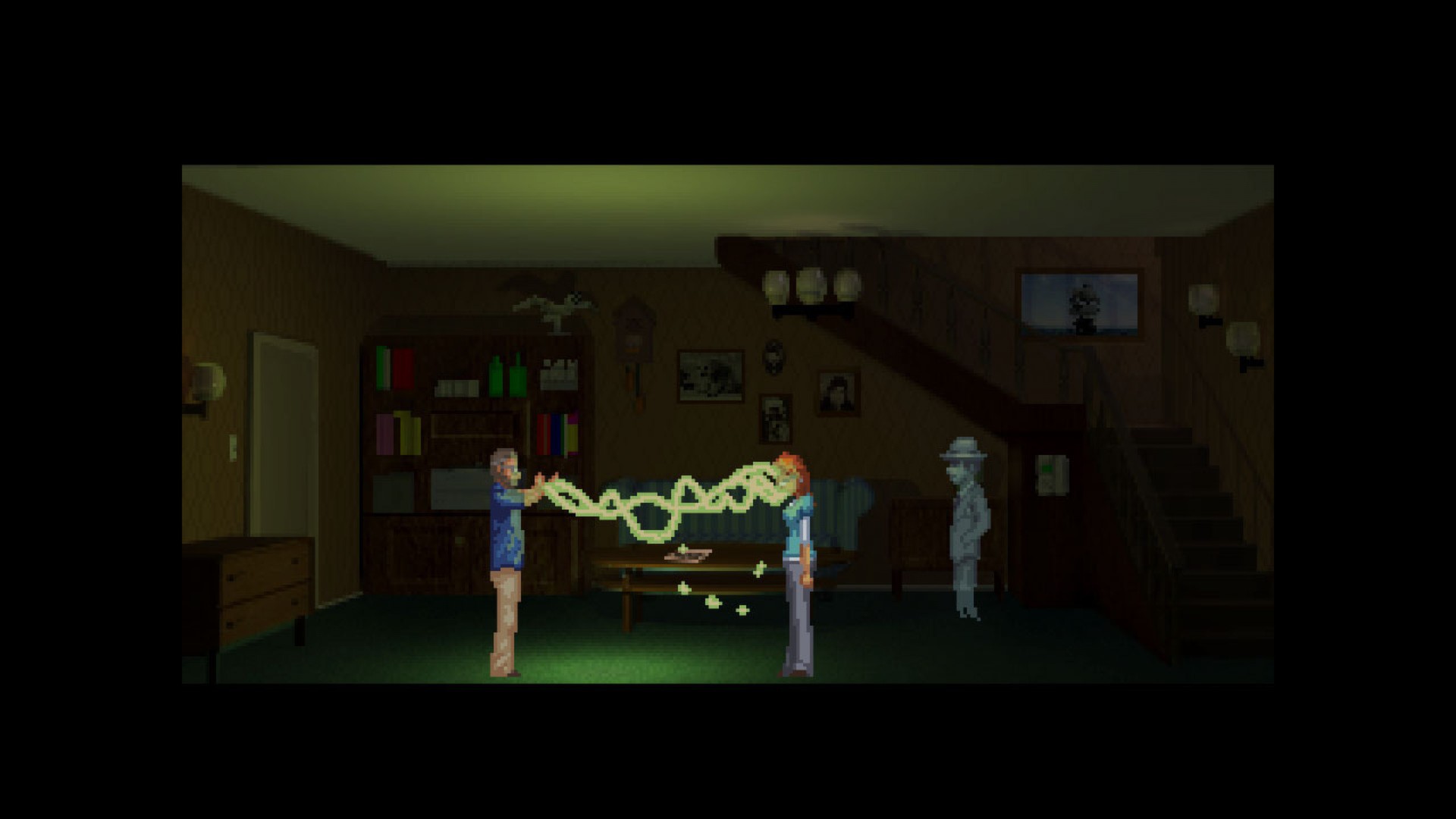
Rosa’s myPhone makes the evidence chain more specific to this installment. It combines the old notebook function with a search engine, email and calls. Notes keep track of names and details, can be combined to form a new thought, and can be used as topics when Rosa questions someone. Oogle searches turn a name into a possible business or location, while a conversation can provide a second name that makes an earlier clue newly useful. This lets the case move through a recognizable sequence: inspect a scene, record a detail, compare it with what is already known, then use the resulting question in an interview or search. The phone is also the hub for selecting destinations, so research and travel sit in the same interface. That matters in a case with many people and locations: the player can revisit notes directly rather than relying on memory or retracing a route to a central archive. Physical inventory still has a role, especially for Rosa, but the more distinctive detective tool is information that can be reorganized and put to a new use. Phone searches are not simply flavor text; they can supply context that unlocks a conversation or shows where the investigation should go next.
Helping a ghost move on is a case-solving process as well as a recurring supernatural task. The dead Rosa and Joey meet often do not understand that they have died, so the pair learn about the person’s former life and use that knowledge to explain the situation. A spirit’s possessions, acquaintances and memories can all provide pieces of that history. Joey’s tie is used when the pair are ready to help a ghost move on, but reaching that point depends on learning enough about the person rather than simply finding the object. This gives individual encounters a shape of their own: investigate the circumstances, connect a few personal details, then return to the ghost with a fuller understanding. The same information can also intersect with Rosa’s larger case, since a dead client’s story may point toward the people or practices that created the problem. These smaller resolutions keep the street-psychic mystery grounded in individual lives. The game’s progression therefore comes from closing lines of inquiry and carrying their implications into subsequent scenes, not from raising character levels or improving combat statistics. The focus stays on how much the pair can establish from what a person left behind and what other people are willing to say.
Deception gives Joey a personal thread alongside the client cases. The investigation uncovers secrets he would rather leave buried, and an older man calls Joey by name, prompting Joey to leave with Rosa. The scene makes Joey’s history a question inside the present investigation: the player sees his reaction before the full context is available. That thread changes the tone of their banter without displacing Rosa’s work on the street-psychic case. It also makes character observation useful beyond collecting clues about the current victim. Joey’s responses, hesitations and choice to leave can be read as information about him, even when they do not immediately provide a new location to visit. Rosa remains the person who can interview living witnesses, but she is also the only partner who can ask Joey what he is withholding. Their relationship is presented through fully voiced dialogue, including exchanges that mix dry humor with genuine concern. The game makes this a character-centered mystery: solving the external case and understanding why a familiar companion reacts strongly to a stranger are related forms of investigation, though the latter’s explanation is reserved for the story itself.
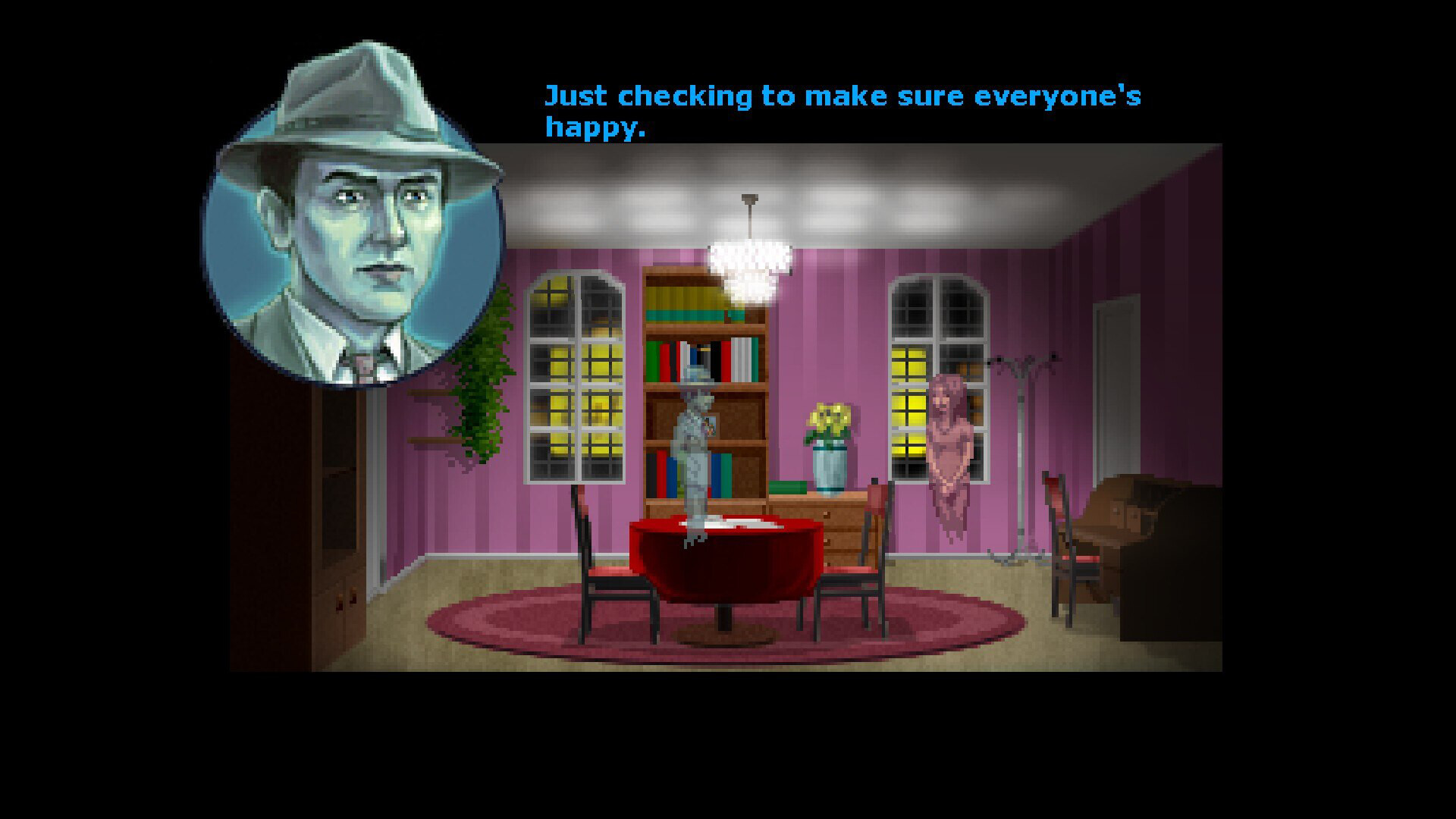
The visual and audio presentation reinforces the difference between public city spaces and private histories. Pixel-art environments are detailed enough to invite inspection, with lighting and background music used to set a scene’s mood. Character portraits change expression during conversation, and fully voiced dialogue gives Rosa and Joey’s contrasting voices a place at the center of the investigation. The result is a largely quiet form of play: a player studies a room, selects an object or question, then listens for a detail that may alter the case file. Optional developer commentary can be enabled in the game, separate from the main dialogue, and may discuss production or puzzle moments. Deception is the fourth Blackwell adventure and has its own case about street psychics and their clients. Its closing material develops the characters and Joey’s history, but this remains distinct from Blackwell Epiphany, the fifth and final game, whose opening crisis concerns a soul being destroyed. The shared protagonists and supernatural rules connect the installments; their central investigations, locations and story stakes remain separate.
- Developer
- Wadjet Eye Games
- Genre
- Point-and-click supernatural adventure