
About Binary Domain
In 2080, Sergeant Dan Marshall and the international Rust Crew enter Tokyo to investigate humanlike robots that violate an international ban. The squad fights through a city divided between neglected lower districts and an affluent upper level, while conversation, battlefield conduct and trust shape how teammates respond to Dan.
Binary Domain is a squad-based science-fiction shooter set in Tokyo in 2080, when robots have become central to industry and humanlike machines are appearing in violation of international rules. Dan Marshall, a sergeant in the Rust Crew, leads a small international team into the city on a covert investigation. Their mission places them in the middle of an emerging conflict between people and robots that can pass unnoticed among human society. The question of what separates a person from a machine runs through both the combat and the squad’s conversations. The campaign follows Dan and his teammates through a military operation in a city whose social divide is visible in its streets and architecture. Their progress depends on surviving armed resistance while communicating with the people beside them, whose reactions are tracked rather than treated as background chatter.
Tokyo is presented in contrasting layers. The lower city is worn down and neglected, while the upper city is clean and affluent; the Steam description frames the two areas as a divided urban environment. Combat spaces turn this contrast into a route through the investigation, from ruined streets and industrial areas to more orderly districts. The Rust Crew moves through these locations as a unit, taking cover, advancing between obstacles and responding to threats together. The Sega product page describes a clandestine operation by a special squad under an international inspection body, while the PC store page introduces Dan’s team as sent to regain control of Tokyo from an infiltrating robotic community. The setting is therefore more than a backdrop for shooting: its robot economy, urban hierarchy and uncertainty over who is human give the investigation its stakes.
The core shooting loop uses a third-person view, cover and a squad that can receive tactical orders. Dan can tell teammates to advance, hold position or attack, and can address an individual by name when using voice input. A microphone or headset allows spoken commands and replies; players without one can select from a contextual list of orders and responses. Communication serves a combat purpose as well as a narrative one, since teammates react to instructions and questions. Covering one another, keeping track of wounded allies and coordinating fire all affect how the group functions in an encounter. The manual also documents situational sequences such as operating a crane or moving through a vehicle event, alongside ordinary movement, aiming, reloading and melee attacks. The result is a campaign in which the player directs Dan’s immediate actions while also tending the squad’s cohesion.
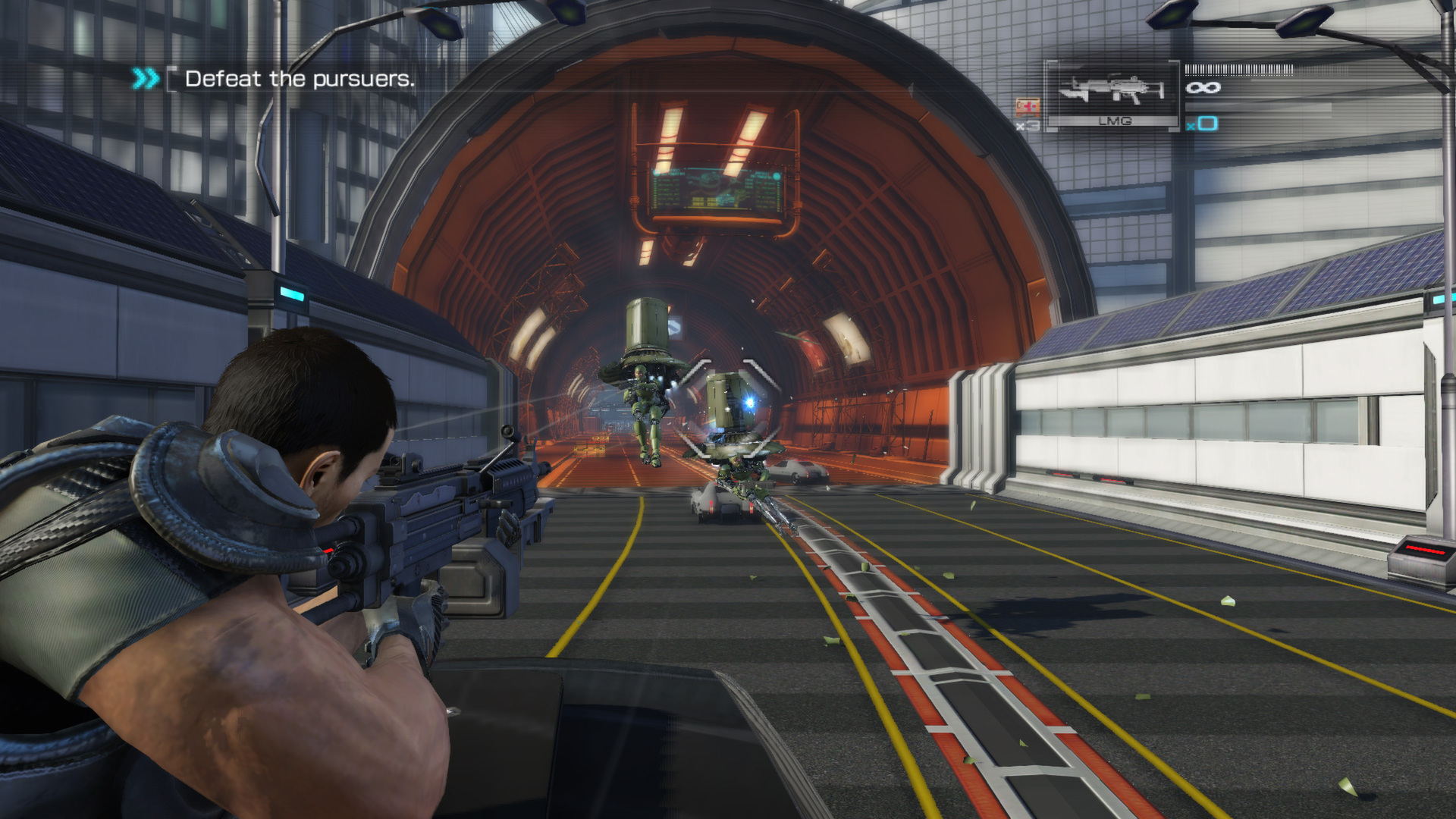
Trust is the central squad system. Each teammate has a Trust Level that can rise or fall through conversation and battlefield behaviour, and the status screen lets the player review it. Following a request, helping a critically wounded ally and responding in ways that fit a character can build trust. Ignoring expectations, acting too rashly or shooting a teammate lowers it. A trusted companion becomes more effective in combat and is more likely to follow difficult orders; a teammate with low trust may refuse commands and fight less effectively. Characters also have different conversational preferences, so the same answer need not produce the same reaction from everyone. Because these changes can influence later developments in the story, small exchanges and split-second conduct are part of the campaign’s progression. The system ties leadership to repeated choices rather than a single menu of abstract moral decisions.
Robotic enemies use destructible bodies that can be damaged in separate areas. The Steam listing describes them as adapting to the damage they sustain, encouraging the player to identify weaknesses and choose where to aim. This makes target selection part of the firefight: a robot may lose a component or respond differently as its parts are damaged, changing the immediate threat. Breaking additional parts also earns more credits, linking combat decisions to the equipment economy. The player can earn currency by defeating enemies, then spend it at Ammunition Transit Supply Terminals on weapons, ammunition and items or on upgrades to a primary weapon. A terminal also supports choosing a weapon associated with a teammate and selecting which component to improve. The campaign therefore connects tactical shooting with longer-term resource choices, as players weigh supplies and weapon improvements against the demands of upcoming missions.
Dan’s squad needs care as well as orders. Teammates can be injured during fights, and first-aid kits can be used to help a critically wounded member; leaving any party member incapacitated for too long can cause mission failure. The player has to notice when a team member needs assistance while managing ammunition and incoming fire. Trust and health are related parts of the same battlefield relationship: helping someone can improve their confidence in Dan, while friendly fire has an explicit cost. The game also lets the player inspect each member’s status and skills, then adjust their skill settings using enhancements called nanomachines. These are found in the field or purchased at shop terminals and placed into open spaces in a skill set. The available slots make each character’s preparation a small configuration task alongside the choices of weapons and supplies.
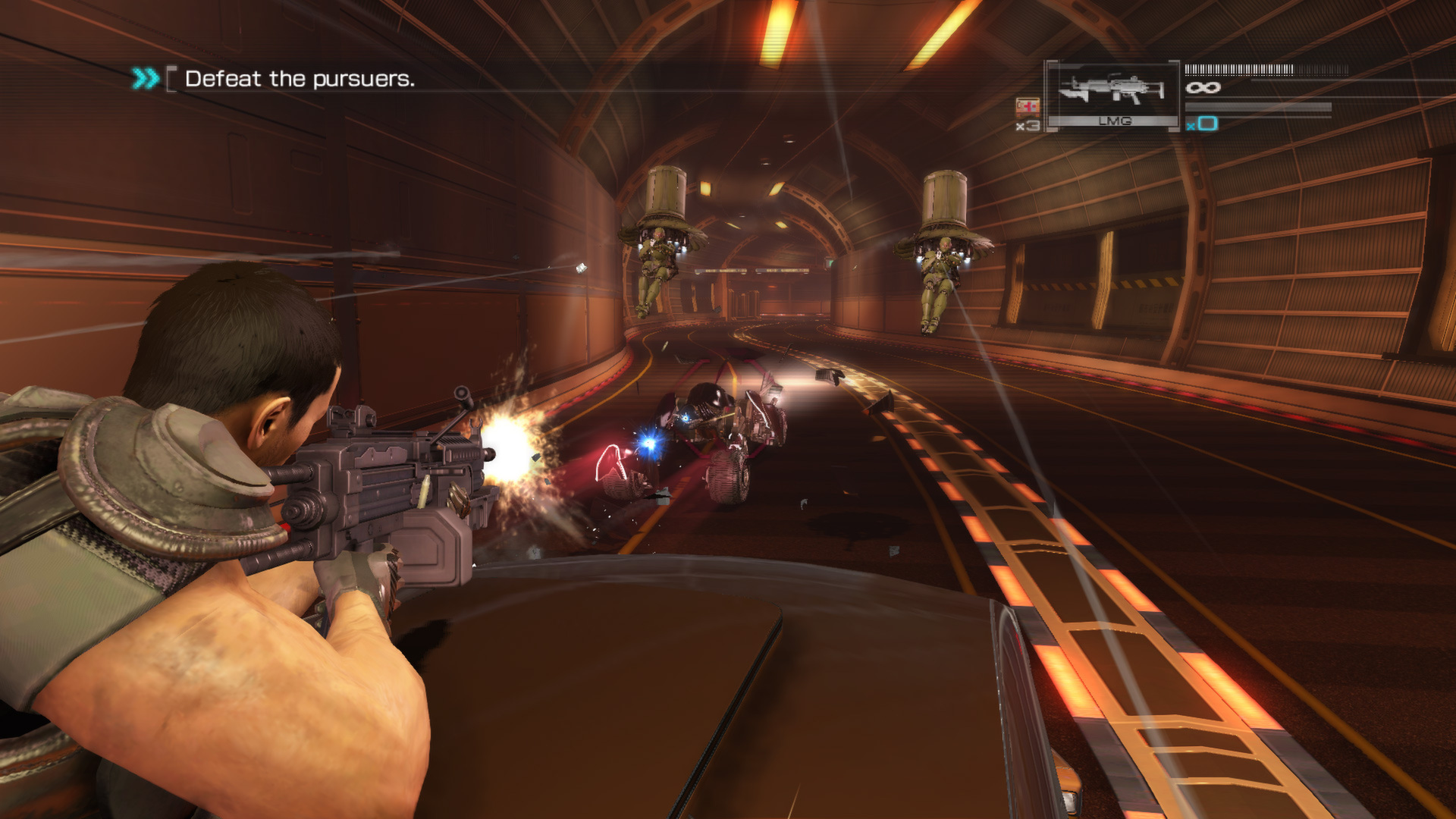
The campaign’s wider consequence system treats words, decisions and actions as inputs to the team’s changing relationship with Dan. The Steam description presents real-time moral decisions and trust as part of guiding the squad, while Sega’s Japanese product page calls out Ripple Link, a system in which conversation, suggestions, cooperation and rescue actions can change trust and the direction of the story. This page-level description does not require a particular outcome: the player’s job is to lead the team through the operation, manage its combat needs and decide how to respond as the situation develops. The PC release also lists a single-player campaign and separate online features, but current online availability is not assumed here. The main play experience remains the investigation with Dan and the Rust Crew, where robotic combat and human relationships unfold side by side.
- Developer
- Devil's Details (Steam listing)
- Genre
- Squad-based third-person science-fiction shooter