
About Baldur's Gate: Enhanced Edition
Raised within Candlekeep, the player character leaves home with Gorion and is drawn into a crisis as iron shortages threaten the Sword Coast. Recruit companions, investigate the road toward Baldur’s Gate, and uncover the forces behind the disruption. The Enhanced Edition includes Tales of the Sword Coast, new companion quests, and the separate Black Pits arena campaign.
Baldur’s Gate: Enhanced Edition begins inside Candlekeep, a fortified library where the protagonist has been raised under the care of the mage Gorion. A mysterious danger forces them to leave, and events soon connect their journey to an iron shortage that is weakening weapons across the Sword Coast and raising tensions between Baldur’s Gate and Amn. The route takes the party through settlements, wilderness and ruins as the player follows clues, meets people affected by the shortage and learns why the crisis reaches beyond trade. The story is built around travel and investigation: conversations and journals add leads, while new areas reveal other people and conflicts tied to the larger journey. The protagonist’s origin and Gorion’s choices frame the adventure, but the immediate work is to keep moving, gather allies and decide which problems to pursue along the way.
The player creates the protagonist by choosing a race, class, alignment, abilities and weapon proficiencies, then selects a portrait, voice and name. Class shapes the actions available: warriors develop weapon expertise, thieves distribute skill points among abilities such as opening locks and finding traps, and arcane spellcasters choose spells for a book or personal repertoire. Humans can later change class through dual-classing, while eligible non-human characters can combine classes from the start; these choices affect what a character can learn and when. Experience earned during the adventure unlocks levels, which can improve combat statistics, hit points, skills or spell access according to class. The resulting character leads a travelling group whose members contribute different strengths. Replacing a specialist or adding a sturdier front line changes how the party handles obstacles, so recruitment and party composition become part of the adventure’s planning rather than a purely cosmetic choice.
Travel alternates between detailed local areas and the wider Sword Coast map. The party walks to the edge of an explored region before choosing a connected destination, and new territory remains obscured until characters move through it. Towns and wilderness hold conversations, encounters, shops, containers and quest leads; the journal records developments so separate errands can be followed alongside the central investigation. Players can talk to people, inspect the surroundings, collect equipment and decide which leads merit attention. Inns and temples provide services, while rest can restore health and let prepared spellcasters replenish their selections; resting in the wild restores fewer hit points and may be interrupted by an attack. Time passing can also matter to some quests, so rest and travel are practical decisions. The map and journal help organize this branching journey without turning its locations into a fixed sequence of marked objectives.
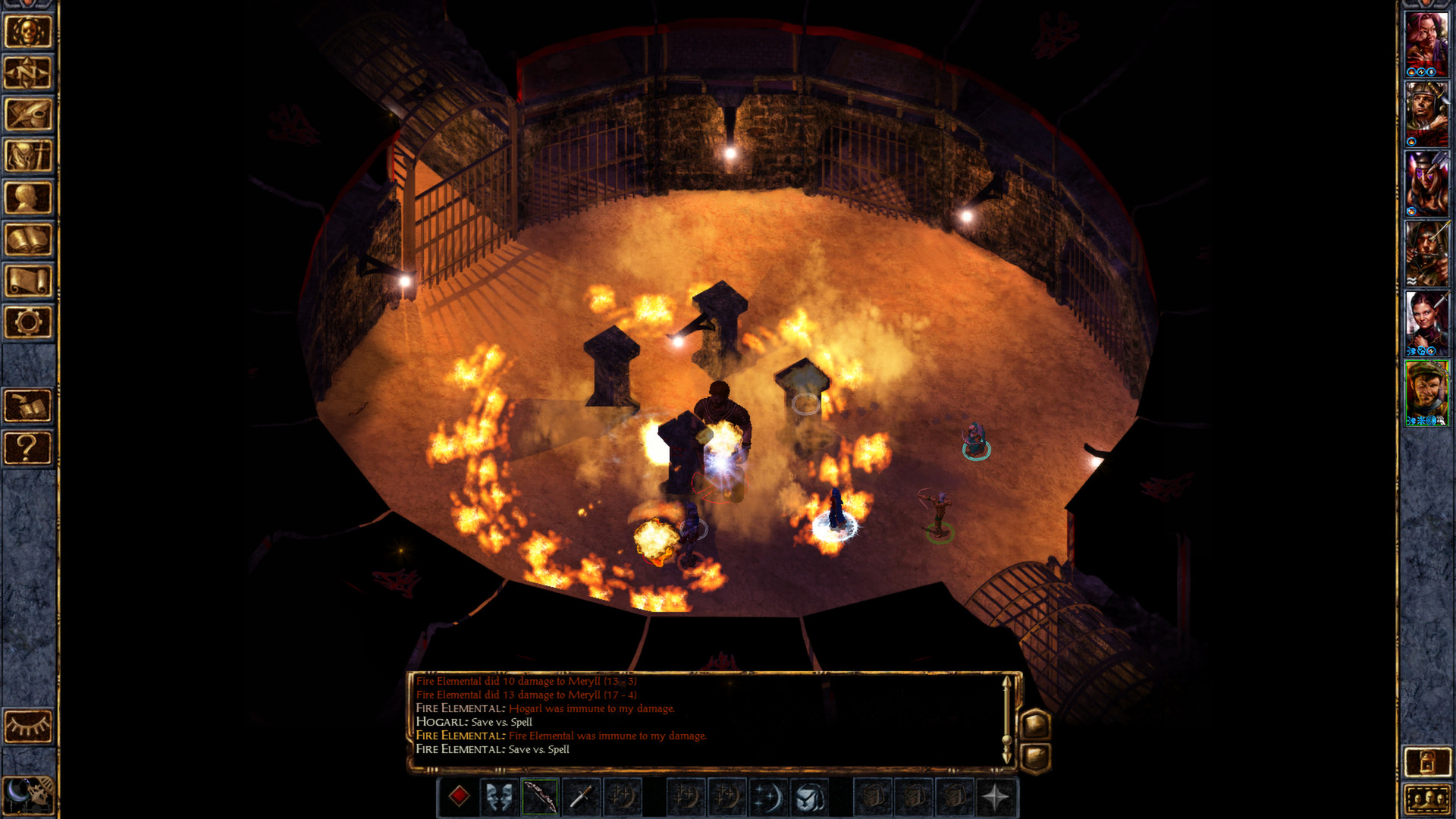
Combat runs in real time but follows AD&D rules beneath the interface, with the game calculating attack rolls, armor class, saving throws and spell effects. The player can pause at any moment, issue orders to selected characters, then resume to watch them carry out those actions; configured auto-pause conditions can interrupt combat when chosen events occur. Position and party formation influence who meets an enemy first, while ranged weapons, melee attacks and spells give different characters useful roles. Weapon proficiency matters: a character can use an unfamiliar weapon, but suffers penalties, while investment in a preferred style improves its effectiveness. Enemies may require more than repeated attacks: protective spells, disabling effects, healing and the timing of a retreat can all alter an encounter. The party’s health and spell resources persist between fights, which makes the decision to press onward or rest part of the tactical loop.
Magic and class skills give the party ways to prepare for dangers before they become direct fights. Mages select spells to learn and memorize; clerics and druids prepare from their own spell lists, while thieves develop practical skills used against locks, traps and guarded pockets. A thief can enter a trap-finding mode while moving through an area, and a successful stealth approach can create an opening for a backstab. Charisma and the party’s reputation also affect how non-player characters respond, what information they are willing to share and the prices offered by shops. Reputation reflects the party’s public conduct rather than just the protagonist’s alignment, and companions may become unhappy when its direction conflicts with their own outlook. These systems connect character build and conduct to everyday play: who leads a conversation, which specialist handles a locked container and how the group behaves can all change the options available.
This edition packages the original Baldur’s Gate adventure with Tales of the Sword Coast, whose additions include Durlag’s Tower and other locations, as well as Enhanced Edition material such as the quests involving Rasaad yn Bashir, Neera and Dorn Il-Khan. These character stories add separate threads to the wider Sword Coast journey; they do not replace its central investigation. The Black Pits is another distinct campaign: the protagonist and a party fight through an arena run by Baeloth, with survival and escape defining that scenario rather than the iron crisis. The added campaigns therefore create different reasons to assemble and develop a party while remaining distinct from the original plot. The Enhanced Edition also updates the interface with high-resolution fonts, dynamic zooming and other improvements, and supports multiplayer; these presentation and session features sit alongside the same character-led, party-based adventure structure.
- Developer
- Beamdog
- Genre
- Adventure, RPG