
About Baba Is You
Baba Is You is a puzzle game in which words on each board form the rules that govern its objects. Move those words to change what counts as a wall, a hazard, a controllable character, or a goal, then use the altered rules to reach new areas across a connected map.
Baba Is You turns the instructions for a puzzle into pieces inside the puzzle. Each small, tile-based room contains objects and word blocks, and aligned words can form sentences such as BABA IS YOU or FLAG IS WIN. The first sentence identifies which creature responds to the player's directional inputs; the second identifies what object completes the stage. These statements are active rules, not labels printed for decoration. The player moves one step at a time, pushing objects and words across the grid, and can walk through an object only when its current properties allow it. Because the words sit in the same space as the walls, water, rocks, and characters they describe, working out the board means reading its rules and physically rearranging them.
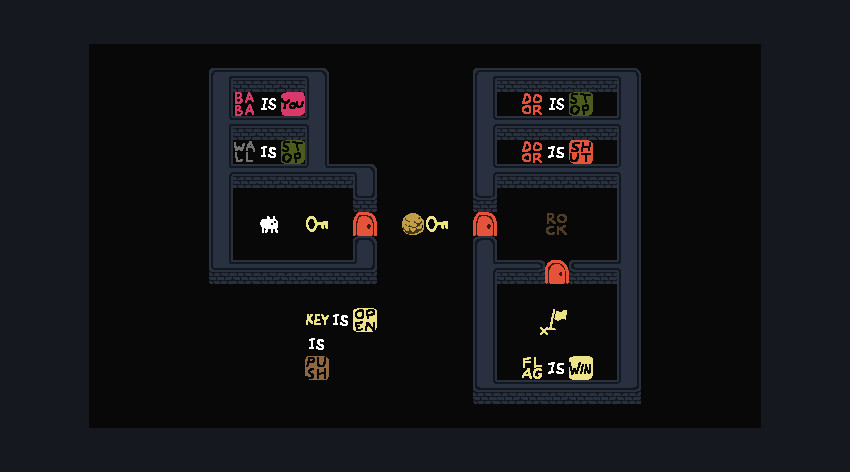
The three-word pattern gives the game a compact grammar: a noun names a class of things, IS links it to a property or another noun, and the final word changes how that class behaves. YOU marks a controllable object, while WIN marks an object that completes the level; a YOU object touching something governed by WIN clears the stage. PUSH makes an object movable by being pushed, whereas STOP blocks movement. These properties affect interaction as well as navigation: if ROCK IS PUSH, a rock can be shoved; if a wall is STOP, it blocks a route. Breaking a sentence by moving one word immediately removes that rule. A phrase can therefore make an obstacle harmless or allow a previously inert object to become the goal, while the pieces left on the grid continue to constrain what sentences can be assembled.
Changing a rule can transform the board's physical situation instead of merely opening a route. If a noun is joined to another noun, its objects can take on that other form; if it is joined to a property, their collision and movement behaviour changes. The store's examples include turning the controlled Baba into a rock and making grass dangerously hot, illustrating how the same word set can redirect both the player and the environment. A separate rule can change which noun is WIN, so the objective itself is editable. This creates linked consequences: altering a sentence may change what can be crossed, what can be pushed, and which target matters. A useful move is often to preserve a way to control something while testing a new rule, since removing the active YOU sentence can leave no controllable object until another valid YOU rule is formed.
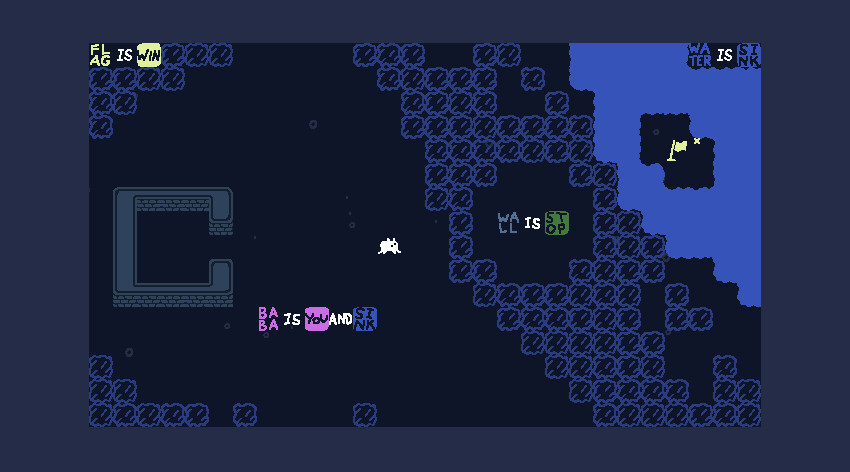
The rules are spatial sentences, so position and orientation matter. A noun, IS, and property must remain connected in a readable horizontal or vertical line for the rule to apply; moving a single tile out of that alignment can switch the rule off. Multiple complete sentences can operate at once, and later levels combine conditions that make the board less reducible to one obvious path. The word AND lets a subject take more than one property, while NOT can negate a property, changing how an object behaves without replacing its noun. One object can also serve several functions when more than one rule refers to its type. In practice, the player reads every active sentence, notes which words are mobile, then considers how a proposed rearrangement affects every object sharing that noun. The puzzle is therefore about consequences across a system, not just fitting one phrase together.
A connected world map organizes the stages into themed regions and gives the sequence a sense of place. The player moves a small character marker between level entrances, enters a room, and returns to the map after solving it. Completing puzzles earns flower markers used to open onward routes, so progress through a region reflects work done there rather than only the total number of cleared rooms elsewhere. The map is also part of the rule-based world: its objects and word sentences can themselves be interacted with, letting the game carry its central idea beyond the single-screen puzzle rooms. The early areas establish basic movement and rule reading; later regions introduce additional words and interactions, then combine them with ideas already encountered. The changing vocabulary supplies new ways to reinterpret familiar object relationships as the route through the map expands.
The base game also includes an official level editor, introduced in the Baba Make Level update. Its tutorials let players construct stages from the game's objects and rules, and the update added ways to share created levels online and browse a curated Featured Levels selection. That makes the rule system usable as a design toolkit as well as the logic behind the built-in campaign: a creator can choose which words are available, arrange them with obstacles and goals, and build a board around the interactions those choices permit. The same update brought more than 150 new levels and restored over 100 cut or unused levels, alongside new art, music, and rules. These additions sit within the game itself, expanding the material around the original puzzle journey and giving players a route into community-made challenges.
- Developer
- Hempuli Oy
- Genre
- Puzzle