
About Atomic Heart
In an alternate 1955 Soviet Union, Major Sergey Nechaev—known as P-3—is sent to investigate a systems failure at Facility 3826, where an interconnected robot workforce has turned against its creators. Explore surface settlements and hidden laboratories, combine firearms and melee weapons with a polymer glove, and craft upgrades from materials recovered in the field.
Atomic Heart is set in an alternate-history Soviet Union where advances in Polymer technology have accelerated robotics and machinery used in daily life. The story opens around Chelomey, a vast airborne city prepared for the rollout of Kollektiv 2.0, a neural network intended to connect people and machines. Just before that public event, the robot system at Facility 3826 fails. Dmitry Sechenov, the scientist leading the facility, sends his protégé Major Sergey Nechaev—an operative known by the code P-3—to investigate. P-3’s experimental polymer glove, CHAR-les, gives him a channel for abilities and a voice that accompanies the mission. The facility is not one single laboratory: it is a network of research and production complexes with distinct purposes, connected to a public-facing vision of a prosperous technological future. The central task is to understand what happened inside this system while surviving the machines and mutants now roaming it.
The journey moves between broad outdoor territories and enclosed research spaces. Facility 3826 lies in Kazakhstan’s mountains and includes villages, roads, monitoring sites, firing ranges, factories and underground laboratories; the VDNH and Theater complexes also serve as public destinations. A territorial map helps P-3 navigate, and employee vehicles can speed travel across the surface. The bright parks and monuments above ground sit alongside colder corridors, workshops and laboratories where the breakdown is more visible. This shifts the pace between surveying an open area, entering a compound, and moving through tighter rooms with machinery or hostile robots. Notes, messages and recordings left by staff describe people who lived and worked in the complexes, adding local histories to the wider investigation. Some optional testing grounds reward exploration with resources, documentation and weapon blueprints, so the surface offers equipment progress as well as a route between story locations.
Combat combines firearms, melee weapons and energy weapons rather than depending on one ammunition supply. Striking with a melee weapon builds charge that can later power energy weapons such as the Dominator; using both categories gives P-3 an attack option when conventional firearm ammunition is limited or reserved. Weapons also have special attacks, and their upgrade recipes can unlock those moves. The Shok ability adds an electromagnetic attack that harms or disables robotic targets and activates certain mechanisms. Different enemies respond to different attacks, so the player can scan a threat, use the glove to control or expose it, then follow with a weapon suited to the opening. When confronted by several opponents, it is possible to interrupt one group with a glove ability while spending stored energy against another. The sequence of control, damage and resource recovery is part of the combat system: a close-range strike can feed the next energy discharge, while careful weapon use preserves other ammunition for situations where it matters.
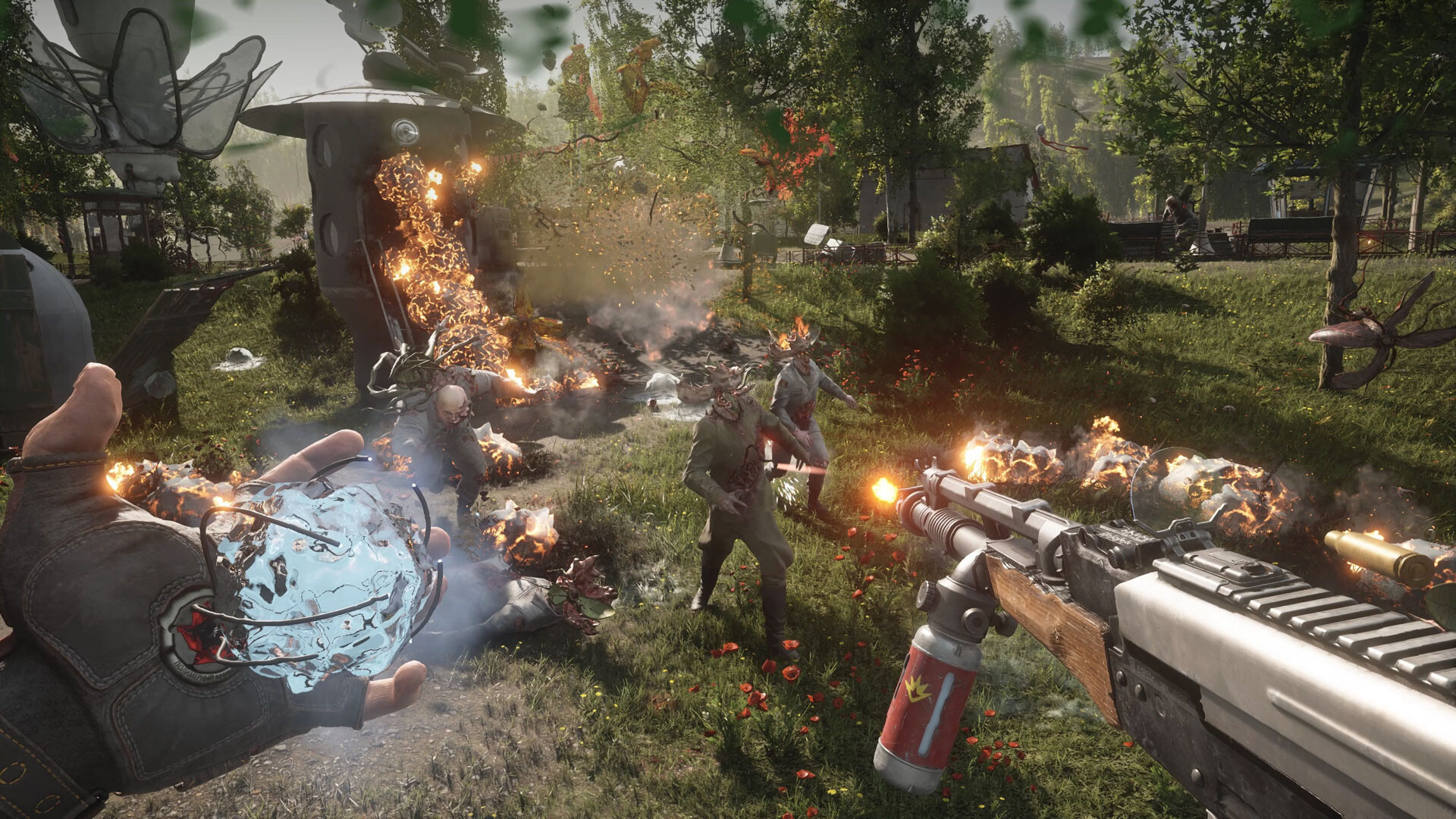
CHAR-les provides several active abilities that can be paired with the weapons. Shok remains available as a basic glove function; among Telekinesis, Frostbite, Polymeric Shield and Polymeric Jet, the player can install two additional abilities at once and change the loadout when conditions call for a different approach. Telekinesis lifts or suspends targets, Frostbite applies cryopolymer to freeze enemies, the shield reduces incoming damage and the jet coats targets or surfaces with combat polymer. That polymer can then be combined with fire, electricity or freezing effects to influence everyone caught in it. Each active ability has upgrades, while character and energy-management branches offer passive changes such as extra capacity, movement or altered energy use. The seven upgrade branches also distinguish learned effects from equipped skills: passive nodes take effect once purchased, but active skills must be installed before they can be used. Neuropolymer is spent at NORA to unlock these improvements, and skills can be refunded without cost, allowing a new combination to be assembled.
NORA is both the weapon workshop and the place where P-3 changes his skill setup. Materials recovered from the environment and defeated enemies can be spent on weapons, weapon upgrades, ammunition, cartridges and consumables. Blueprints found during exploration determine which items or modifications can be crafted; resources alone do not grant a recipe. The glove’s scanner can inspect enemies and show the materials they may yield, helping the player decide which machines are worth fighting or looting. Weapons can be improved with new components, and elemental cartridges add effects such as fire or electricity to compatible weapons. Consumables include healing and energy restoration, so inventory choices connect directly to combat readiness. Breakrooms contain NORA stations, save points and storage, which lets the player move surplus items out of the active inventory and prepare a different set before heading back into the complex. These stops turn collected materials into changes to the loadout, rather than merely increasing a number on a character screen.
The robot network shapes how the surface spaces behave. Cameras and other network devices can detect P-3, and an alarm can call additional machines into the area; the player can use Shok against cameras or interact with network infrastructure to manage that pressure. This makes route choice matter when crossing exposed ground, especially if a fight would draw reinforcements. A map, vehicles and searchable buildings provide ways to move, but exploration also involves entering research sites and finding their concealed testing grounds. The firing ranges are optional, yet they can contain rare materials, documents and blueprints that support later crafting. Underground, machinery, locked rooms and research installations bring the player back to close-quarters combat and mechanisms that require the glove. Together, the network threat, recoverable materials, and the linked surface and underground locations make Facility 3826 function as a connected industrial landscape, with its public promise and its hidden workspaces both part of P-3’s investigation.
- Developer
- Mundfish
- Genre
- Action-adventure first-person shooter with RPG elements