
About ASTRONEER
ASTRONEER is a science-fiction exploration and construction game about an astronaut venturing through an unfamiliar solar system. Players reshape terrain, gather resources, extend oxygen and power from a home base, and build modular equipment for deeper expeditions. Strange structures and communications hint at mysteries across seven celestial bodies, playable alone or in online co-op.
ASTRONEER follows an astronaut exploring the frontiers of outer space in an unrecognized solar system. The player arrives on an unfamiliar world with a small set of tools and begins to turn its resources into the means for longer journeys. Rather than following a single linear route, exploration and settlement feed one another: materials found beyond the base can support new equipment, and that equipment makes more distant places reachable. The solar system contains seven celestial bodies, each with its own geography and challenging biomes. The landscape continues below the rounded surface toward each world’s core, so a nearby ridge, a cave and a faraway planet offer different kinds of terrain to investigate. The world also contains mysterious structures and artifacts, while communications from unknown sources raise questions about the wider system. These discoveries give an exploratory framework to the game without needing to resolve its central mysteries here.
The Terrain Tool makes the ground itself part of the player’s equipment. It can dig, collect, shape, build and color terrain, so excavation changes both the route through a landscape and the material brought back from it. Collected terrain can be used to make a path through uneven ground or to alter the shape of a slope; the same tool lets players form terrain rather than treating the planet as an unchangeable surface. That creates a close link between movement and resource gathering: the player can open a way forward, gather what lies beneath, and use the ground to make a return route more manageable. The tool is also one piece of a wider construction system. Its modifications and attachments sit alongside machines, vehicles and base modules, turning exploration into a cycle of traveling with limited equipment, collecting useful materials and improving what the astronaut can do next. Each world can be physically changed as the settlement grows.
Oxygen sets a practical boundary around expeditions. Away from an oxygen source, the astronaut has a limited supply, so the player extends that reach with oxygen tethers placed across the ground. When connected to the home base, a tether line supplies oxygen farther from shelter and forms a visible trail that helps mark the path taken. The system ties survival to navigation: each new tether continues the breathable route, and a break in that chain means the player needs another way to stay supplied or must turn back. This transforms walking into a deliberate survey of distance and return. Tethers can also carry power to nearby players when linked to an oxygenated network. Other oxygen sources can support trips beyond a fixed tether path, but the basic logic remains connected to planning a route outward from shelter. The expedition’s reach grows as the astronaut makes a dependable chain of support across the terrain.
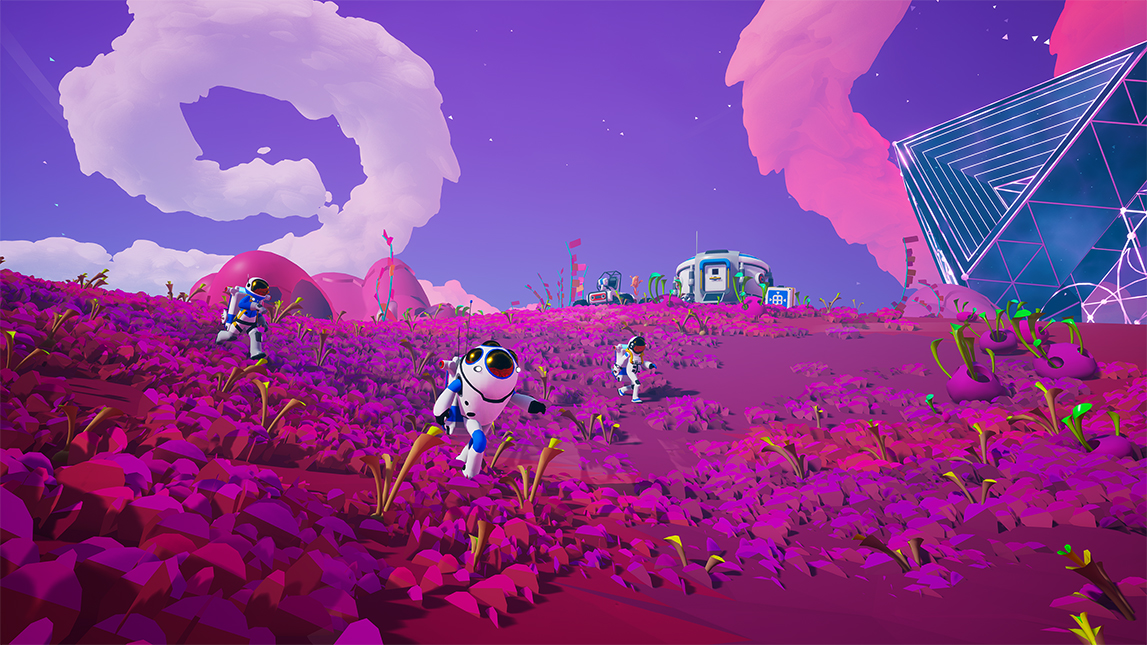
A home base is assembled from modular platforms and the equipment attached to them. Printers, crafting stations, power plants, resource harvesters and railway facilities can be built into a layout suited to the player’s needs. Machines use power, and connected structures share a network through physical cable plugs; the available supply affects how quickly powered operations work. That means new equipment is useful only when the base can support it. The player can gather resources by hand and bring them back, then turn those materials into tools, vehicles, storage and larger machines. As production expands, arranging platforms, modules and power connections becomes part of the work. The base is not only a safe place to return to: it is a workshop whose design determines what an astronaut can prepare, refine or print before leaving again. Later construction can include repeat-task machinery and railway infrastructure, adding new ways to move items and coordinate production around the settlement.
Research gives the astronaut a way to turn finds into progress at the base. The Research Chamber studies objects gathered during expeditions and produces research points, while a Soil Centrifuge can turn collected soil into basic resources. These machines let the player make more than one use of an expedition’s haul: a specimen can be carried home for study, while other gathered material can be directed toward construction. Finding objects and unfamiliar materials therefore connects exploration with the equipment assembled at home. With research and crafting facilities in operation, the player can expand the settlement’s capabilities and prepare for more demanding work. This loop moves between the landscape and the workshop: travel to gather, return to process, then use the resulting resources or knowledge to build. Discoveries can be pursued for their place in the world as well as for the practical role they play in the next stage of construction.
Travel beyond the starting world brings the construction loop into a larger scale. Shuttles allow the player to leave a planet and reach other bodies in the solar system, whose geographies and biomes vary. The Steam description presents exploration from surface to core, making both local terrain and deep underground spaces part of the same world. Resource gathering and research support the equipment needed for such trips, while destinations offer new environments to examine and resources to bring home. The player can also investigate strange structures, artifacts and confusing communications distributed across the system, pursuing the game’s mysteries through exploration. In online co-op, two to four players can work together in a shared expedition, and players may join or leave a solo online world. That cooperative option fits the game’s practical tasks: people can explore, gather, shape terrain and build while sharing the same settlement and its machinery.
- Developer
- System Era Softworks
- Genre
- Adventure and exploration sandbox with survival, crafting and base-building systems