

About Assemble with Care
Maria, a travelling antique restorer, arrives in the seaside town of Bellariva looking for work. As residents bring her broken keepsakes and gadgets, she takes them apart, studies their mechanisms and puts them back together. Each repair reveals why an object matters, connecting tactile puzzles to the town’s relationships and the ways its people try to reconnect.
Assemble with Care begins with Maria arriving in Bellariva carrying the tools and belongings of a travelling restorer. The town offers work, but the objects people bring to her quickly show that repair here means more than making something function again. A cassette player, camera, watch, telephone or keepsake belongs to someone with a history, and restoring it gives Maria a way into that person's life. The game moves between illustrated story scenes and close views of the item on her work surface. That shift establishes its central rhythm: listen to why the object matters, inspect its construction, work through the repair, then return to the people whose relationships surround it. The setting is sunlit and welcoming, but the stories include distance, grief and strained family ties. Maria is not a detective solving a town-wide mystery; she is a newcomer whose practical work gradually makes her part of Bellariva's everyday concerns. Each job gives a small, tangible focus to a larger human situation.
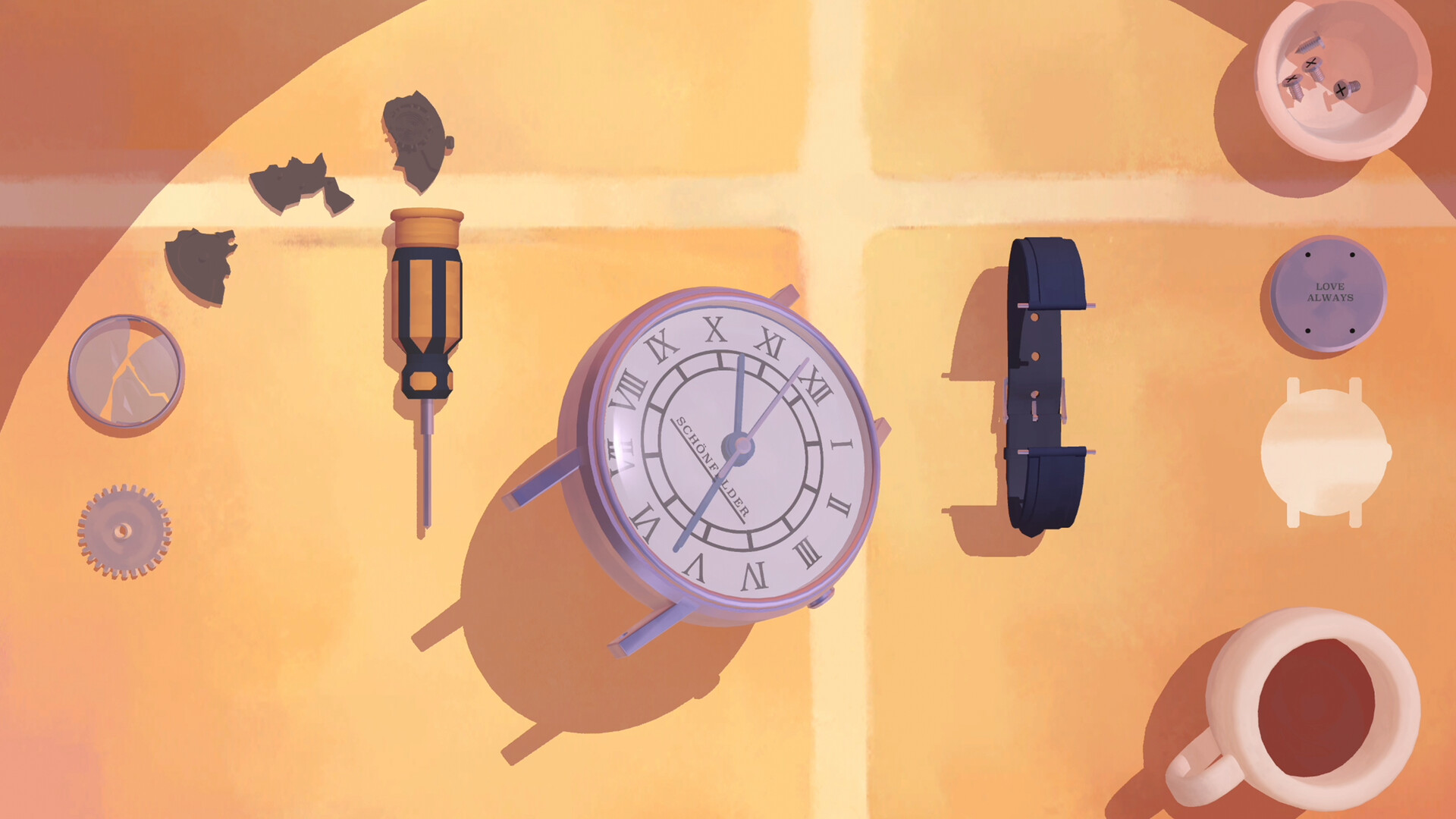
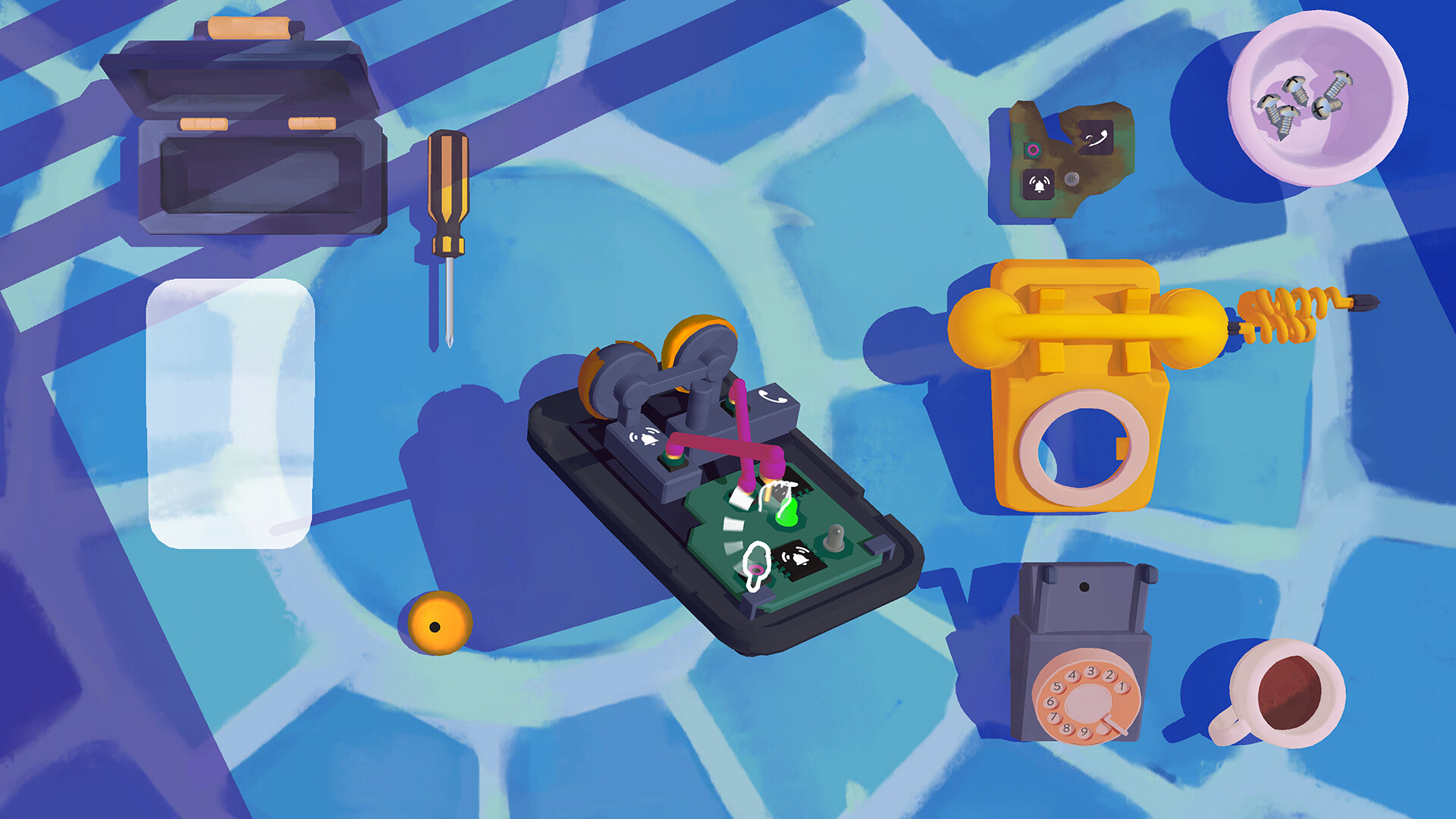
The repair puzzles ask the player to look closely at how an object is put together. A device can be rotated and inspected from several sides; screws, covers, batteries, wiring and other pieces must be handled in a sensible order. Depending on the item, the work may involve opening a case, removing or replacing a component, reconnecting parts and closing the object once its internal pieces are in place. Tools such as a screwdriver or pencil have clear practical purposes, and small components remain visible as they are set aside or returned. This turns repair into a tactile sequence of observation and action rather than a conventional abstract puzzle board. The important question is often what is wrong inside the object and how its parts relate, not how quickly the player can perform a timed input. Restoring a cassette player or watch makes its construction part of the scene, while an old handheld game or camera brings its own recognizable shape and purpose. The items differ, so the repeated act of fixing them has room for variation.
The objects also carry information about their owners. A repair might reveal a photograph tucked inside a projector or a recording held by a tape player, making the process of opening an item overlap with learning a character's history. The contents are not merely collectible clues: they connect the physical keepsake to a memory that can be difficult for its owner to discuss directly. Maria's role gives her a reason to handle those private things carefully. The game uses the player's attention to the object as a bridge between mechanical and emotional understanding: first notice how a panel or component comes apart, then recognize why what is inside matters to someone. Not every repair can be reduced to a single symbolic meaning, and the town's stories are carried through dialogue as well as the hardware. Still, the repeated pairing of an object with its owner gives the chapters a coherent shape. A restored mechanism becomes a reason for conversation, and that conversation may change how two people understand the same memory.
Bellariva's principal relationships give that sequence a longer arc. The story follows two family pairs in particular: sisters Carmen and Helena, and father and daughter Joseph and Izzy. Maria meets them through ordinary requests for help, then learns where affection, misunderstanding or loss has complicated those connections. Their possessions provide a way to talk about subjects that might otherwise remain difficult to raise. Fixing a keepsake can bring back an account of the past; repairing a gadget can create a moment in which someone asks for help or listens differently. The people are not interchangeable customers in a queue because their stories accumulate as Maria moves through the town. Earlier repairs and conversations help make later developments legible, while each character retains a distinct relationship to the object they have brought. The result is a narrative puzzle game in which practical work is the means of meeting people, not a side activity interrupting the plot. The machine may be restored in a single sitting, while trust between people takes the larger story to develop.
The mechanics stay deliberately accessible and close to the objects. Maria uses direct actions such as turning a device, undoing screws, lifting a cover, moving a part, replacing a battery or arranging a wire. The player can see the work surface and the available tools, then manipulate pieces with mouse or touch-style gestures depending on the version. The puzzles teach their language through the objects themselves: a screw holds a panel in place, a battery compartment needs power, a cable must connect to the right point. The challenge is to notice what the item needs and carry out the repair in a coherent order. The game does not frame this as a timed workshop or a score attack. It leaves room to inspect the object and uses the repair sequence to keep the player physically involved while narration and character scenes supply context. This is why the handheld electronics, timepieces and other keepsakes work as more than themed props. Their visible mechanisms shape what the player does, and their owners' stories shape why completing that work matters.
The presentation supports the scale of an intimate illustrated story. Bellariva and its people are drawn with a handcrafted, impressionistic look, while repair scenes bring the player close to the outlines, surfaces and small parts of each object. The change from storybook images to the workbench makes the puzzle feel like a focused task inside the larger narrative. Narration, voice performances and music help connect those modes: Maria's account of arriving and taking jobs gives the chapters continuity, while the soundtrack draws on the sound of the 1980s and suits the older devices she restores. Objects such as cassette players and handheld games point to a period when personal technology often had moving parts that could be opened, handled and repaired. Nostalgia is present, but the items matter because they belong to Bellariva's characters. A camera can prompt a memory, a music device can carry a voice, and a household object can stand for a relationship that needs care. The game repeatedly returns from such associations to the tangible question of how to put the thing back together.
Assemble with Care is a single-player puzzle adventure organized around a sequence of repair commissions and the people who bring them. Its central systems reinforce each other: close inspection makes the repair possible, the repair reveals an object's personal context, and the conversations around that object develop the story of Bellariva. There is no combat or character build to manage; progress comes from completing each item's mechanical puzzle and following the residents' intertwined concerns. Maria's work offers an approachable structure for stories about family, memory and reconnection without asking the player to leave the workshop's intimate scale. The town's setting, the illustrated scenes and the handled objects all support the same idea: care takes attention, whether the task is finding a loose part or hearing what a person is trying to say. Each restored possession is both a solved puzzle and a reason for someone in Bellariva to look again at a connection that has become strained. The game's restrained cast also lets those connections remain in view as Maria goes from one commission to another. The players encounter the object owner's concerns, learn what the possession means in context, and then see how that understanding changes the conversation after the repair. This repetition gives a clear structure to the short, chapter-based story without turning the town's people into a collection of isolated puzzle prompts.
- Developer
- ustwo games
- Genre
- Single-player narrative repair-puzzle adventure