
About Assassin's Creed Unity
In Assassin’s Creed Unity, Arno Dorian becomes an Assassin in Paris during the French Revolution, pursuing the people behind a conspiracy while his relationship with Élise de la Serre ties him to the Templars. Traverse a densely built city, investigate open-ended assassination missions, and shape Arno’s skills and equipment for stealth, ranged attacks or combat.
Assassin’s Creed Unity is set in Paris during the French Revolution and follows Arno Dorian, an orphan raised by a Templar Grand Master. After Arno is framed for the man’s murder, he joins the Assassins and begins pursuing the people behind a web of deceit. Élise de la Serre, Arno’s longtime companion, is connected to the Templars, so their relationship brings the two secret orders into his personal life as well as his work. The campaign moves through a period of upheaval in which events such as the storming of the Bastille and the execution of King Louis XVI reshape public life. Arno’s investigations intersect with the wider struggle between Assassins and Templars, while the story keeps its focus on his choices and his ties to Élise.
Paris is the game’s central open world, with the neighbouring royal residence at Versailles also available to explore. Streets, rooftops, courtyards and interiors connect into a continuous urban space, so crossing a district can mean threading through a crowd, scaling a façade, entering a building or descending into a lower route. Paris is divided into districts with different levels of danger, but the city is not held back behind a sequence of story gates once Arno is released into it. Synchronizing viewpoints reveals map information, and the map can then be filtered to focus on missions or other interests. Main memories and optional activities share the same urban map. The separate Dead Kings expansion adds the city of Franciade, also called Saint-Denis; that location is outside the base game’s Paris-and-Versailles campaign.
Traversal is built around precise control of Arno’s movement on the city’s tall buildings. Dedicated parkour-up and parkour-down actions let him climb or descend quickly, while freer horizontal movement helps carry a route across connected façades. Descending matters as much as climbing: Paris’s buildings and landmarks are unusually large, so a controlled way down lets Arno return to street level without searching for a haycart or leaping from every height. His movement includes sideways runs and spinning dismounts, and the city’s dense public spaces give routes multiple levels. A rooftop path can avoid a patrol, but it can also expose Arno to enemies watching above; moving at ground level may provide crowds and doorways to use as cover. The player is continually choosing a route through a city designed for both vertical and interior movement.
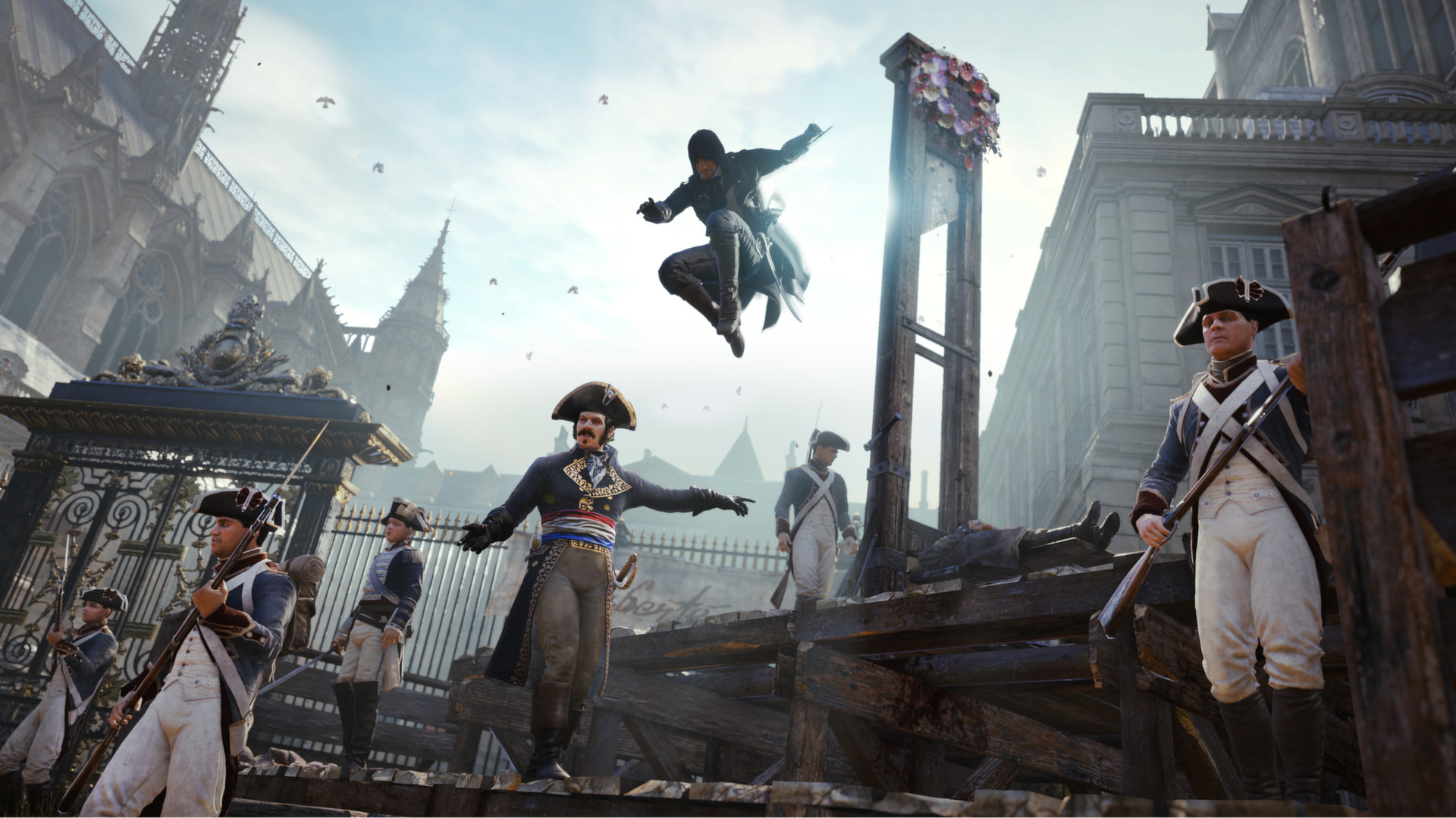
Stealth gives Arno a dedicated crouched mode and the ability to use walls as cover, from which he can observe, stab or shoot. Eagle Vision highlights enemies for a limited period, while the awareness indicators show whether guards are unaware, suspicious or hostile. After Arno breaks line of sight, the last-known-position marker indicates where pursuers begin searching, giving the player a readable chance to change direction or hide. Crowds are especially dense, and social stealth can help Arno pass through public areas; however, Unity has fewer traditional hiding places than some earlier entries, and it does not let him move or stash bodies. Smoke bombs, darts and other limited-use tools help create an opening or break contact, but consumables must be replenished at shops. These rules make concealment a matter of using cover, timing and a route, not simply disappearing into any nearby object.
Major assassinations are structured as open-ended infiltrations: the target occupies a guarded location, and Arno can search for useful routes or information before moving in. Optional sub-objectives can lead to diversions, access points or other ways to change the approach. A contact, stolen key or unlocked window may provide a different entry or bring Arno closer to the target, so the mission becomes a small planning problem inside the larger story. The game does not require every target to be reached by one prescribed corridor; gathering useful information and choosing how to use it can affect the route and the conditions around the kill. Between these set-piece memories, the Progress Tracker shows completed and available missions, and lets the player start an available mission directly. This structure links city exploration with the campaign: a nearby lead or activity can add context before Arno returns to a central memory.
When stealth gives way to a fight, Unity uses timed parries rather than the earlier series pattern of turning every successful counter into an instant kill. Enemy types have different threats: heavy Brutes can deliver attacks that cannot be parried, ranged Watchers are quick to notice Arno, and Officers combine several enemy strengths. Arno can carry one melee weapon and a pistol, or choose a rifle in place of both; melee choices include one-handed, long and heavy weapons. The Phantom Blade gives the Hidden Blade crossbow-like ranged capability. Sync Points earned through single-player missions purchase skills, while equipment pieces can adjust Arno’s attributes and provide bonuses. A player can therefore direct his build toward stealth, ranged attacks or melee, then swap weapons and gear through the customization menu. This progression broadens his options without changing the basic need to read guards and manage risk.
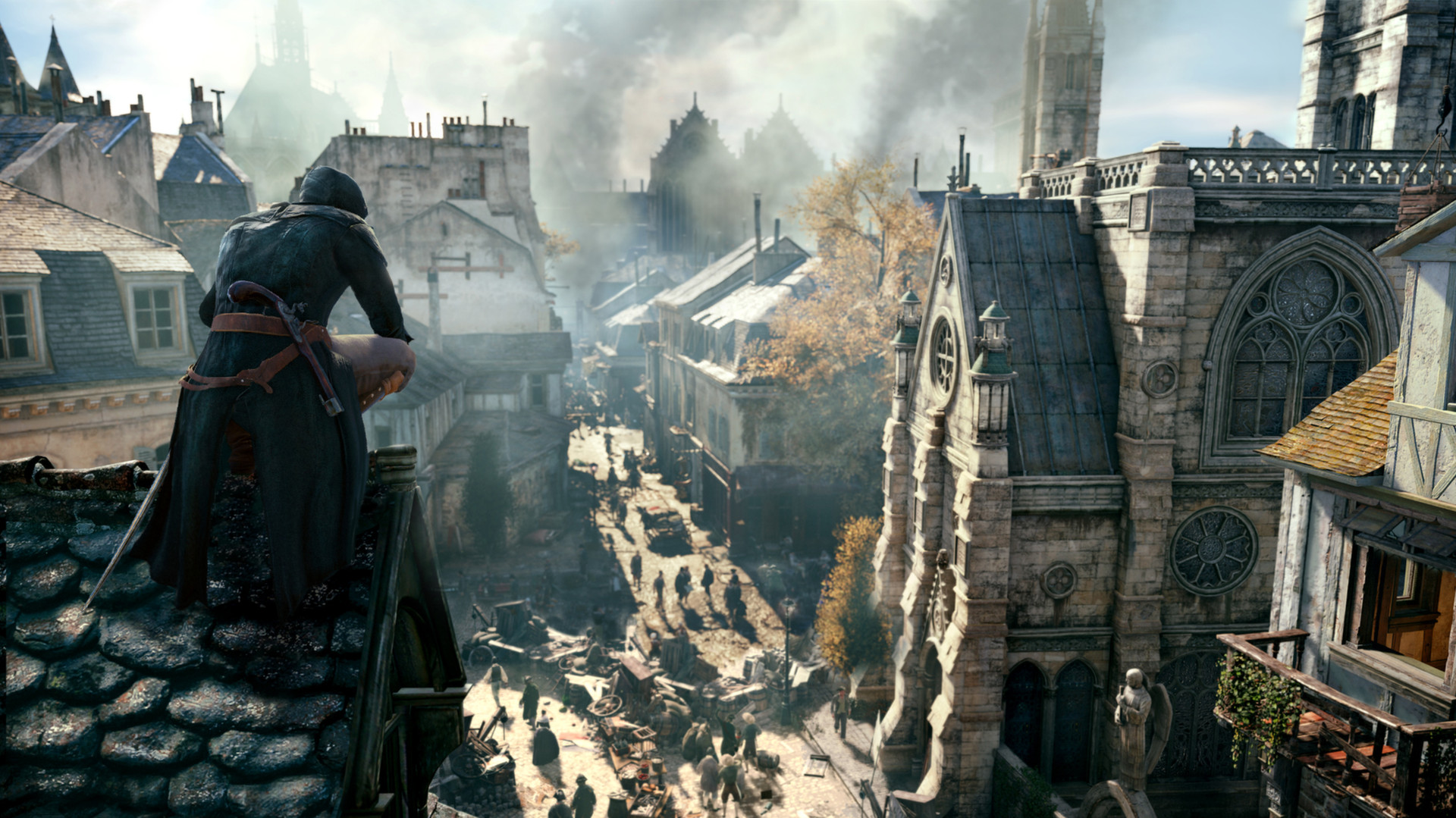
Optional investigations send Arno beyond the main campaign’s targets and into stories tied to Parisian landmarks and public figures. One murder mystery centres on the cannon clock at the Palais-Royal; another assignment has him recover guillotined heads for Madame Tussaud. Other activities follow the trails of Nicolas Flamel and Nostradamus, linking different sites across the city to the mystics’ names and legends. These quests give Arno reasons to inspect interiors and landmarks while following clues, with each investigation carrying its own subject rather than serving as another main-memory assassination. Together, they use the open city for casework as well as traversal: a clue may move the player between public streets, historic buildings and quieter interiors, adding separate lines of inquiry to the Revolution-era setting.
- Developer
- Ubisoft Montreal
- Genre
- Third-person action-adventure with stealth and parkour