
About Assassin's Creed Shadows
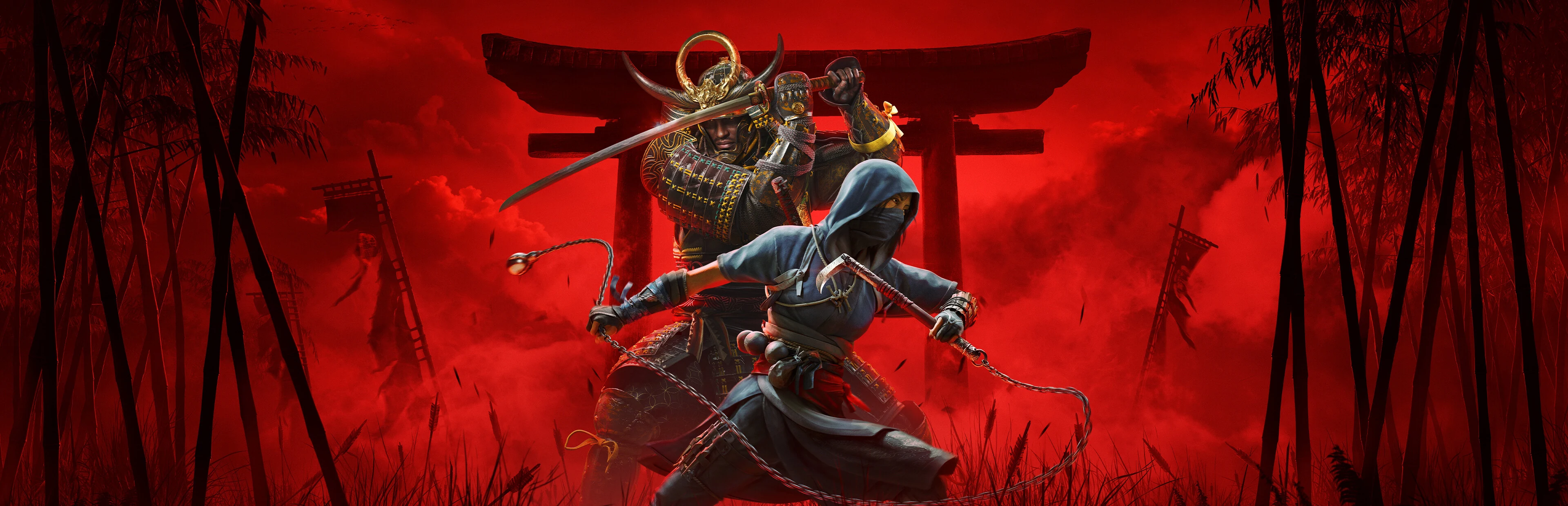
Follow Naoe, a shinobi from Iga, and Yasuke, an African samurai, through a fictionalized late-Sengoku Japan. Choose between infiltration and direct combat, gather intelligence through scouting and allies, and develop two protagonists with distinct equipment, abilities and progression across changing seasons.
Assassin's Creed Shadows follows two protagonists during the turbulent late Sengoku period of Japanese history. Naoe is a shinobi from Iga who moves through the story on a personal mission; Yasuke is an African samurai whose service in Japan places him amid the same political upheaval. Their paths intertwine across a version of feudal Japan built from castle towns, ports, shrines and rural landscapes. The setting is shaped by changing power, fortified domains and people caught in conflict, while the game's alternating perspectives let the player approach the same broad world through stealth or open confrontation.
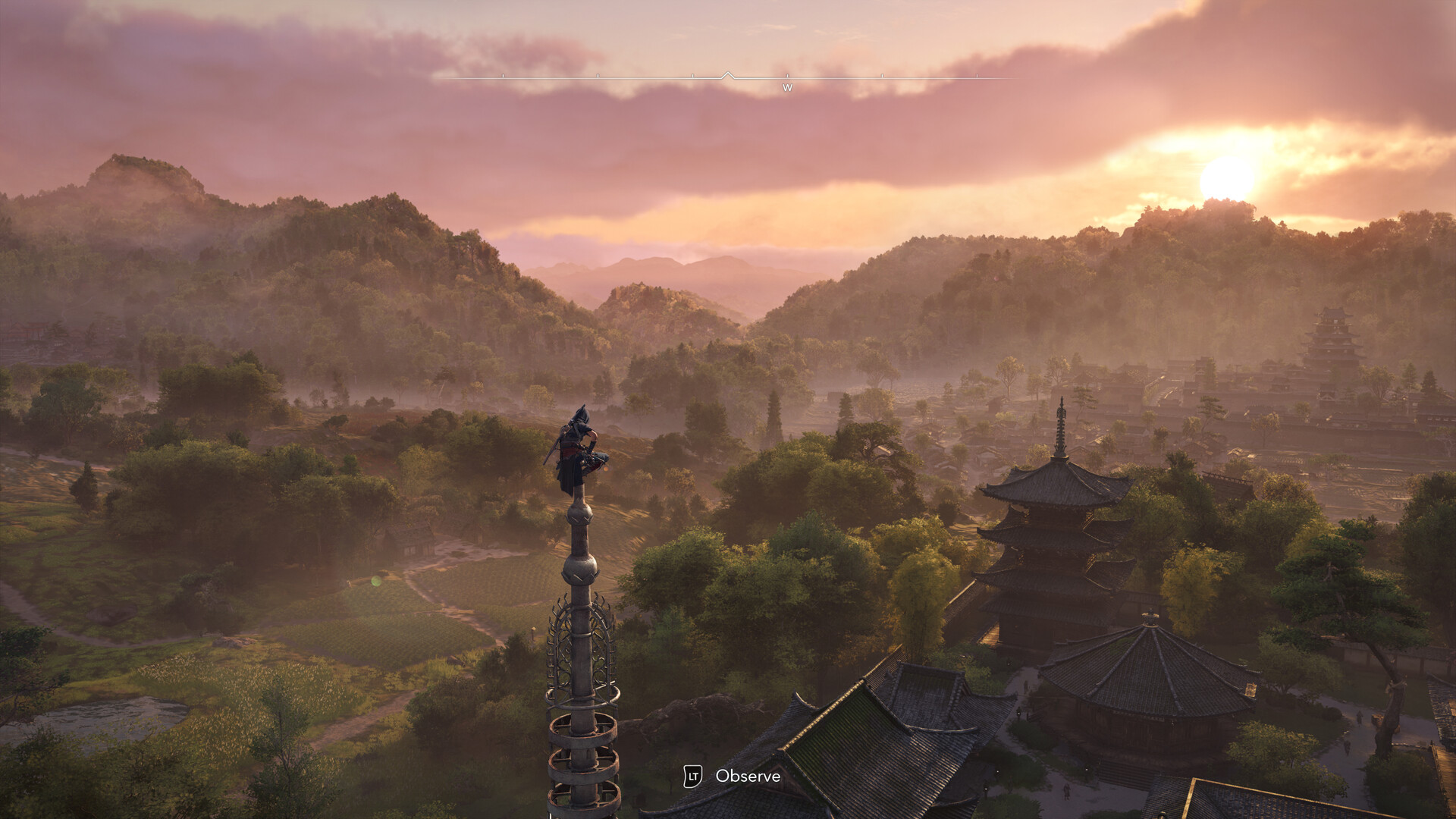
The open world is a space to investigate as well as traverse. The Observe ability helps either character identify people, tag enemies, notice objectives and examine nearby locations from a Synch Point. Naoe also has Eagle Vision, which can reveal enemies through walls and isolate sounds, making it useful for planning a route through guarded interiors. Scouting and building a network of spies adds another layer: gathered intelligence can reveal locations and targets, while allies with specialized abilities can support missions. This emphasizes preparation, where learning who is present and what a place contains can change how a player chooses to enter it.
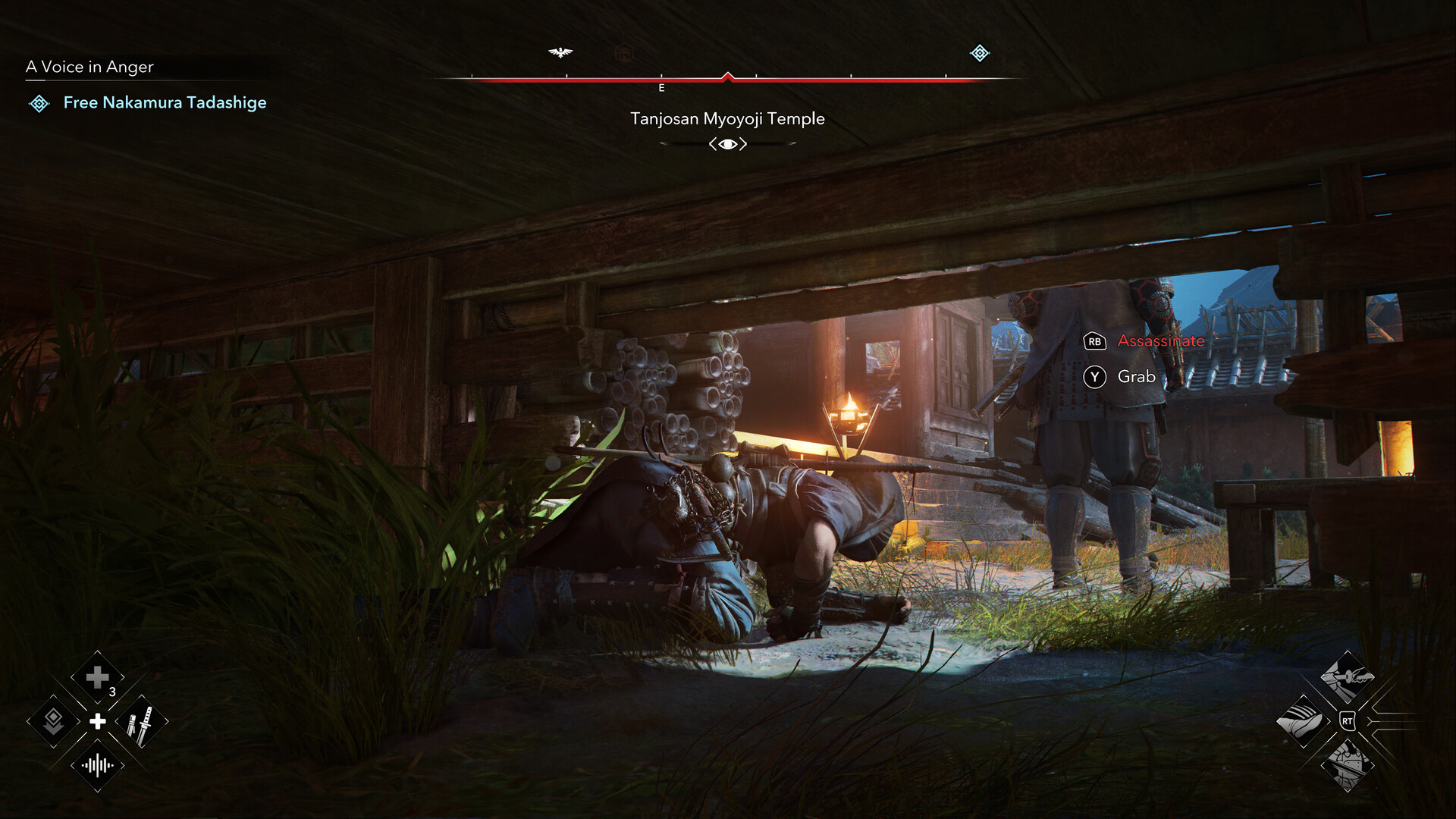
Naoe is built around stealth, agility and quiet movement. She can crouch, go prone, climb with a grappling hook and use parkour to reach rooftops or openings that a heavily armored fighter cannot exploit as easily. Light, sound and shadow affect how guards notice her; at night, pockets of darkness can provide concealment, while a shuriken can extinguish a lantern and create a darker route. Her tools include kunai, shuriken, smoke bombs and shinobi bells, which can damage, distract or disorient opponents. With the tanto and hidden blade, she can also perform a double assassination when the required skill is unlocked. Stealth is also about controlling what guards notice: a noise can draw a sentry away from a doorway, while a thrown bell can create a deliberate distraction and a smoke bomb can interrupt pursuit. If suspicion rises, the patrol's search changes the safe route through a compound; hiding in darkness or breaking line of sight can let Naoe reset the encounter. These tools reward reading guard positions before committing, because using an ability at the wrong moment may redirect attention toward the route she meant to keep open.
Yasuke approaches the same hostile spaces as a samurai with different strengths. He can block attacks with a weapon, parry to open a counterattack opportunity and withstand direct pressure more readily than Naoe. His arsenal includes the long katana, naginata, kanabo, yumi bow and teppo rifle, each changing his reach, speed or ability to deal with groups. The heavy kanabo can break defenses but demands careful timing, while a bow or rifle can strike from range before opponents close in. Yasuke can use stealth in some situations, particularly with his bow, but his equipment and abilities favor a more forceful approach once combat begins.
Both protagonists share a combat foundation built around quick and heavy attacks, charged Posture Attacks, dodges and timing-based defense. Holding an attack input charges a blow that can break an enemy's guard; a successful perfect dodge may leave a foe vulnerable to a counter. Yasuke's parry pushes an enemy back, whereas Naoe's deflection turns her around an opponent and exposes a flank, so a defensive response also affects positioning. Enemy families such as Ashigaru, Ronin and trained samurai apply different pressures. Strong foes may resist a frontal assassination or interrupt a slow attack, encouraging the player to change weapons, use an ability or return to stealth.
Progression develops each character through separate Mastery trees, weapon abilities, gear and statistics. Experience and defeating specific foes can earn Mastery Points for weapon-based skills; Knowledge ranks, gained through activities such as shrine visits, meditation or learning kata, open further options in the trees. These nonviolent activities give the two characters ways to grow outside of combat, and some Knowledge is shared between them. Weapons and armor carry levels and stats, while perks can affect posture attacks, critical damage or other combat properties. At the Hideout's Forge, equipment can be upgraded, dismantled or engraved with perks, and a Gallery can preserve saved loadouts.
The world also changes through weather and the passage of seasons, which alter the look and behavior of familiar environments. Investigation threads appear on the Objective Board and world map, linking discoveries, targets and gear opportunities to the larger pursuit. Merchants sell equipment, resources and cosmetics, and can buy surplus gear or valuables for the era's currency. The Hideout acts as a home base for the paired protagonists, where built facilities support equipment management and the Gallery displays customized weapons and clothing. The result is a campaign that connects Japan's contested landscape to two parallel growth paths, giving the player room to change tactics as targets, enemies and terrain shift.
It launched in 2025, and the free additions made since then are already in the base game. Support has moved into a winding-down phase of smaller, less frequent updates, so the shape it has now is close to the shape it will keep.
Two heroes, two toolkits, shared levels
Naoe is the shinobi half. Her kit is noise, light and shadow: kunai and shuriken as damaging throwing tools, smoke bombs for concealment, a grappling hook and parkour to get above a problem, and the hidden blade to end it once nobody is looking. Stealth is her strength rather than her only option — she can fight when an approach goes wrong — but a straight stand-up scrap is the situation she'd rather not be in.
Yasuke is the other answer entirely. Katana, kanabo, bows and naginata, with combat skills built around attacking, blocking and parrying, and a bow for silent takedowns. He can sneak his way through some of the same ground Naoe does, just with a far smaller toolkit for it, which is why a courtyard full of people is the situation he's built for.
Progression is two tracks, not one, and the split is worth understanding before you commit. Character level rises from just about anything you do and lifts both heroes' base stats, and Knowledge, which you build by clearing the map activities marked with an orange hexagon, is shared: there are six ranks of it between them, and each rank opens another tier of passive and active abilities for the pair. The gear and the Mastery menus are where Naoe and Yasuke stop sharing. A build you assemble for one doesn't hand the other the same numbers.
Quests are not all open to both, either. The campaign runs two storylines, one per hero, and each has its own missions, so the honest version of "play whoever you want" is that you choose where the game lets you. The early hours are fixed as well: after a short opening as Yasuke, you play as Naoe for a long stretch with no access to him at all before the pair open up.
The country changes under you
Shadows runs on dynamic seasons, shifting weather and reactive environments, and the game treats those as conditions rather than scenery: enemies respond to their changing surroundings. The seasons also set the rhythm of the map in ways you can plan around. Scout numbers are replenished at the start of a season, or bought back at a Kakurega for a fee, and seasonal caps apply elsewhere — corrupted castles, for instance, are limited per season rather than unlimited. What the game doesn't offer is a promise that a route stays valid, so what you found on one pass is worth re-checking rather than assuming.
The useful habit this builds is to scout before committing a hero. Height first, because a rooftop view shows the patrol pattern before you commit to anything. Then the light you stand in, because being somewhere a guard could see you is a separate problem from being somewhere a guard is looking. Then the tools: a shuriken or kunai is a real attack that can also move a guard's attention, and a smoke bomb buys you concealment, so you're choosing what happens next rather than picking a distraction. Assassination is the last step of an approach that has already worked, not a plan for one that hasn't.
Information is the third resource
Beyond the moment-to-moment stealth, Shadows gives you a network: spies to place across the map, scouting to reveal what's actually there, and allies with specialised skills to recruit. It changes the shape of the game from clearing markers to deciding which markers are worth the trip, and it pairs well with a two-hero roster, because knowing what's inside a fort usually tells you which of them to send.
What arrived after launch
The paid centrepiece is Claws of Awaji, an expansion that adds a new region on the island of Awaji, a new storyline and new enemies, and which Ubisoft describes as more than ten hours of adventure. It is included in the Premium Edition and also sold separately, and that edition adds legendary gear and weapon sets for both heroes, a legendary mount and trinket, and four hideout ornaments. Check any existing expansion entitlement before buying it again, and compare the listed contents of the edition you are considering.
Domains is the endgame, and it arrived free. It is five new simulations across ten challenge levels, unlocked at level 30, where higher difficulty applies more modifiers to your build rather than simply scaling enemy health, so different Domains can call for different builds. Domain gear, engravings and a progression tree come from MOD's own shop and in-game currency, and the Domain-exclusive items are not sold in the store or the exchange.
Around that sit a free story quest, Black Tides, which asks you to finish both main stories and two specific post-launch quests before it opens; an additional Animus Rift; a pair of crossover Projects in the Animus HUB with themed rewards; a detailed stats page; and manual jump added to the advanced parkour options. A later update also put a non-Legendary Bo weapon into the open world for players who don't own the expansion. On the technical side, PlayStation 5 Pro picked up PSSR 2 support and Nintendo Switch 2 picked up mouse-and-keyboard support.
Where the game stands now
Support has moved into a winding-down phase, and that has played out as bug-fix title updates — one of them described in its own notes as the closing title update for the game — followed by a quick user-interface patch. Support winding down isn't a promise that nothing else will ever arrive, and a "closing" patch is a description of that update rather than a guarantee about the future. Plan around the features available now.
The practical reading is that you can buy this and expect the game as it stands rather than a roadmap. It is out now on PlayStation 5, Xbox Series X|S and Nintendo Switch 2, on Windows PC through the Ubisoft Store, Steam and the Epic Games Store, on Macs with Apple silicon via the Mac App Store, and through Ubisoft+ and Amazon Luna. An iPad release is announced rather than available. What you get depends on the edition rather than the platform: the standard copy is the base game, the Premium Edition adds Claws of Awaji and its associated gear and hideout extras, and the Collector's Edition adds cosmetic packs on top of that.
Should you play it
Yes, if you want an Assassin's Creed where the stealth is a real discipline and the choice between two playstyles is the actual game. The two heroes have genuinely different answers to the same fort, the seasons change what the map offers you, and Domains asks you to rework a build rather than out-last it.
Skip it if you want a game that will keep growing, because the support window is closing on purpose, or if being asked to invest in both heroes sounds like homework rather than a sandbox. Play with one of them exclusively and you will find story missions that wanted the other, which is a design choice worth knowing before you start rather than after.
Go deeper with V4mp
- Developer
- Ubisoft Quebec
- Genre
- Action adventure
Explore Assassin's Creed Shadows further
Explore the wiki for detailed reference pages on the game's world, systems, items and locations.