
About Assassin's Creed Rogue
Assassin’s Creed Rogue follows Shay Patrick Cormac as a fracture with the Assassin Brotherhood turns him toward the Templars. Its campaign crosses eighteenth-century New York, frontier river country and the icy North Atlantic, combining stealth, close combat, ship battles and exploration aboard the Morrigan.
Assassin’s Creed Rogue places Shay Patrick Cormac inside the eighteenth-century conflict between the Assassin Brotherhood and the Templar Order, then makes his changing allegiance the centre of the campaign. Shay begins as an adventurous Assassin whose confidence in the Brotherhood’s methods is shaken by events he witnesses. The story follows the consequences of that break and the skills he turns against former allies. It is a North American chapter linked to the period and characters of Assassin’s Creed III and Assassin’s Creed IV: Black Flag, while remaining focused on Shay’s own decisions. Missions are presented as memories from his life, so the main campaign advances through a sequence of specific objectives rather than a free-form set of faction choices. The player guides Shay through that account; the game does not offer a branching allegiance system.
The playable world connects three contrasting areas: the North Atlantic, the River Valley and a recreation of eighteenth-century New York City. The North Atlantic is open water framed by cold conditions and icebergs, where the Morrigan moves among islands, forts and ships. The River Valley combines navigable waterways with stretches of frontier that Shay can explore on foot, allowing travel to shift between sailing and climbing or combat on land. New York provides a denser urban environment for rooftop routes, streets and missions. Each location gives the main story and free exploration a different texture: ship handling matters most at sea, while settlement and wilderness spaces invite scouting, traversal and encounters on foot. The game lets players leave campaign memories to range through these regions and return to the story later.
The campaign is organized into sequences of memories, each with its own required goals and optional objectives. A memory may ask Shay to reach a target, escape a pursuit or complete an action under a condition such as remaining undetected; meeting optional conditions improves synchronization for that memory. The objectives appear as the relevant section begins, and completed memories can be replayed, so a missed condition does not have to be corrected during the first attempt. Between story missions, the open areas support side activities, hunting, ship and equipment improvements, and exploration. This structure means progress can alternate between a directed mission and a self-chosen excursion rather than requiring every map activity before the next story beat. A progress tracker records campaign and activity completion, while brief present-day interludes frame the memories without replacing Shay’s historical campaign as the main focus.
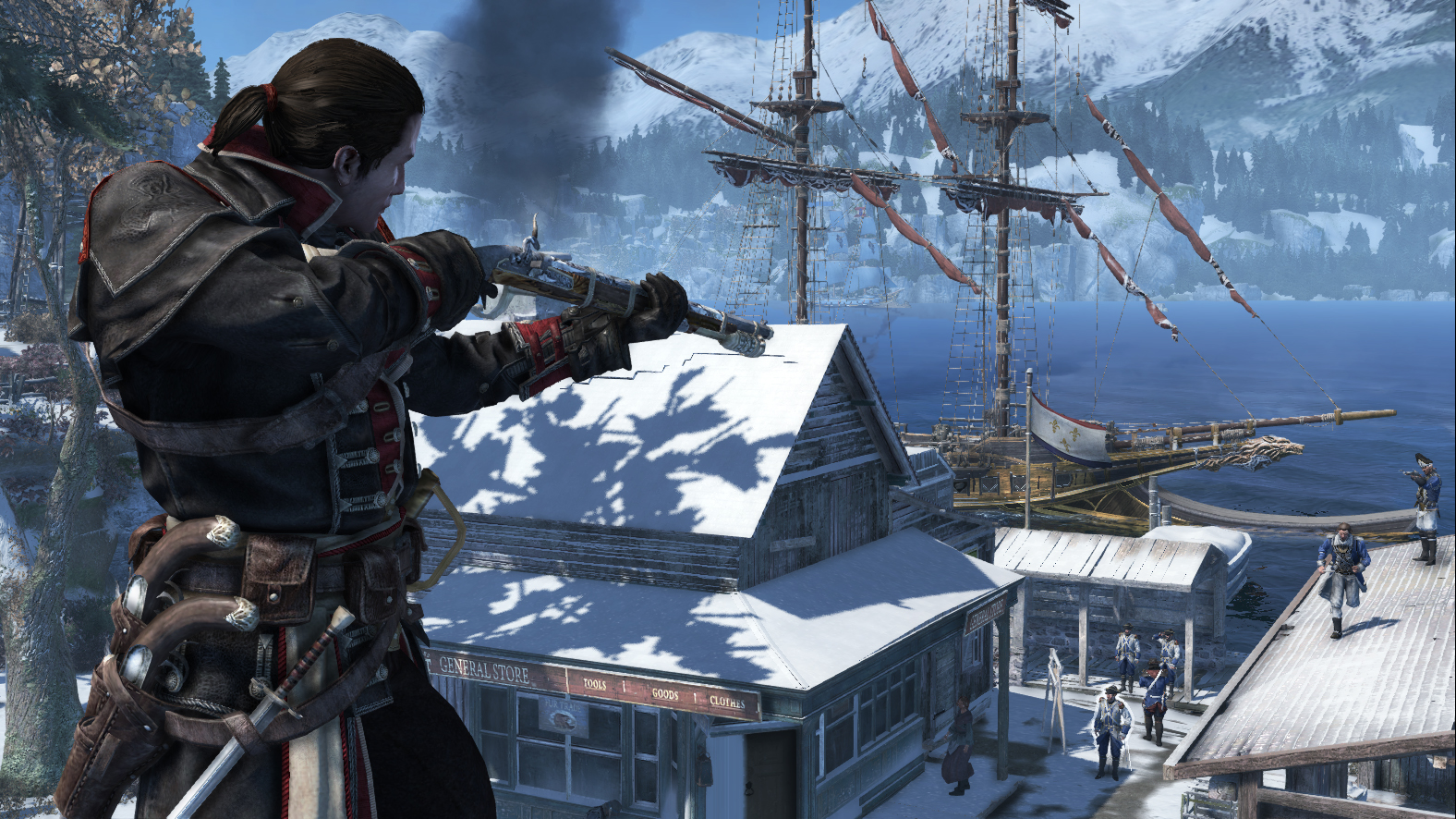
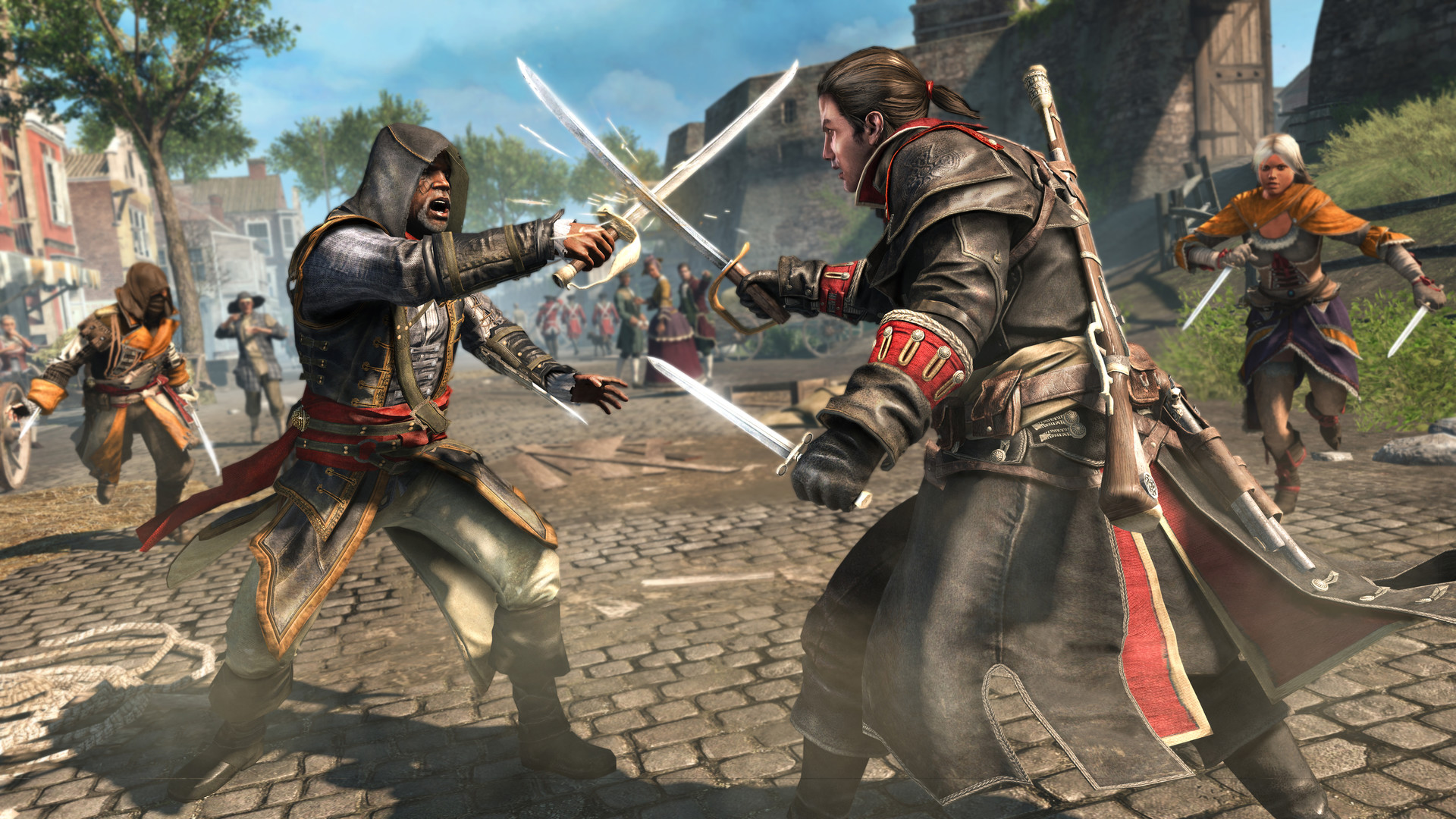
On land, Shay can move between stealth and direct fighting with hidden blades, pistols, a sword-and-dagger combination and an air rifle. The hidden blades suit quiet close-range eliminations; the air rifle extends that approach with darts for a single target and grenade ammunition that can affect groups. In open combat, the sword and dagger rely on counters, breaking an opponent’s guard and following with attacks, while smoke bombs create a short chance to break contact or disrupt a group. Different weapons give the player alternatives when approaching a guarded site: mark and avoid patrols, use a ranged tool to thin them, or accept a fight and manage several attackers. Some mission objectives impose their own constraints, so a tactic useful in one memory may fail an optional requirement in another.
Rogue also changes the direction of its stealth encounters: Assassins can hunt Shay. He can intercept pigeons carrying Brotherhood messages, search haystacks for hidden opponents and block air assassinations. Assassin Stalkers attack from concealment and can be detected with Eagle Vision. That threat makes the familiar tools of observation and hiding relevant defensively as well as offensively. Shay can use Eagle Vision to reveal concealed opponents, watch for an ambush, and choose whether to take the fight or move out of danger. Other enemy groups bring distinct pressures: scouts pursue and tackle, gunners attack from range, and heavier fighters punish careless frontal exchanges. Recognizing which threat is present changes how an approach unfolds without turning the campaign into a pure stealth game.
At sea, Shay captains the Morrigan, a sloop-of-war that carries Rogue’s second major action loop. Broadside cannons reward lining up a ship beside the target, while front weapons and the stern-facing burning-oil trail serve different positions; the oil can leave a wall of fire behind the Morrigan. Its icebreaker ram also lets the ship push through icy obstacles and collide with enemies. A Puckle gun can strike highlighted weak points and sweep an opposing deck as the vessels close for boarding; heavier opponents can call for mortar fire at range. Once a ship is weakened, the player may board it, fight its crew and take cargo. The encounter therefore links steering, weapon selection, protecting the crew and the decision to capture the vessel, with ice, weather and enemy fire shaping movement across the water.
Improvements tie those activities together. Money and recovered materials support stronger ship weapons and hull protection, while storage and crew upgrades affect how long the Morrigan can operate and how much it can carry. On land, Shay’s equipment can be upgraded or changed, and animal parts gathered while hunting can be crafted into lasting improvements to health, weapon capacity and carrying limits. The distinction matters: buying or crafting a better tool changes what Shay can bring to later memories, while changing an outfit is usually cosmetic. As players move between memories, ports and open regions, combat and exploration can feed upgrades that make the next sortie more capable.
- Developer
- Ubisoft Sofia and Ubisoft Kiev
- Genre
- Action-adventure; stealth and naval combat