
About Assassin's Creed Mirage
In ninth-century Baghdad, street thief Basim Ibn Ishaq joins the Hidden Ones and trains under Roshan, pursuing answers to the visions that haunt him. Move through the city by parkour and social stealth, investigate the Order of the Ancients, and plan assassinations with a growing set of tools as Basim's place in the Creed changes.
Assassin’s Creed Mirage follows Basim Ibn Ishaq before the events in which he appears in Assassin’s Creed Valhalla. He begins as a street thief in ninth-century Baghdad, troubled by recurring visions and looking for a way beyond the life he knows. After meeting the Hidden Ones, the organization that preceded the Assassins, Basim travels to their stronghold at Alamut and becomes Roshan’s apprentice. His training places him inside a conflict between the Hidden Ones and the Order of the Ancients, while his personal search for answers develops alongside his work as an Assassin. The story centres on Basim’s coming of age and the relationships that shape his understanding of the Creed; it does not follow Valhalla’s Viking-era setting or Eivor’s campaign.
Baghdad is the main space for that story: a dense city divided into four districts, including the industrial quarter of Karkh and the Round City’s gardens. Basim can move between street level, rooftops and interiors using parkour, and the city’s crowd is part of stealth rather than scenery alone. He can blend into groups, use hiding places and slip past guards, while climbing gives him routes over walls and into guarded compounds. The districts contain bureaus where the Hidden Ones organize their work, contracts that offer smaller assignments, and world events involving the city’s residents. Historical figures also appear in the city. Viewpoints reveal more of the map, while observation with Enkidu, Basim’s eagle, helps locate people and points of interest from above; marksmen can threaten the bird, making their position relevant to reconnaissance.
The larger investigations turn scattered leads into a route toward an Order target. At a bureau, Basim can take contracts, then follow clues, favors and story missions to uncover identities and weaknesses. These steps may send him to search a warehouse, recover confiscated goods, question a witness or gain access to a gathering. Investigation is therefore connected to movement through the city: a clue can expose a new lead, an errand can earn access to a protected place, and information can suggest where to enter or whom to approach. Major assassinations use a Black Box structure, in which the target’s guarded setting contains different ways to learn, infiltrate and reach the kill. The player observes the environment and chooses among available routes rather than receiving one fixed path through every encounter.
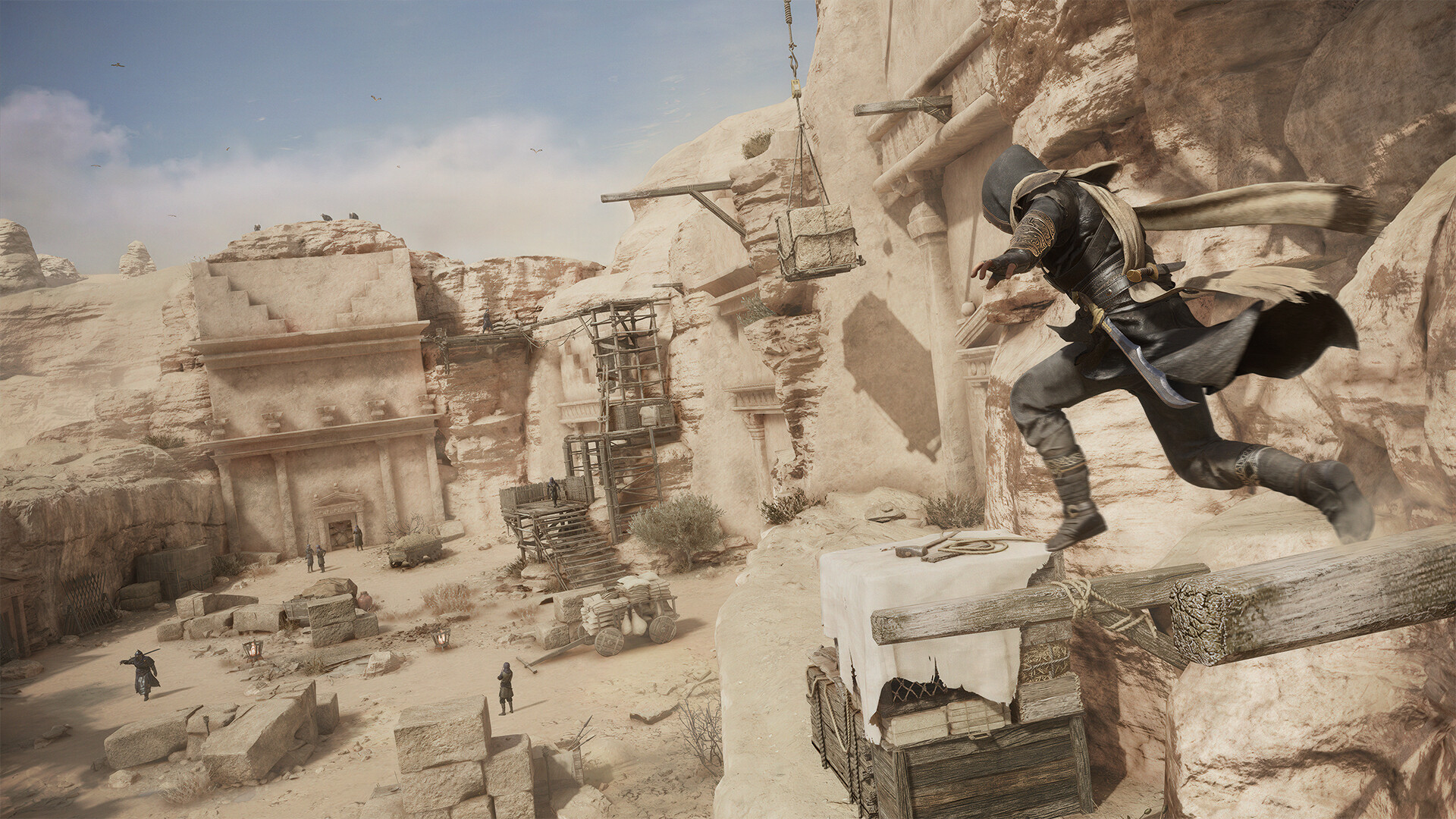
Stealth rests on staying unnoticed and deciding how to respond when a plan changes. Basim has a Hidden Blade for close takedowns, throwing knives for distant targets, and tools such as smoke bombs, traps, blowdarts and noisemakers. Their upgrades can change how a tool functions, so the same equipment slot can support distraction, a quiet takedown or an escape. Objects in a compound can also create opportunities: an explosive oil jar can be used against a barrier or nearby enemies, while spices can produce a temporary smokescreen when struck. If guards raise an alarm or Basim is spotted, smoke and hiding places can break pursuit and help him disappear into the streets. Combat remains possible, but Basim is less suited to trading blows with a group than to avoiding the fight or controlling its opening.
Assassin’s Focus gives Basim another way to handle a tightly guarded space: he can slow time, mark up to five enemies and execute them in a rapid sequence. This is part of the approach rather than a replacement for scouting; Basim still has to identify threats, reach a position where the sequence can be used and avoid leaving himself exposed afterward. His tool selection can be expanded and modified, and the skill tree offers upgrades that support those choices. Contracts, investigations and the main story provide reasons to revisit the city’s districts, while the player decides when to rely on crowd blending, a distraction, a direct infiltration or a planned escape.
When stealth breaks, the combat system asks for measured timing. Basim fights with a sword and dagger; attacking and dodging consume stamina, while a well-timed parry can recover some of it. An enemy’s attack can leave Basim open if he commits to a swing at the wrong moment, so parrying, dodging and creating space matter more when several guards are present. The contrast encourages players to read a patrol and use the environment before entering a fight. If the city’s attention rises, wanted posters can be torn down and officials bribed to reduce notoriety, while pickpocketing crowds returns as a way to obtain valuables. These systems tie public behavior, resources and stealth together: actions that attract witnesses can make later movement harder, and money or tools can help prepare for another assignment.
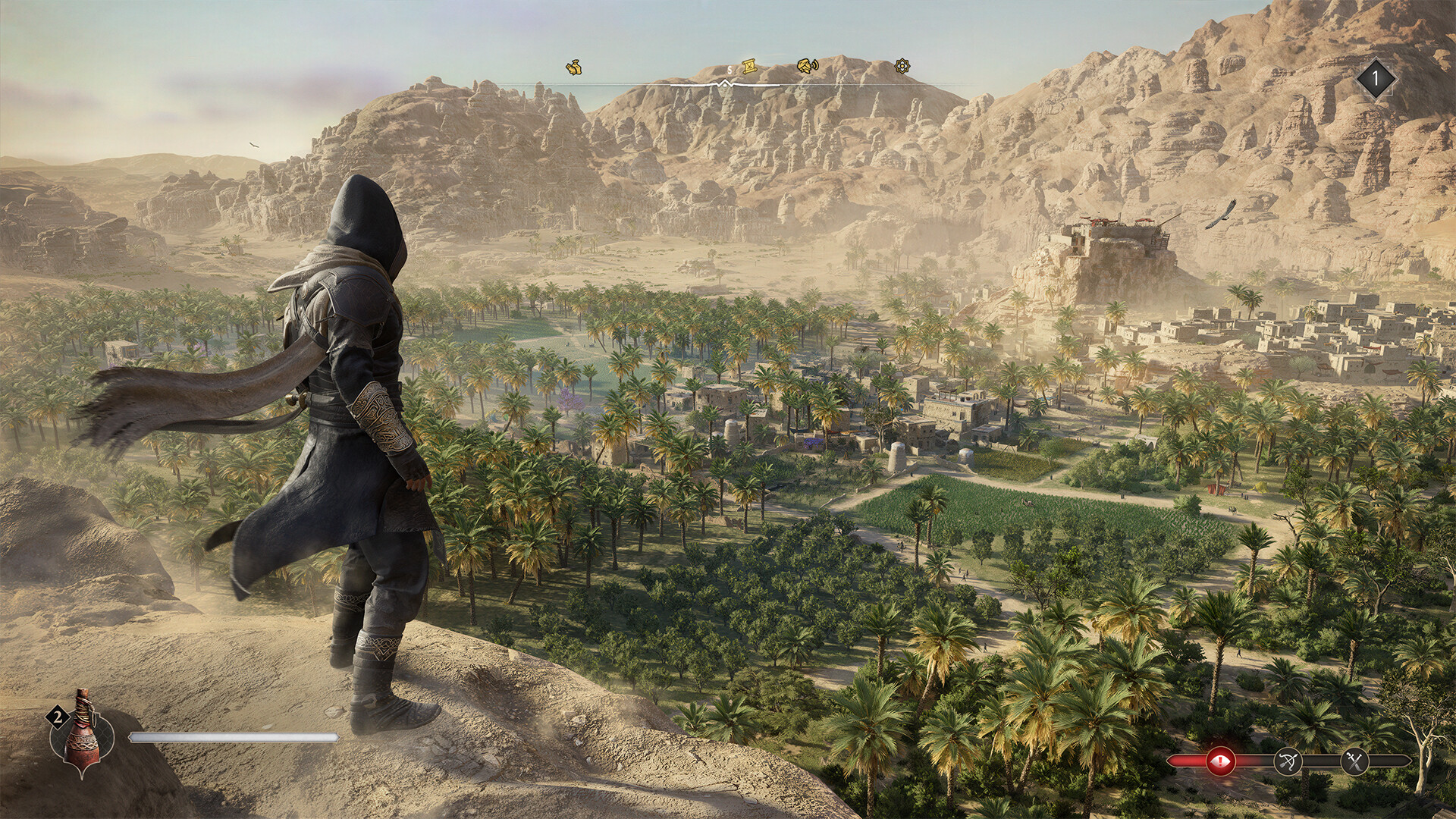
Valley of Memory adds a separate story arc in AlUla, where Basim investigates rumours that his long-lost father might still be alive and a gang threatening the valley. It takes place before the main adventure’s finale. A later update also made completed Black Box missions and contracts replayable through Animus Sequences. Each sequence can add challenges, such as finishing without Eagle Vision, killing only the main target or staying undetected, and completed challenges unlock rewards including Animus mods. Those mods can change a replay sequence or a New Game+ run, giving missions an additional challenge layer after their first completion.
- Developer
- Ubisoft Bordeaux
- Genre
- Third-person action-adventure with stealth and parkour