
About As Dusk Falls
In 1998 Arizona, the Walker family’s road trip collides with the Holt brothers’ botched robbery at a roadside motel. This interactive drama follows both families across decades as player choices shape relationships, survival and later events. Dialogue decisions, brief action prompts and scene searches guide a branching story presented through layered, digitally painted images.
As Dusk Falls begins in small-town Arizona in 1998, where a robbery gone wrong brings two families together at a roadside motel. The Walkers are travelling toward Missouri to make a fresh start, while the Holts arrive from a nearby town burdened by debt and a reputation for trouble. Vince Walker is the father at the centre of the first family’s crisis; his young daughter Zoe is also present, and the Holt brothers’ decisions pull the motel occupants into a tense standoff. The story follows the consequences beyond that night, moving through different points in the characters’ lives over three decades. Its focus is the way one dangerous encounter links people whose histories and priorities were already under strain.
The player guides several members of both families rather than controlling one hero from beginning to end. Conversations present choices about what to say, what to conceal and how to respond under pressure. Some responses appear on a timer, so a hurried exchange can close before every option has been considered; pivotal Crossroads decisions instead provide more time to choose. Smaller answers matter alongside those marked turning points, shaping trust, conflict and the way people interpret one another. The result is a branching drama in which a decision’s meaning may become clearer only after later scenes. A choice can affect a relationship or the next immediate danger, while another can send the story toward a substantially different path. These decisions also make relationships part of the playable story: Vince’s family bonds and the Holts’ ties can be strengthened or strained by how their members act when frightened, divided or under pressure.
The story is divided into two books and six chapters, moving between the 1998 crisis and later events that show its lasting effects. This structure lets the perspective shift as the Walker and Holt stories develop, bringing the player into the concerns of different characters rather than treating the motel incident as an isolated plot. Family loyalty, financial pressure and the desire to escape past mistakes influence why people take risks, but the game leaves room for a player’s responses to change how those pressures play out. Character outcomes can diverge, and events set in motion early may surface much later. The timeline connects these scenes while leaving visible branches that a single sequence of choices will not reveal. The jumps through time are a way to see how an earlier decision continues to shape the lives of the families, rather than a separate mode or a new playable campaign.
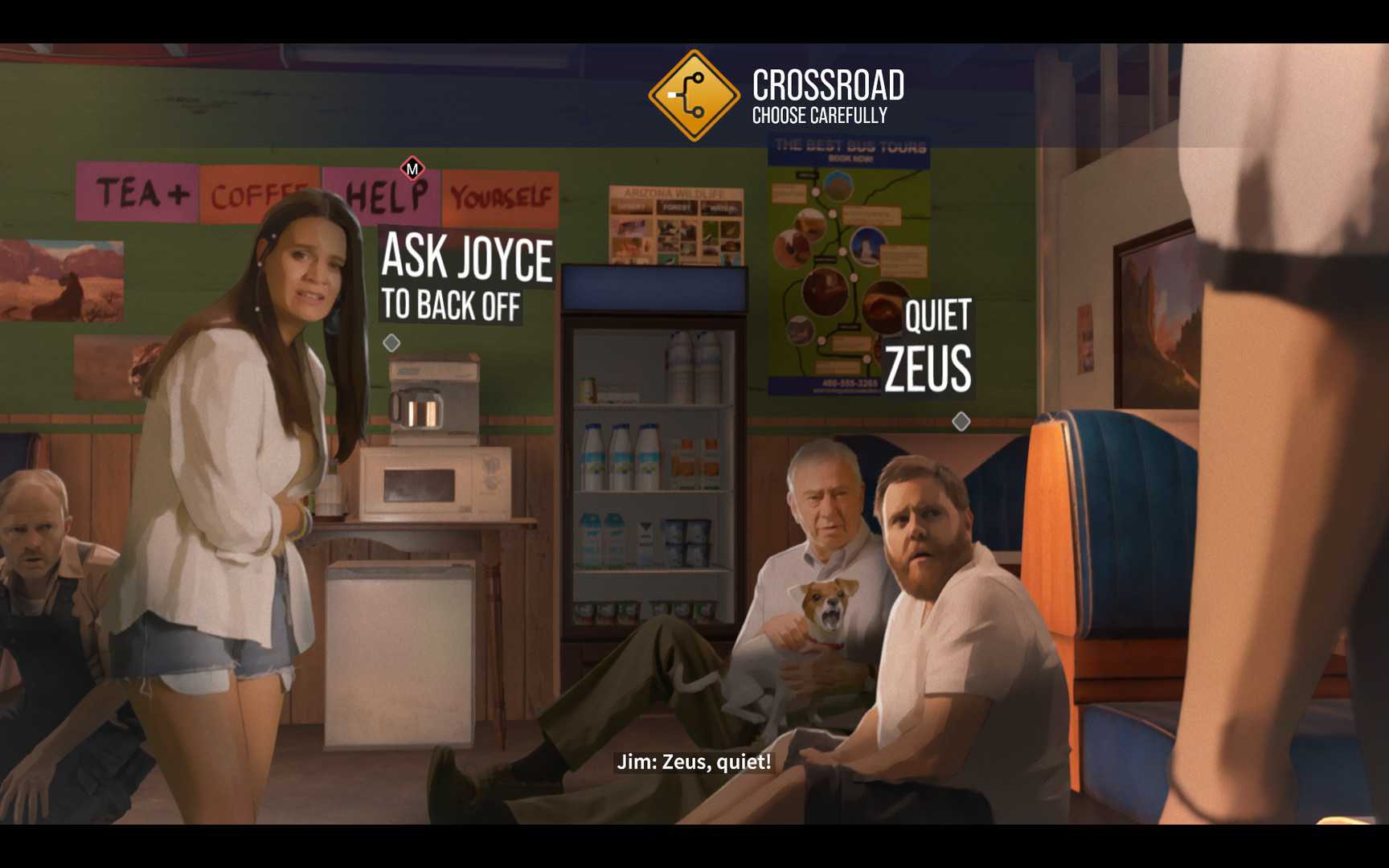
Between conversations, short point-and-click searches let a character inspect a scene and interact with selected objects. These moments offer a little time to look around, but the experience remains built around narrative decisions rather than free movement through a continuous 3D space. Action sequences use quick-time prompts that ask for timely button presses or directional inputs; succeeding or failing can affect what happens next. The interface makes the player’s role clear: choose a response, examine a limited part of the surroundings, or react when a scene calls for it. A missed prompt is not simply a score loss, because these actions can carry consequences for the people caught in the situation. In tense moments, a character may have to act before a timer expires, and the available response can define how the following exchange unfolds. Scene searches are similarly brief, providing a handful of interactions within a story that otherwise advances from one cinematic sequence to another.
The game records decisions in a branching story tree that appears after chapters. It maps paths already taken against scenes and outcomes still unseen, showing how a route can split and later reconnect with major events. Chapter replay points allow a player to return to selected moments and try a different decision, with an option to retain or replace what happened before. The tree also places a choice beside the share of players who made the same selection, while chapter summaries show character traits associated with the decisions. These tools make the narrative structure visible without turning every branch into a separate full-length campaign. They also help distinguish an immediate variation from a choice whose consequences emerge later. Revisiting a key point lets the player test a different path from that point, while the broader tree provides context for how that change may redirect subsequent scenes and character relationships.
As Dusk Falls can be played alone or with a group of up to eight people, locally, online or in a mix of the two. During cooperative play, each participant can vote on story choices; the game resolves the group’s decision and moves the shared narrative forward. A companion app lets additional local players use a phone or tablet to take part, while Steam lists shared-screen and online cooperative features for the PC version. The format changes who participates in choosing, but the same character-focused scenes and action prompts remain at the centre. Its visual presentation supports that emphasis: digitally rendered actor performances are arranged as painted, largely still images, with shifts between frames and moving environmental details giving scenes the feel of a motion graphic novel. This layered look is distinct from fully animated character movement, and it keeps attention on expressions, dialogue and the changing composition of each scene as the story moves between viewpoints.

- Developer
- INTERIOR/NIGHT
- Genre
- Adventure