
About Arx Fatalis
After a solar catastrophe leaves the world without sunlight, its peoples retreat into caverns and mines. Arx Fatalis is a first-person role-playing game about a nameless prisoner trying to survive this underground civilization and oppose the destructive force threatening it, using trained skills, weapons, stealth, magic and close interaction with the world.
Arx Fatalis begins after a solar catastrophe has driven the world’s peoples below ground. Humans, goblins, trolls, dwarves and other races now inhabit a connected network of caves, mines, temples and settlements, where light, food and safe passage matter. The player awakens in a prison with no memory or name and must escape into this fragile society. Its human city of Arx and the Goblin Kingdom are distinct communities with their own pressures and interests; the threat of Akbaa, a destructive god, hangs over a civilization already strained by scarcity and conflict. Rather than moving between outdoor regions, exploration descends through an inhabited world built beneath the surface.
The main rhythm is to investigate places, speak with inhabitants, follow clues and decide how to handle obstacles while pursuing the larger threat. A drawer, cushion, book or overlooked object can hold information or a useful item, so observation has practical value. The spaces connect in ways that let players reach dangerous areas before their character is prepared, and several tasks can be pursued at once or in different orders. Conversations carry clues that the diary may record only vaguely, making it useful to listen closely and inspect the environment instead of treating each objective as a marked waypoint. The result is a role-playing adventure structured around returning to places with new knowledge, testing possibilities and choosing when to press deeper.
Character creation and advancement shape which approaches are dependable. Attributes such as strength, intelligence, dexterity and constitution affect physical capability, mana, accuracy and resilience; skills cover areas including close combat, distance weapons, magic, stealth, technical ability, intuition, object knowledge and defense. Experience levels grant points that can be assigned to improve the character. Technical skill helps with locks, doors and traps, while intuition aids in noticing hidden objects and passages. Object knowledge supports repair, potion brewing, weapon poisoning and identifying items. These related abilities make progression more than a simple damage increase: investing in a skill can change which environmental and social problems are practical to tackle.
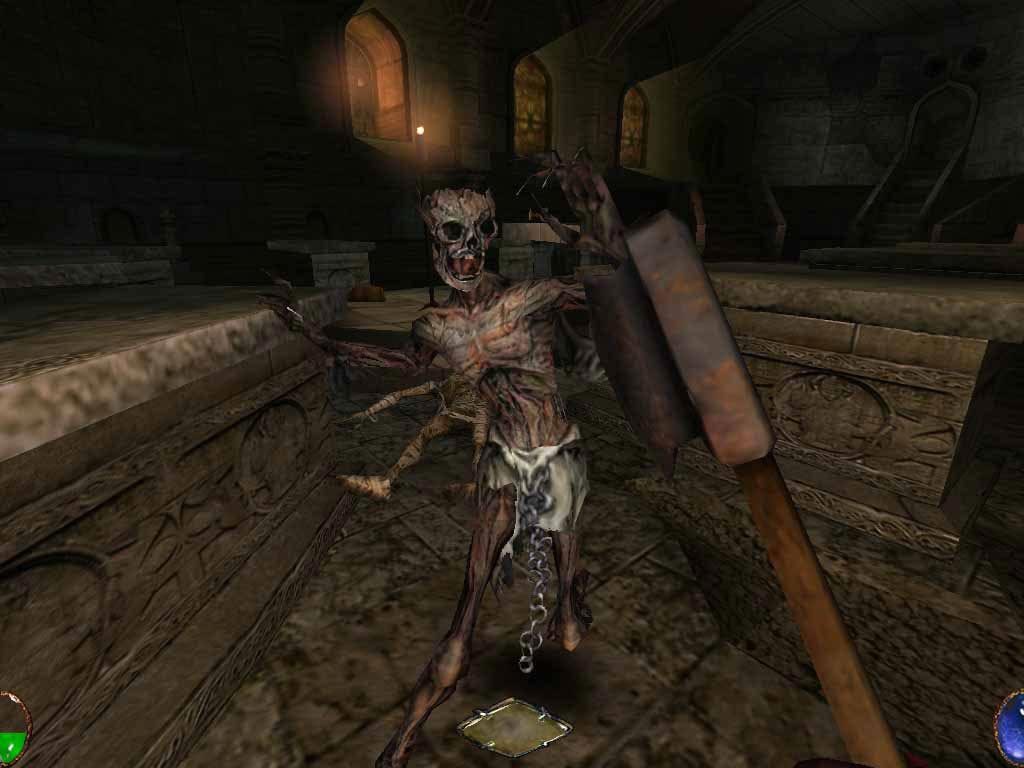
When a situation turns hostile, combat combines real-time first-person weapon use with preparation and positioning. Swords, axes and clubs suit close encounters, while bows provide a ranged option; holding an attack builds power before the strike, and the weapon’s reach and weight affect its use. Stealth lets a character move quietly and take advantage of shadow, setting up attacks from behind or opportunities to pickpocket. The shadows are not universal protection, since some creatures can still detect a hidden character by sound or smell. Magic and retreat are further options, so an encounter can call for a different response depending on the enemy, available equipment and character skills.
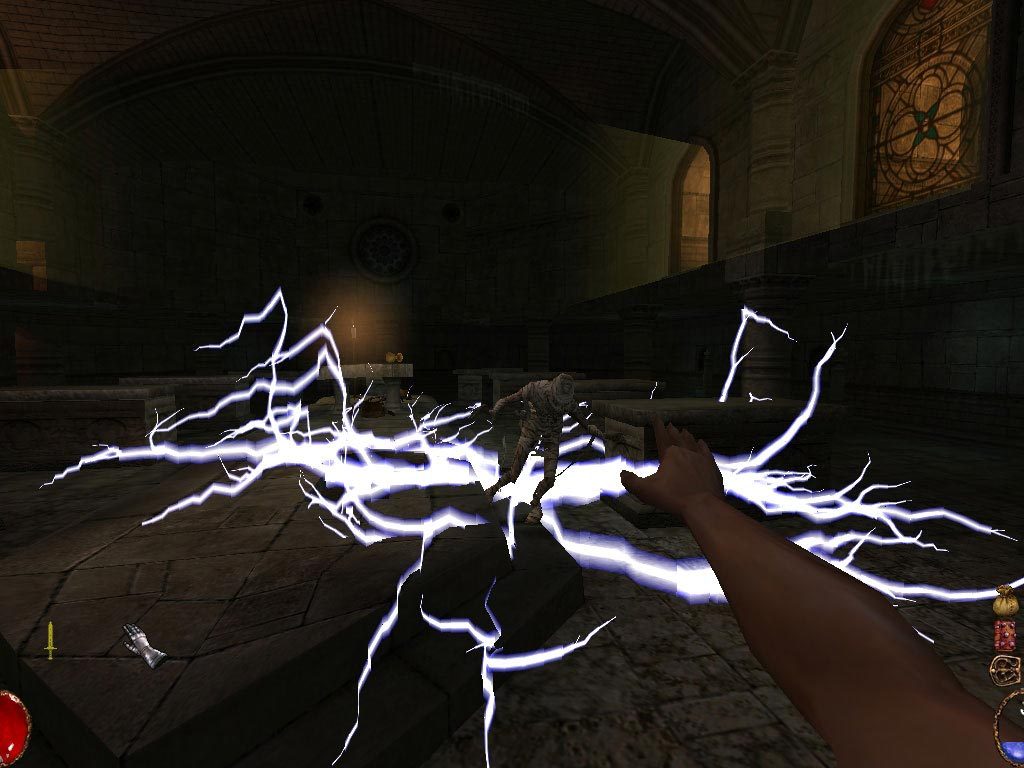
Magic is built around collecting runes and learning how their combinations form spells. In the PC version, casting means tracing the required rune gestures with the mouse in the correct sequence; each rune contributes a magical element or command, and more advanced spells require greater magical ability. The range of effects includes attacks, healing, invisibility, summoning and teleportation, with mana limiting how freely they can be used. Since drawing symbols takes attention, the character can store a small set of learned spells for quick activation. This turns preparation into part of combat: players can choose useful spells in advance, then decide when an effect is worth its mana and when a weapon or stealth approach is better.
The world also responds to ordinary objects and simple combinations. Items can be inspected, carried, given to characters or joined with tools and other objects, and books and conversations can reveal how to use what you find. Food is part of survival: meat and fish can be cooked near a fire, and the character needs to eat periodically. You can make a fishing rod from components, catch fish, light a fire with magic and prepare a meal; these steps connect exploration, crafting and resource management. The manual also lists baking a raw apple pie over a fire and improving an apple pie with wine. Limited inventory space encourages decisions about what to carry, while shops and the game’s economy make gold and useful supplies part of the journey. Small interactions therefore support both practical needs and puzzle solving.
The setting's communities give that freedom a social dimension. Humans, goblins, dwarves and Ratmen share a confined world in which the loss of sunlight and scarce resources have aggravated old disputes. Arx is a place to learn its inhabitants' concerns, trade for supplies and follow clues before heading back into the dangerous spaces between settlements. The larger effort to confront Akbaa remains in view, but the journey is not a chain of isolated levels: its areas connect, and, as Arkane describes it, some tasks can be undertaken in different orders or at the same time. That structure makes a familiar location worth revisiting when a conversation, discovered object or newly learned spell suggests another way forward.
- Developer
- Arkane Studios
- Genre
- First-person role-playing game