
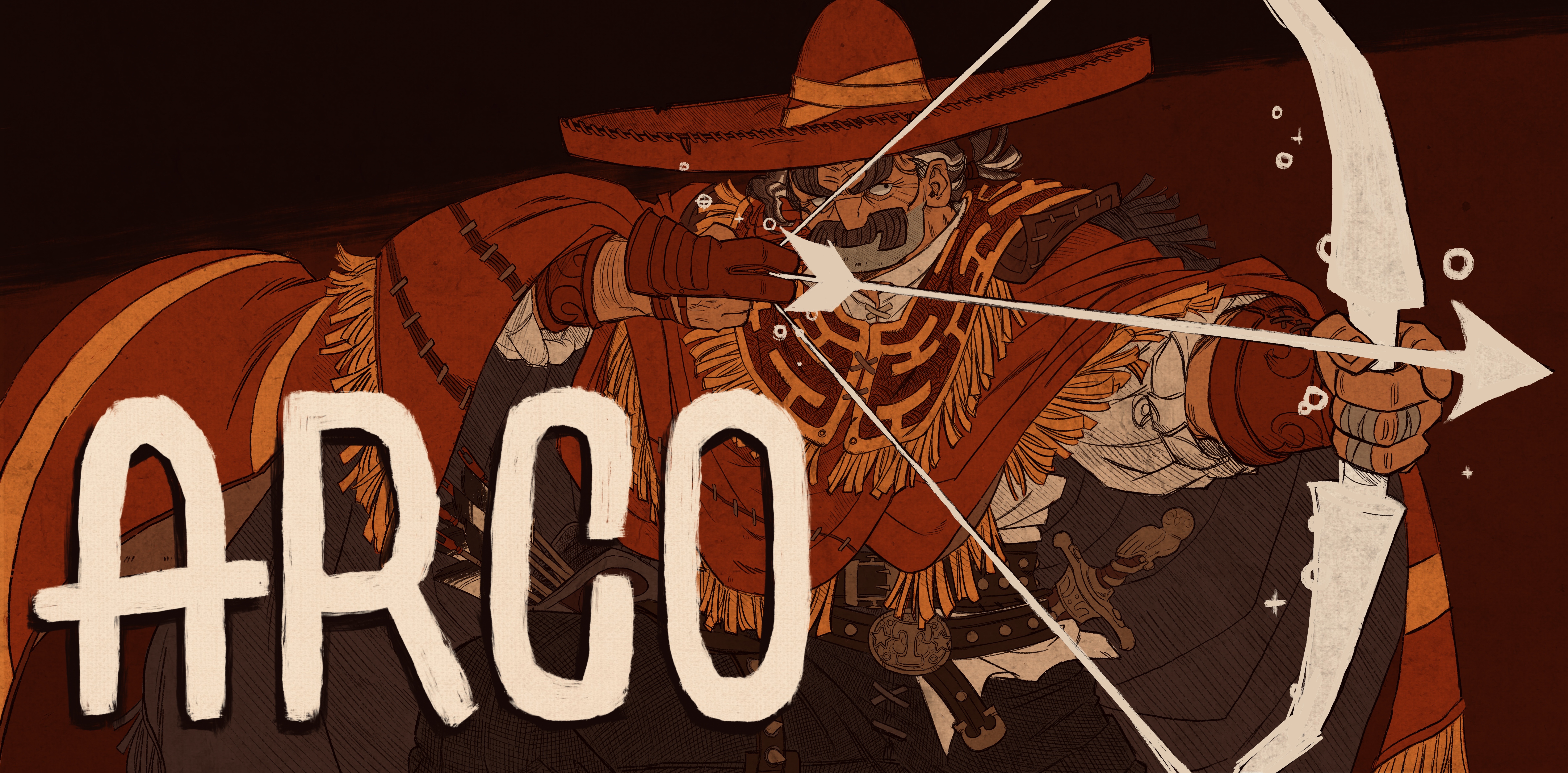
About Arco
Arco is a Mesoamerican fantasy role-playing game following four Indigenous heroes whose stories converge in a struggle against the Red Company. Travel through villages, forests, plains, and deserts, make choices that shape relationships and encounters, and plan simultaneous battles where attacks, projectiles, and movement unfold together in real time.
Arco builds a fantasy frontier from Mesoamerican influences and the visual language of the Western, shifting its focus from the familiar gunfighter to Indigenous communities facing colonisation, violence, and change. Its four heroes are drawn into intersecting stories of revenge, but the journey spends time with the lives and responsibilities that precede each conflict. Teco’s story begins with the Iyo people’s pilgrimage to a Sacred Tree; Itzae’s begins with duties to her Kanek village. Their different starting points show that the world is not a single uniform backdrop. Settlements, customs, landscapes, and the threats pressing on each community shape what each protagonist has to protect and what vengeance means. The Red Company is a recurring force in this conflict, while rival nations and fantastic creatures add other dangers to a setting that mixes invented fantasy with cultural and historical inspirations.
Travel links the story’s places and its changing cast. The player advances across a hand-crafted world of forests, plains, deserts, villages, and larger settlements, selecting locations and following routes that can open through exploration, dialogue, or side tasks. Some routes lead onward and close off previous areas, so a journey is shaped by what the player chooses to investigate before the next major step. At a location, the broad landscape frames smaller points of interest: people to speak with, errands to take on, resources to trade, or trouble that can become a fight. This movement between an overworld map and individual scenes gives the campaign a travelling-story structure. The visible scenery establishes distance and scale, while the route map turns that scale into decisions about where the party goes next and which local encounters become part of their path. The map also makes returning a tactical choice: an open branch may offer a merchant or side task, while advancing along a one-way path can make earlier opportunities unavailable. Exploring first can therefore secure supplies or reveal a different route, but it can also expose the party to additional events before the main journey continues.
Conversations and events give those journeys their human stakes. Dialogue choices can affect how an encounter develops, whether a problem becomes a battle, and what new possibilities appear on the route. The player may help locals, pursue a task, or respond to a threat with force; not every opponent can be persuaded, and an apparently small choice can change the state of a later encounter. Arco connects decisions to the characters’ traditions and experiences through its Guilt mechanic. The game’s creators describe Guilt as character-centred rather than a universal moral score: characters can feel its weight after cruelty, a mistake, or acting against their own cultural tenets, even without deliberate wrongdoing. Ghosts associated with this guilt can intrude into combat and move in real time, altering the battle’s rhythm. Choices therefore affect more than dialogue branches; they can change the pressures and timing that the tactical system asks the player to manage.
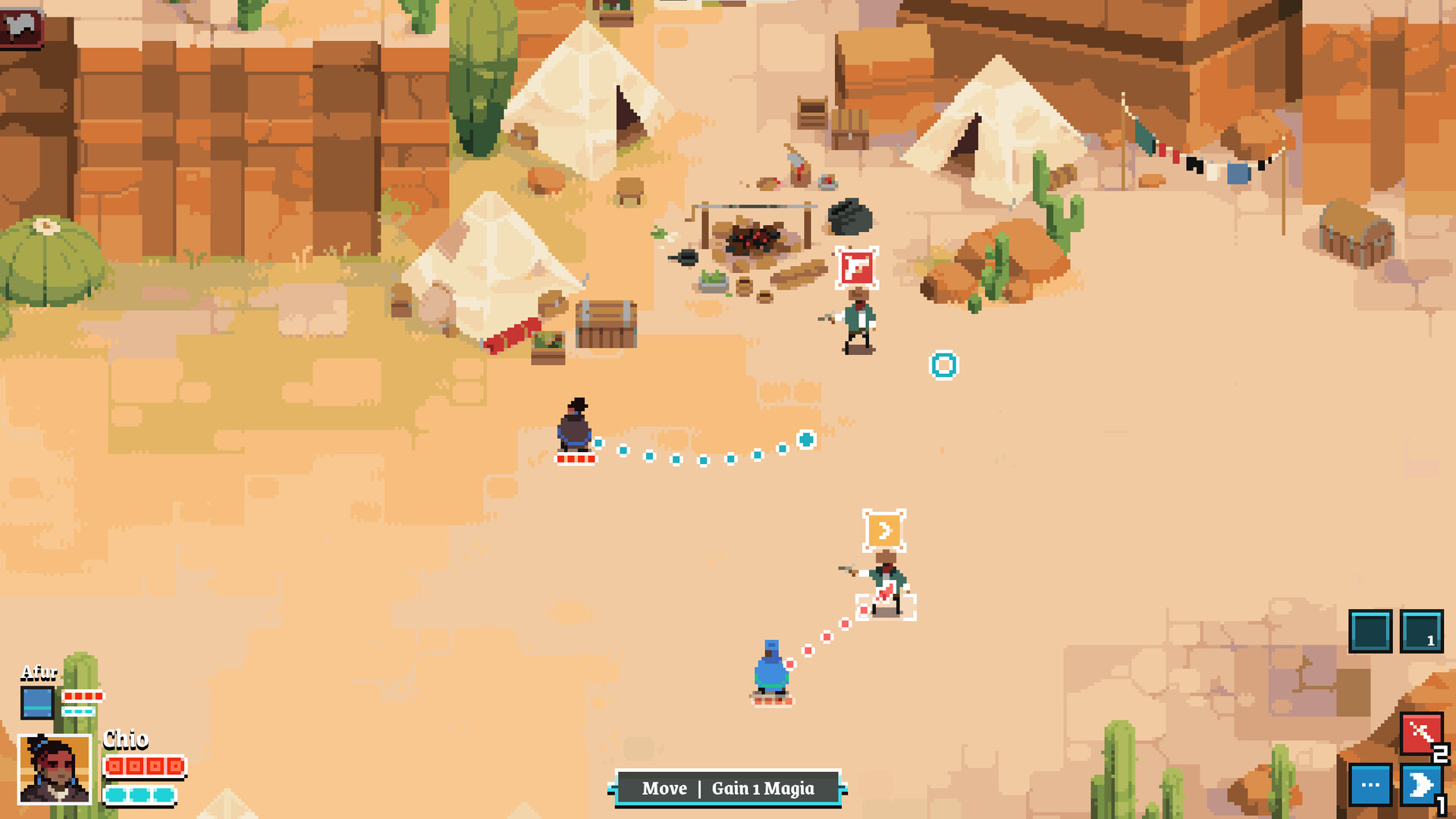
Combat is simultaneous turn-based rather than a sequence where one side finishes all its actions before the other responds. The player plans moves while enemy intentions are visible, then both sides act together. Because the arenas are not arranged on a rigid square grid, attacks and movement play out across open space, and the outcome depends on positioning and timing. Projectiles can cross the field as characters move, creating a bullet-hell pattern that the player must read and navigate. A planned movement can dodge an incoming line of fire; an attack can interrupt an enemy before its action resolves; a melee attacker may need to be avoided or met with a timely strike. The pause between action phases allows planning, but once the turn begins the battlefield changes in real time. This combination makes enemy telegraphs useful information without turning each encounter into a fully predictable puzzle.
Each hero’s skill tree and playstyle gives the party different answers to a fight. Arco describes its encounters as problems to solve with skills, items, and the environment, and its four characters do not share one interchangeable build. Action points put a cost on combat moves, so the player weighs whether to reposition, attack, defend, or use an ability within the available turn. Skills can affect the shape of the battlefield, while items supply another way to respond to injuries or a difficult situation. Since enemies can attack at the same moment as the heroes, a powerful move is only useful if the character can survive long enough to complete it. Planning must account for where each ally will finish, which enemy action is most dangerous, and whether an attack or interruption can prevent that action. Character development and tactical decisions consequently reinforce one another: upgrades expand a hero’s options, while the encounter determines which option is worth its cost.
Between battles, Arco mixes point-and-click exploration, short text-led situations, side quests, and trade. Merchants reflect the regions they inhabit: goods that are plentiful in one place may be scarce and more valuable elsewhere. Buying locally abundant supplies and carrying them to a different market can turn travel into an economic choice, while quest objectives can put specific goods to use. Text events frame activities such as hunting, climbing, or finishing a task through choices about continuing or trying again, and their outcomes can carry risk. Exploration may also reveal hidden items or locations, adding reasons to look closely at each scene before moving on. The party’s health and carried items persist as practical considerations, so a dialogue or travel event can affect the resources available when a later combat begins. These quieter systems make the journey more than a chain of arenas: each stop can change both what the party knows and what it can afford to do.
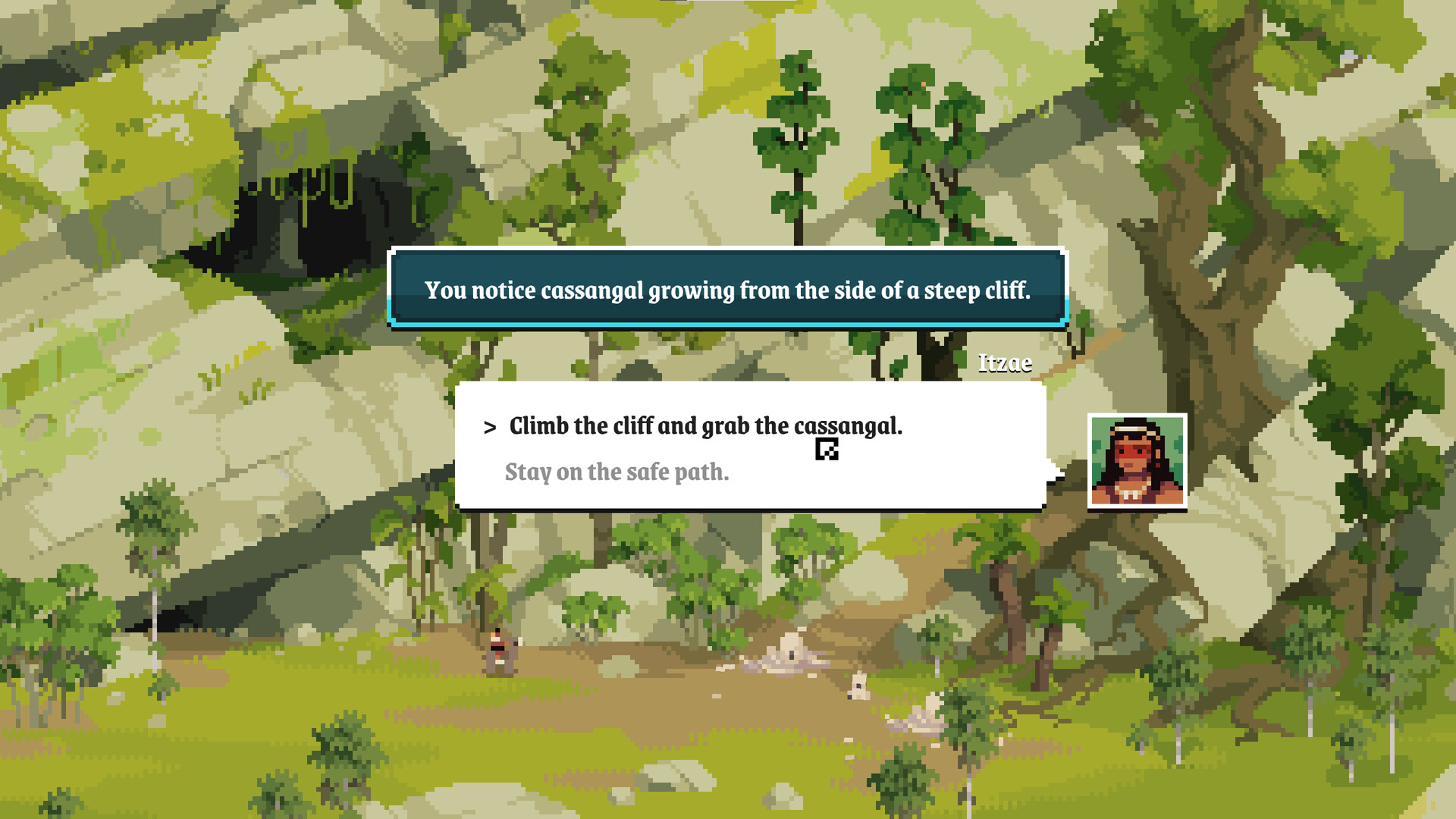
The presentation supports a story that balances sweeping travel with intimate consequences. Pixel-art scenes place small figures against broad landscapes inspired by Central and South American environments, with distinctive architecture, wildlife, and magical details. The camera often gives the environment more space than the characters, so travel reads as movement through a larger world rather than a sequence of character portraits. Exploration, dialogue, and battle each use their own framing and tempo; combat tightens attention around the moving party and visible enemy actions, while quieter scenes leave room for conversation and local detail. That shift in scale helps the setting carry narrative weight: the protagonists are part of communities and landscapes larger than any one vendetta, while a conversation or battle can still turn on one person’s choice. The world also blends grounded cultural detail with overt fantasy, including unusual creatures, so it does not claim to depict a literal historical society. Music and sound accompany the shift from travel to violence, and the soundtrack is sold separately as an optional bundle on Steam. Arco was developed by Franek Nowotniak, Max Cahill, José Ramón “Bibiki” García, and Antonio “Fáyer” Uribe, and published by Panic. The Steam edition is single-player and lists Windows and macOS support; it is distinct from the separately offered demo and other platform releases. The release page also shows supported interface and subtitle languages, but those settings do not change the story’s separate protagonists, choices, or battle systems into separate editions. The full campaign brings the protagonists’ different routes into one interconnected journey.
- Developer
- Franek Nowotniak, Max Cahill, José Ramón “Bibiki” García, and Antonio “Fáyer” Uribe
- Genre
- Mesoamerican fantasy RPG; Steam tags include Action, Indie and Strategy