

About Apollo Justice: Ace Attorney Trilogy
Apollo Justice: Ace Attorney Trilogy collects Apollo Justice: Ace Attorney, Phoenix Wright: Ace Attorney – Dual Destinies, and Phoenix Wright: Ace Attorney – Spirit of Justice. Across courtroom cases and investigations, defense attorneys examine scenes, question witnesses, compare testimony with evidence, and use distinct perception, emotional-analysis, and séance-trial techniques to challenge the prosecution.
The collection follows three connected courtroom adventures, beginning with rookie defense attorney Apollo Justice and continuing through Phoenix Wright: Ace Attorney – Dual Destinies and Phoenix Wright: Ace Attorney – Spirit of Justice. Phoenix, once the series’ central attorney, appears in Apollo’s first game as a mentor and later returns to active courtroom work alongside Apollo and the newer attorney Athena Cykes. The cases build around clients accused of crimes, witnesses whose accounts contain gaps or distortions, and prosecutors determined to support a conviction. Each episode alternates investigation with hearings, gradually supplying a record of statements, objects, and observations that can be tested in court. The trilogy’s chronology belongs after the earlier Phoenix Wright stories, but each included game has its own case sequence and particular lead attorneys; the set is not one uninterrupted case. The first title establishes Apollo’s entry into the profession, while the later games widen the cast and take the defense into different legal settings. Its connecting thread is the practical question at the heart of every case: whether the evidence really supports the version of events presented in testimony.
Investigations are built from deliberate menu choices rather than free movement through a continuous space. At a location, the player selects places to inspect, people to question, or another destination to visit. Examining a scene means directing a cursor over objects and areas that might hold useful details; conversations reveal what a witness knows, while presenting an item from the Court Record can prompt a new response or expose a relevant connection. Case evidence and character profiles accumulate in that record, giving the courtroom phase a concrete body of material to compare against testimony. Locations and available topics change as the inquiry progresses, so a new clue or conversation can make a previously visited place useful again. The cycle is investigative in a specific sense: collect observations, ask people about them, then decide whether a discrepancy matters. In Dual Destinies, the series’ three-dimensional environments let the player adjust a scene’s viewpoint and zoom toward suspicious areas. These camera controls support close examination; they do not turn the game into an action or roaming adventure. Dialogue history and investigation notes in that game help keep case facts and immediate leads accessible while moving between people and places.
Courtroom play turns that collected information into argument. A witness gives testimony in short statements, and the player can press a statement to ask for elaboration; sometimes the witness revises or adds to what they said. When a statement conflicts with a document, object, profile, or earlier testimony in the Court Record, the player presents the relevant evidence at that point in the cross-examination. The reasoning depends on matching a particular claim to a particular contradiction, not simply selecting any suspicious item. Presenting irrelevant material reduces the judge’s confidence, so the player must connect evidence to the words currently under scrutiny. Pressing can reveal why an account was phrased a certain way or supply a new statement that changes what should be challenged. The court therefore serves as a second analytical pass over the investigation: information gathered outside the courtroom becomes meaningful when a witness’s version is set beside it. The objective in an episode is to defend the client successfully and resolve the case, with hearings advancing as testimony is tested and the judge weighs the argument.

Apollo’s Perceive ability gives the first game a distinct way to interrogate testimony. His bracelet tightens when a witness displays a small physical tell associated with a statement they are trying to conceal or evade. During a focused perception sequence, the player watches the witness’s gestures while testimony is delivered, identifies the tell, and calls attention to the associated statement. This is not a general lie detector that supplies the answer: it directs attention to an inconsistency that must still be investigated and explained through the rest of the case. Dual Destinies brings Apollo’s ability back, but also adds Athena’s Mood Matrix. Using a device that visualizes a witness’s emotional responses, Athena examines feelings expressed alongside spoken testimony and looks for a reaction that does not fit the words or situation. Her courtroom technique asks the player to compare emotional signals and statements, then challenge the mismatch. The two methods examine different kinds of information: Apollo notices bodily behavior, while Athena assesses emotional responses. Both sit alongside ordinary cross-examination and evidence presentation, adding another layer to a case rather than replacing the need to establish what happened.
Dual Destinies adds other tools to make a long case easier to reason through. Its Revisualization sequence asks the player to review major facts already established and select a conclusion that fits them, turning a scattered case record into a focused reasoning step. Investigation notes provide a checklist of current leads, while the dialogue backlog lets the player reread recent exchanges when a detail needs to be checked. During a cross-examination, Consultation gives the defense attorney a way to seek advice from an assistant. These aids serve different purposes: notes orient the investigation, the backlog preserves dialogue for reference, consultation offers courtroom guidance, and Revisualization tests an emerging theory against known facts. They do not replace the player’s core task of comparing testimony with evidence. Instead, they make the process of managing information more visible as cases grow more complicated. Their presence also marks a shift in emphasis between games: Apollo’s original adventure centers its investigative identity on Perceive, whereas Dual Destinies layers several interfaces and analytical steps around its three-attorney cast. This design makes it possible to track what has been found, revisit what was said, ask for help at a difficult hearing, and then organize facts into a possible explanation.
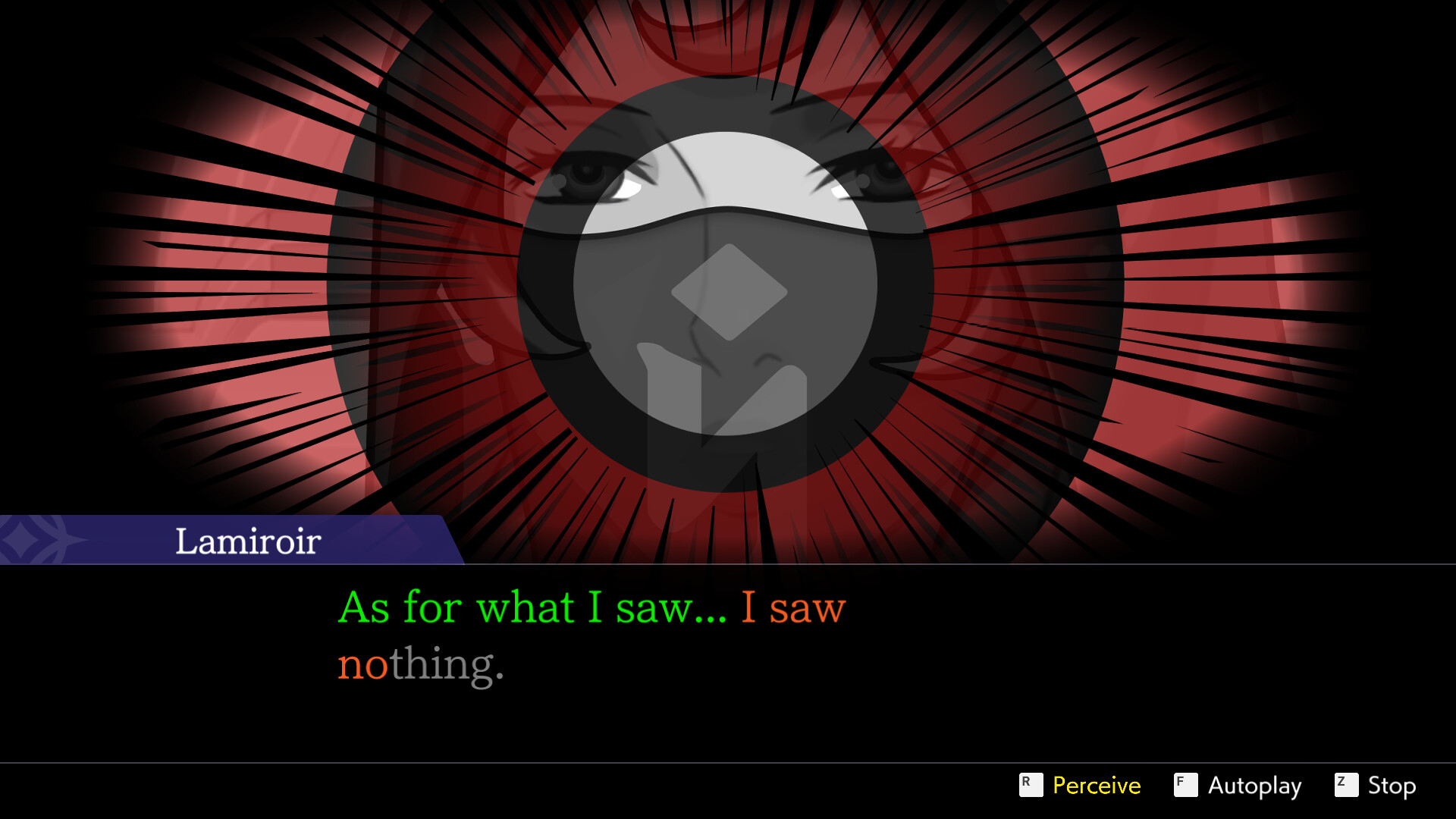
Spirit of Justice expands the setting by dividing attention between Phoenix’s work in the Kingdom of Khura’in and Apollo’s cases at the Wright Anything Agency. Khura’in has a distinct legal order in which defendants face séance trials, and Phoenix’s defense challenges findings treated by that court as authoritative. The Divination Séance, guided by Royal Priestess Rayfa Padma Khura’in, presents a victim’s final perceptions in the Pool of Souls. The player compares that vision and its sensory impressions with the circumstances of the case, locating a discrepancy that undermines the priestess’s interpretation. This differs from an ordinary witness cross-examination: the material to question is a ritualized reconstruction of a victim’s last moments, rather than a living witness’s recollection. The Khura’inese courtroom’s assumptions about legal representation also shape the conflict around Phoenix’s role as a defense attorney. Apollo’s side of the game keeps him in a more familiar legal environment but gives him a separate set of challenges. These parallel threads let the collection place different legal cultures and forms of testimony beside the recurring task of testing claims against evidence, without making all three games’ courtroom systems identical.
Across the trilogy, progression is organized by episodes and their investigation and trial sections. Completing a case carries its evidence and revelations forward within that story, and successive episodes introduce new witnesses, locations, and questions for the attorneys. The player’s forward movement is primarily through reading dialogue, selecting investigative actions, examining presented evidence, and making courtroom deductions; there is no character leveling or combat loop. Trials and investigations rely on the same Court Record, so an object discovered during examination can later contradict a precise line of testimony, and information learned in questioning can suggest where to look next. The collection packages the three games’ main episodes together with two Special Episodes that had previously been downloadable content, for sixteen episodes total. Outside the cases, Orchestra Hall offers the in-game music and orchestral arrangements, the Art Library gathers illustrations and design material, and Animation Studio allows character animations to be arranged into scenes. The Steam edition identifies the PC release as a single-player adventure and includes the collection’s supported languages and extras; original presentations are retained for some content. These galleries provide optional ways to revisit the trilogy’s art, music, and performances after or between its case-based stories.
- Developer
- Capcom
- Genre
- single-player adventure / courtroom mystery