
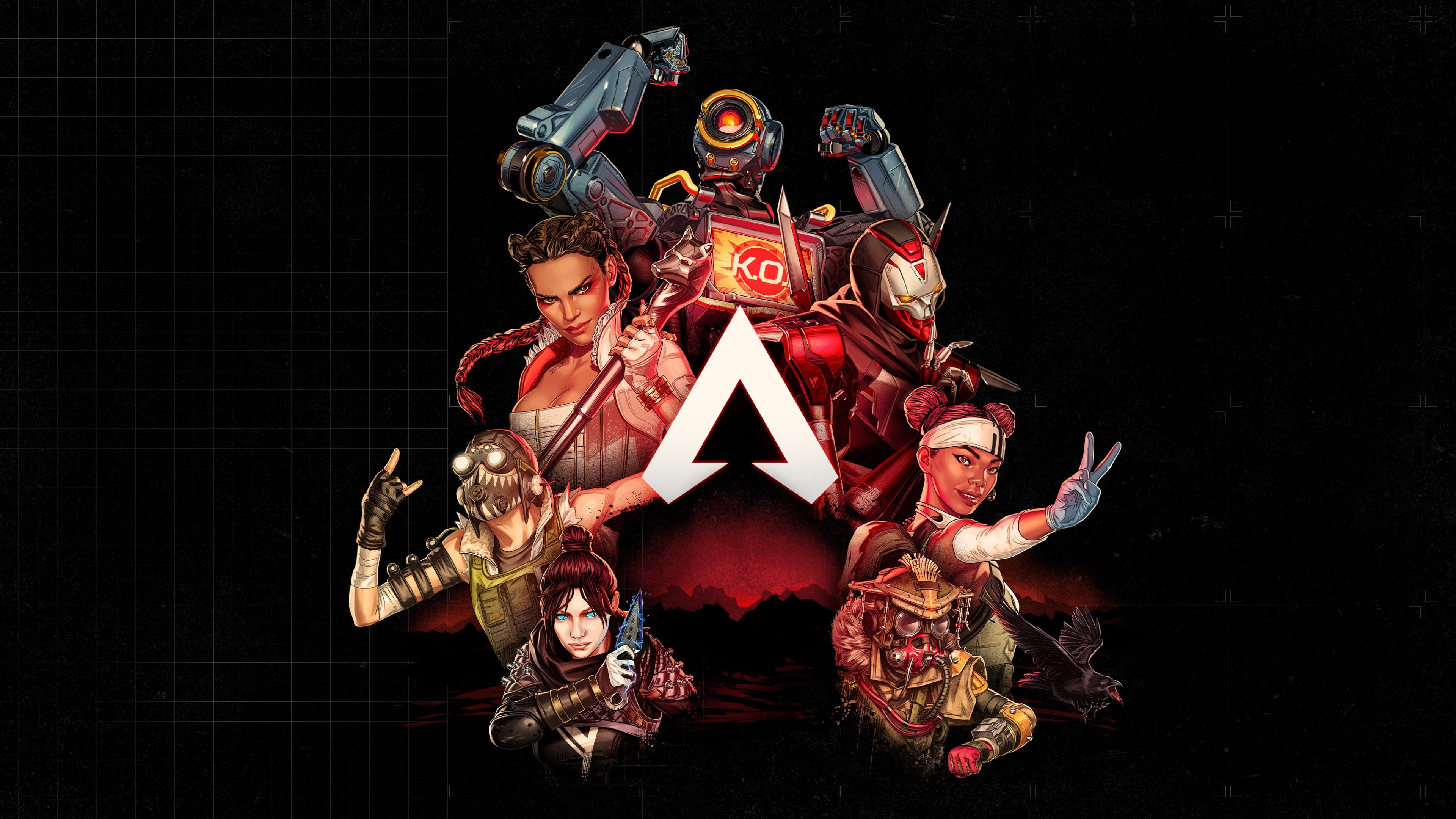
About Apex Legends
Respawn built a battle royale around movement and abilities, and the playlist has grown out from there. Wildcard is a permanent mode, Mixtape covers the short sessions, and Ranked is the ladder that sits on top of Battle Royale.
What you are actually playing
Apex Legends is a free-to-play, squad-based shooter from Respawn Entertainment, published by EA. Its main mode is a battle royale: you drop onto a large map with almost nothing, loot your way up, and try to be the last squad standing while the playable area shrinks around you. A squad is up to three players, so Duos and Trios both have a home in the unranked playlist.
It runs on PlayStation 4 and PlayStation 5, Xbox One and Xbox Series X|S, and Nintendo Switch 2, plus PC through the EA app, the Epic Games Store and Steam. The live game is well into its seasonal cycle. The current season is Marked, which reworked Bloodhound, updated World's Edge, and added Corrupted Attachments and a new energy weapon system on top of the usual balance pass.
Legends, classes and how you unlock them
Every Legend carries a passive, a tactical ability and an ultimate, and the match is largely a negotiation between three of those kits. The roster is grouped into five classes, which give you a fast read on what a pick is for: Assault, Skirmisher, Recon, Controller and Support. The classes describe a Legend's role rather than locking them into one job, so a Support can still be the one who finishes a fight.
The differences show up in the small mechanics. Bloodhound's reworked passive leaves a lingering trail behind enemies, so the tracking happens without you having to look for it, and it also lets them call in White Ravens. Their tactical scans for a full three seconds and then keeps dropping fading snapshots, and their new Ultimate, Allfather's Cloak, throws down a device that cloaks anyone who steps into range, squadmates and enemies alike. Cloaked players move 20% faster and gain threat vision, the cloaking area lasts eight seconds, and the cloak itself lingers for twelve seconds after you leave it before breaking on damage, gunfire or most abilities. That is a Recon Legend whose job has quietly grown beyond pointing at people.
Unlocking Legends is the part that trips up new players, because a Legend is one of the things money can buy outright. A Legend can be picked up in the store for 12,000 Legend Tokens, and Legend Tokens are earned by playing, including past the player level cap. Apex Coins, the premium currency, can also be spent on a Legend directly, so you can skip the wait if you want a specific one now. Legend Spotlight Passes are a third route: 20-level passes built around a single Legend and bought with Apex Coins, and a few of them have bundled in a bonus Legend unlock at purchase. New Legends have also been made globally available to everyone for a stretch after release, which is the cheapest way to find out whether you like one before you commit.
The Ring, the loot and the squad
Battle Royale puts 60 players on the map, and you land with basic gear and loot the rest from the ground, from Supply Bins and from the Death Boxes of players who lost their fight before you arrived. The Ring runs to a timer and pulls in for each round rather than shrinking smoothly, and it is the real clock in the mode. Outside it you take damage, so the safe space keeps tightening until squads with no room left are forced into each other.
Your squad is the other half of the calculation. Apex is built around squad decisions, and the ping system means you can call a target, a piece of loot or a destination without a microphone. Queueing alone with squad fill enabled pairs you with other players, so you do not need a premade team.
Knocked, eliminated and respawned are three different states
It helps to keep the recovery rules straight, because they are the reason a lost fight is not always the end of a match. A knocked player is still in the game and needs a revive from a squadmate. An eliminated player is out, and their Banner is the thing that matters: recover the Banner, carry it to a Respawn Beacon, and the squadmate returns by dropship.
Season 29 added a faster and riskier option on top of that. Deathbox Respawn brings an eliminated teammate back directly at their Death Box, and it hands back any weapons and gear still left unlooted inside. The cost is exposure: the interaction takes seven seconds and it is loud and visible to nearby enemies. There is a lockout timer as well, because each additional death on that teammate increases the wait before the squad can use Deathbox Respawn again, and staying alive resets it. A Beacon elsewhere can be a safer option when enemies still control the Death Box.
Modes beyond the main one
Wildcard is the mode that changed Apex most. It is permanent, and it is built for more shooting and less looting. Legend limits are off, so you can run up to three of the same Legend and find out what three Octanes or three Caustics actually do to a lobby. Upgrades are streamlined, loot arrives in bigger bursts, and the mode hands out second chances, self-revives and health regeneration to keep squads alive and keep the match moving. It plays out on remixed maps loaded with gravity cannons, ziplines and other ways to launch a squad into a bad decision.
Mixtape is the other permanent playlist, rotating three shorter modes. Team Deathmatch is six against six and plays to a points target. Control is nine against nine, with both teams fighting over capture points and infinite respawns to keep the pressure on. Gun Run has you facing three other squads while you work through a track of weapons, which is the closest the game gets to a firing-range warm-up with stakes.
Ranked, casual and who you get matched with
Battle Royale splits into Ranked and Unranked. Ranked is Trios only, while the Duos playlist lives in Unranked, and the difference beyond that is what is on the line. Ranked runs a longer map rotation than the casual list, resets with a new season, and seeds your placement from the previous one. Unranked is the lower-pressure version.
Matchmaking is where the rules have been shifting most. The highest-skill lobbies are given a longer maximum queue search so the skill bands stay tighter. Bots have been used in lower-skill unranked lobbies to fill gaps during quiet hours, and they are never dropped onto your squad or used in Ranked at all. Restricting how far apart ranked squadmates can be has also been tested in Ranked, but that is still being evaluated rather than settled.
Crossplay scope is worth knowing before you buy anything on a second platform. All console players play together, and PC players play with other PC players. If a console player parties up with a PC player, the whole party goes into PC matches. Crossplay is on by default and can be turned off, but switching it off narrows your matchmaking to other players who did the same thing, which makes queue times much longer.
What it costs
Apex Legends is free to play, and most of what it sells is cosmetic. Apex Coins are the premium currency and can be spent on Apex Packs, store items and Legends. Legend Tokens and Crafting Metals are both earned by playing, but they are not interchangeable: Legend Tokens buy Legends and some store cosmetics, while Crafting Metals only craft specific cosmetic items. Exotic Shards cover Apex Artifacts and select Mythic melees.
Apex Packs are the loot-box layer, and they are cosmetic-only. Each pack holds three items, and the cosmetic roll never repeats something you already own, though Crafting Metals can always drop and will replace an item when you own everything in that rarity tier. Nothing in an Apex Pack changes a match. Bad luck protection sits underneath, so thirty packs cannot pass without a Legendary, with Collection Event Packs excluded.
The battle pass is the other main spend, and there are two per season. Each has a free track that any player can progress through, the Premium pass covers 60 levels of rewards, and the Ultimate and Ultimate+ tiers add instant rewards, with Ultimate+ making every Legend playable for the length of that split. Progress comes from Battle Pass Stars earned through daily and weekly challenges, and the XP you earn from ordinary matches counts toward your Battle Pass level too. Buying a pass late still grants the rewards for levels you have already reached.
The honest tradeoff is that this is a free game with a paid tail, and not all of that tail is decorative. Cosmetics and packs rotate constantly, limited-time events push urgency, and the store always has something new. Legends sit on both sides of the line: every one of them can be earned by playing, but paying for one is a real shortcut to a gameplay-relevant unlock rather than a bigger hat.
Should you play it
Yes, if you want a shooter where movement and abilities matter as much as aim, and where a squad can talk a fight through without a microphone. The Ring gives every match a shape, the recovery rules mean a bad start is not fatal, and the ability kits give a squad several genuinely different ways to solve the same fight.
You do not need two friends to start, either, because queueing on your own fills the squad around you, and Duos is waiting if you only have one other player. Skip it if loot-heavy openings wear you out, since Wildcard's faster pacing is the exception rather than the rule, and skip it if you want every fight to be a straight aim duel with nothing else in the way.
Go deeper with V4mp
- Developer
- Respawn Entertainment
- Genre
- Battle royale
Explore Apex Legends further
Explore the wiki for detailed reference pages on the game's world, systems, items and locations.