
About Antichamber
Antichamber is a first-person puzzle exploration game set in a stark facility whose corridors bend, reconnect and change according to unfamiliar spatial rules. Move through connected chambers, read their visual clues, and use a matter-manipulating gun to test ideas, reshape routes and find ways onward.
Antichamber begins in a small, clean-lined chamber that serves as a point of reference for a much larger place. From there, the player chooses routes into white corridors, colored rooms and abstract spaces that do not obey ordinary architectural expectations. A passage may return to where it started, a turn can lead somewhere unexpected, and the same opening can behave differently depending on the approach. The game offers no conventional cast or unfolding dialogue-driven plot to explain these changes. Instead, the facility itself supplies the questions: its layout, signs and sketches suggest rules, then invite the player to test whether those rules hold. Progress comes from finding connections and understanding what a room is asking you to notice.
The most important tool is observation. Antichamber repeatedly makes orientation part of the puzzle: looking at a doorway, walking toward it, turning around, or viewing a space from a different position can alter what seems reachable. Some hallways loop or fold; some doors depend on the direction from which they are approached; and falls or apparent dead ends can lead to another route rather than a reset. A path that looks blocked may open when the player stops treating its image as a reliable map. The game therefore asks for experiments with movement and perspective as often as it asks for conventional logic. Reconsidering a room from its entrance, backing away, or tracing a route in reverse can reveal that the obstacle was an assumption about space.
The starting chamber helps keep this disorienting structure readable. An expanding map records discovered branches, while sketches and short messages accumulate as reminders of places and ideas encountered along the way. The player can return to this hub to look over the available paths and choose another challenge, rather than having to force progress through one corridor. Wall plaques offer compact, often cryptic observations; they are not full instructions, but their wording can point toward a change in approach. A sign about taking a step back, for instance, is also a prompt to test whether retreat changes the room. The hub, map and clues create a loose framework for a nonlinear journey without turning it into a sequence of numbered levels.
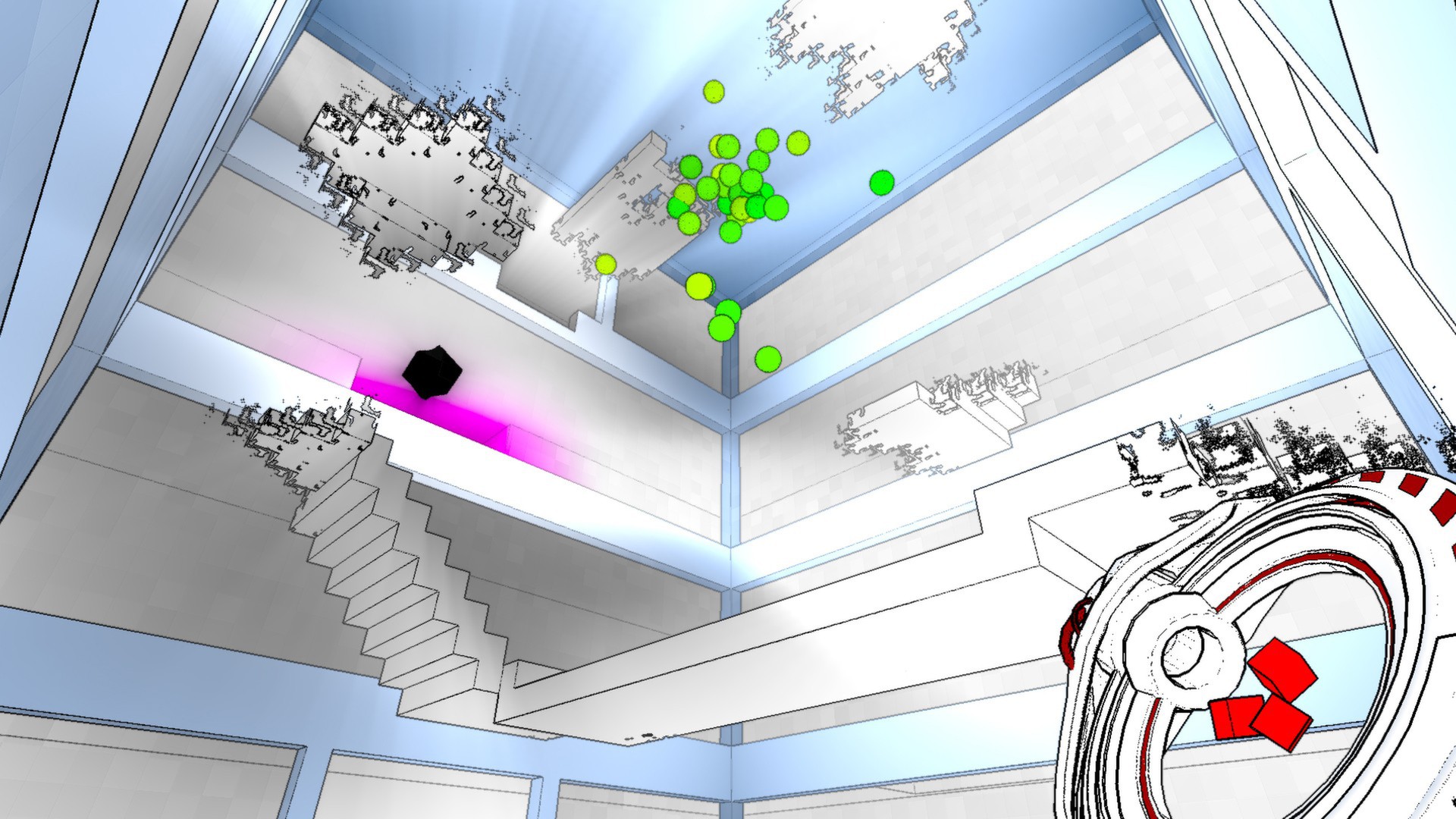
As the exploration develops, a matter gun adds a more tangible layer to the puzzles. Its different modes let the player collect and place small blocks, fill empty spaces, and remove or clear matter from parts of the environment. These functions are introduced as distinct ways of handling the world, expanding the gun from a simple block tool into a compact set of puzzle instruments. The blocks are practical pieces in a problem: they can complete a structure, provide a foothold, bridge a gap, or interact with a barrier or trigger. Each new capability makes earlier-looking spaces worth reconsidering, because a wall, void or scattered block may now be handled in a different way. The gun is not used to fight enemies; it is an instrument for changing the puzzle space. Progress depends on noticing both what the tool can manipulate and how the room’s geometry alters the effect of that manipulation.
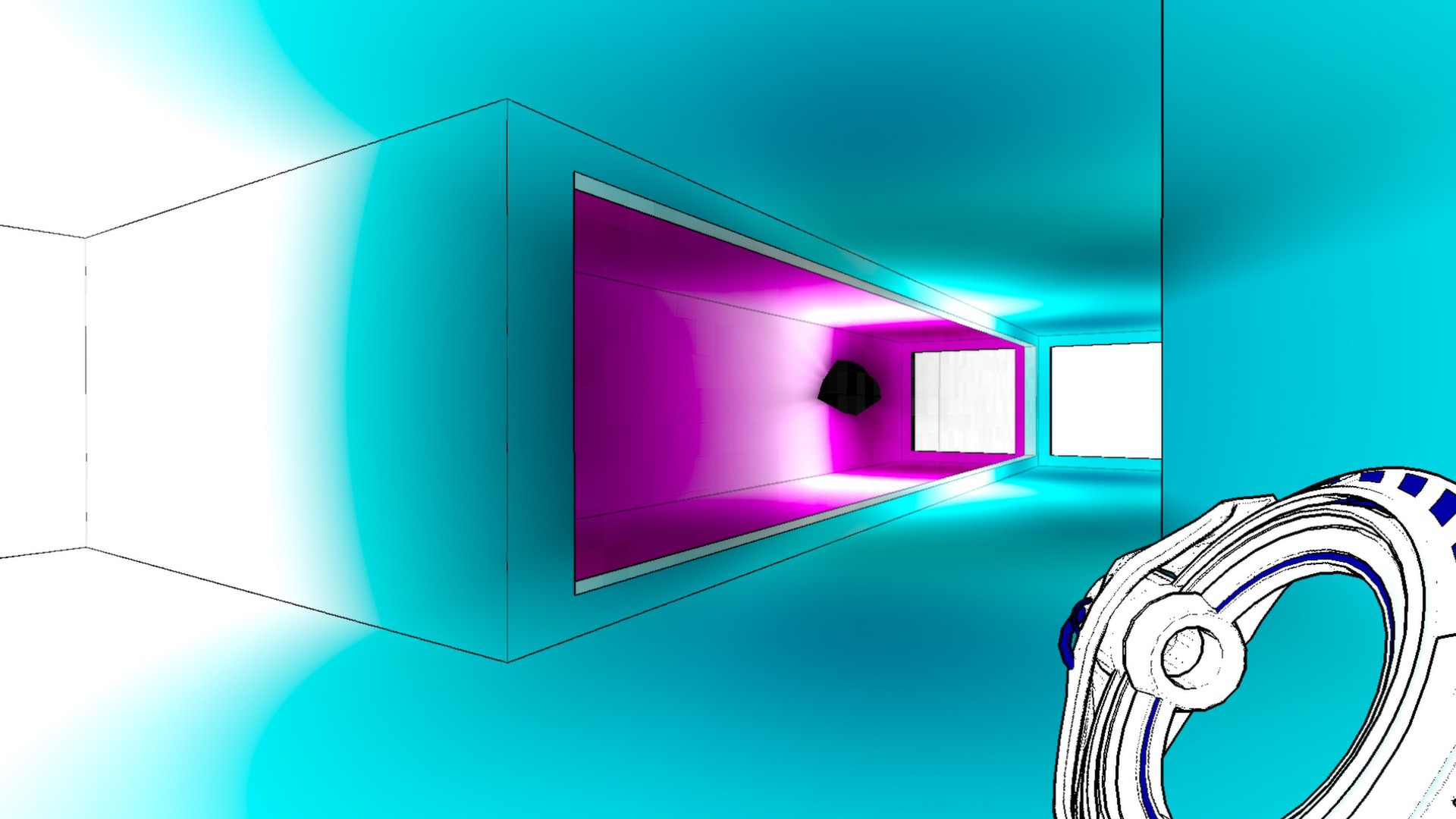
Antichamber’s challenges mix spatial reasoning with block-based construction. One room may turn a simple walk into a test of direction, while another asks for a short sequence of collecting, carrying and placing blocks. In a more involved space, a player may need to make a usable path from loose matter, activate a mechanism, then approach the result from a new angle. The game often combines these modes rather than isolating them: the route itself can change while the player is handling blocks, and the right tool action may only become clear after a shift in viewpoint. Minimal visual decoration keeps attention on lines, openings and color-coded matter. Small clues and environmental reactions serve as feedback, helping the player compare an attempt with the rule the room is teaching. Four handheld forms of the matter gun cover filling voids, picking up and shooting blocks, and clearing matter, so puzzles can ask for more than one type of interaction in the same connected space.
Some of the facility’s transitions make a view behave like a doorway. A framed opening shows a separate space beyond it, but it is more than a picture to inspect from the corridor: moving close until that scene fills the view can carry the player into it. The frame therefore marks a boundary that changes function as the player approaches, turning screen composition and position into parts of the route. A window can be the way forward even when its glass first suggests separation. Elsewhere, four consecutive right turns can carry the player into a different area instead of tracing a square back to its entrance. Both cases make room boundaries behave in ways that must be tested through movement. The player discovers that looking into a space can become a way of entering it.
- Developer
- Alexander Bruce
- Genre
- First-person puzzle exploration game