
About Age of Mythology: Retold
Lead a mythic civilization through real-time campaigns and skirmishes where mortal armies share the battlefield with heroes, monsters and gods. Gather food, wood, gold and divine Favor; choose a pantheon and minor gods as your society advances; then build, research, fight and use god powers. The base roster centers on Greek, Egyptian, Norse and Atlantean mythologies.
Age of Mythology: Retold sets a real-time strategy campaign in a world where human civilizations, legendary heroes and mythological beings meet. The Fall of the Trident follows Arkantos, an Atlantean admiral, and his allies as they pursue the cyclops Gargarensis across lands shaped by Greek, Egyptian and Norse myths. The journey moves between settlements and hostile territory, with story missions asking the player to build a working economy, field an army and complete scenario-specific objectives. The campaign gives the strategy systems a narrative thread, while its mythic settings introduce figures and creatures drawn from several traditions rather than presenting a single historical empire.
In a standard match, villagers turn the landscape into a functioning economy. Food comes from sources such as hunting and farming, wood from trees, and gold from deposits; buildings provide the places to train units, research technologies and store or use gathered resources. The player assigns workers, expands the settlement, queues fresh villagers and military forces, and decides when to devote resources to an age advancement. A Town Center anchors the settlement and supports its growth, while additional building sites and defensive structures help extend control over the map. Scouting is part of this loop: knowing where resources, opponents and expansion sites lie informs both economic plans and the next military move. Keeping villager production active and balancing those three ordinary resources ties growth to defense and research. Walls and towers can protect important approaches and gathering areas; additional Town Centers can support expansion when the map and economy allow it.
Progression is organized around four familiar ages: Archaic, Classical, Heroic and Mythic. At the start, each player selects a major god, which shapes the pantheon’s identity and the strategic options available. Advancing to later ages requires choosing between minor gods offered for that civilization; those choices add a god power, a myth unit and technologies that can alter the army or economy. The resource Favor connects this divine layer to ordinary production, since myth units and repeated god-power uses draw on it. Age advancement therefore changes more than the technology available: it opens new unit roles and tactical abilities while requiring the player to balance food, wood, gold and Favor. The minor-god choice is permanent for that match and determines the special myth unit, power and technologies that become available, giving the player a reason to consider the map and existing army before selecting an age-up.
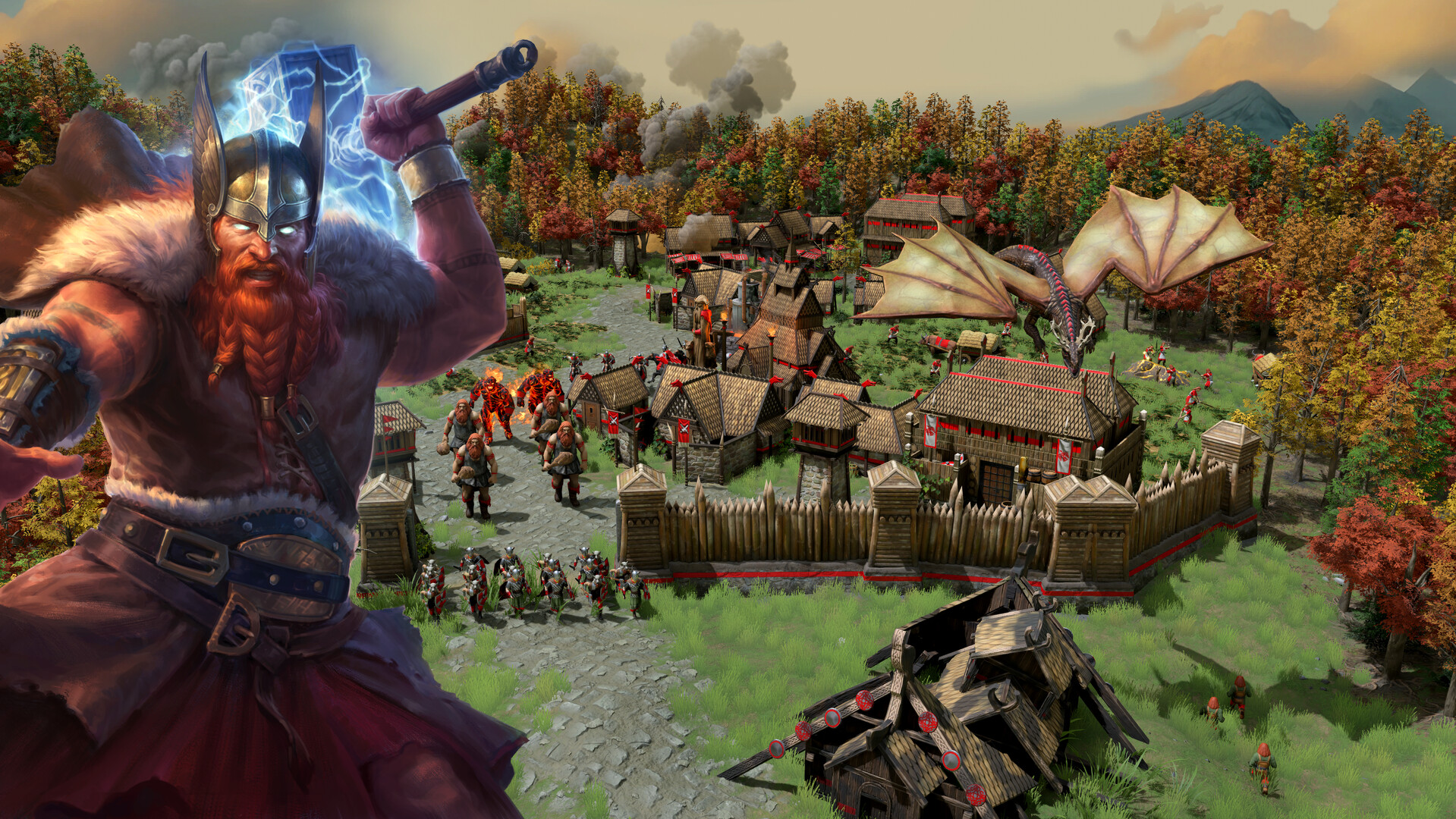
Armies combine human soldiers, heroes and myth units, each with a different job. Human forces such as Greek hoplites, toxotes archers and hippikon cavalry follow recognizable counters: infantry can threaten cavalry, cavalry can close on archers, and archers can punish exposed infantry. Heroes are a crucial answer to myth units, while myth units bring unusual abilities and attack profiles that can pressure a conventional force. A Cyclops, Sphinx or Frost Giant changes what an opponent must protect and which counter units to produce. The player builds military structures, researches improvements and controls groups in real time, choosing when to reinforce, defend a resource line or move against an enemy settlement.
The four original pantheons make those shared systems play differently. Greek villagers can worship at a Temple to generate Favor, allowing the economy to reserve workers for divine production as well as food, wood and gold. Egyptians connect Favor to monuments, and the Pharaoh can empower buildings to improve their work; that makes monument placement and the Pharaoh’s assignment part of managing the settlement. Norse forces gain Favor through combat, tying raiding and military activity to access to myth units and powers. Atlanteans use citizen-workers and a distinct hero-focused system. These broad differences mean that a match begins with a choice of both mythic identity and economic rhythm.
The main campaign is one way to learn the world; the same foundations also serve skirmish and multiplayer matches. Skirmish lets the player select a pantheon, map and computer-opponent difficulty before facing computer-controlled opponents. Online options include competitive matches and cooperative play, while the store listing also identifies Arena of the Gods as a separate mode. Maps place settlements, resources and opponents in different relationships, so scouting and securing room to grow remain important whether the objective comes from a campaign mission or a match victory condition. The game’s tutorial introduces unit selection and control, construction and combat before the player moves into those larger scenarios.
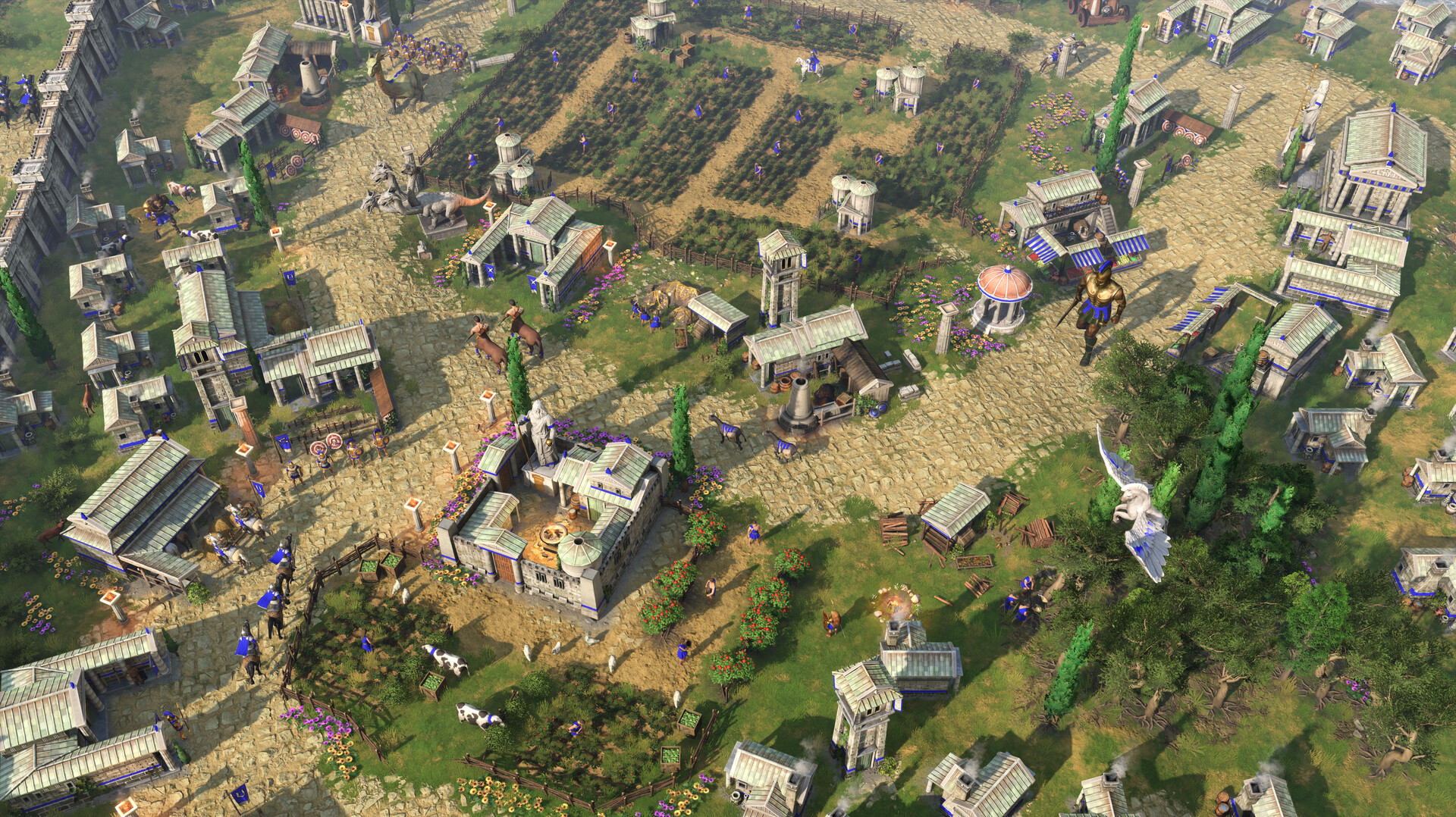
Retold’s standard game centers on the Greek, Egyptian, Norse and Atlantean pantheons. Additional god packs and expansions are sold as separate content, so their added gods, units, missions or pantheons should not be mistaken for the four-pantheon base roster. Retold also changes the original rules: God Powers can be cast again by spending Favor, and reaching the Wonder Age improves myth units while rapidly recharging those powers at a reduced cost. That late-game stage adds a new resource decision to the match, as players weigh another divine intervention against Favor needed for myth units and the rest of their armies.
- Developer
- World's Edge, Forgotten Empires, Tantalus Media, CaptureAge and Virtuos Games
- Genre
- Real-time strategy