
About Age of Empires: Definitive Edition
Age of Empires: Definitive Edition remasters the original historical real-time strategy game and its Rise of Rome expansion. Lead one of sixteen ancient civilizations from a small settlement through the Stone, Tool, Bronze, and Iron Ages. Gather resources, build an army, and pursue victory in campaigns, skirmishes, or multiplayer matches.
This Definitive Edition returns to the first Age of Empires, a strategy game about ancient societies developing from small communities into military powers. Its setting spans a broad sweep of early history, with civilizations such as Egypt, Greece, Babylon, and Yamato represented across campaigns and skirmishes. The included Rise of Rome expansion adds Roman-era material to the original game, so the package ranges from early settlement building to conflicts associated with the ancient Mediterranean. Campaigns give that setting a sequence of authored scenarios, while random-map matches begin with a settlement and let each player build a different route toward victory. This is the first game in the series: its Stone, Tool, Bronze, and Iron Ages and its economic rules belong to this ancient-era design, rather than the medieval progression of Age of Empires II or the later systems in Age of Empires IV.
A standard match opens with a Town Center and three Villagers. The Town Center is the only building that creates more Villagers, and each new worker costs Food, making a steady food supply central to early growth. Houses expand the population limit in small increments, so players must build them as the settlement grows or production stops at the cap. Villagers gather Food from berries, hunting, fishing, and later farms; they also cut Wood and mine Gold and Stone. They can construct buildings, but they are vulnerable when caught away from protection. The player therefore has an immediate set of linked tasks: keep the Town Center producing, send workers to different supplies, scout the nearby map, and build housing and drop-off points before the workforce becomes idle or exposed. The original game has no separate starting scout, so one of those first Villagers may have to reveal the surrounding terrain.
The four Ages provide the main technology ladder. Players begin in the Stone Age and spend gathered resources to advance, first to the Tool Age, then the Bronze Age, and finally the Iron Age. Each transition expands the available buildings, military options, and research, but the resources committed to advancement cannot also pay for workers or soldiers at that moment. Building access is part of this progression: for example, the Market becomes available in the Tool Age and is required before farms can be built, while additional military structures open specialized units. Research at buildings such as the Market, Storage Pit, and Granary improves economic, military, or defensive capabilities. Those upgrades compete with expansion and production for resources, so an empire that rushes ahead in technology may have fewer units to defend its workers, while a player who delays advancement can field pressure sooner with earlier-age forces.
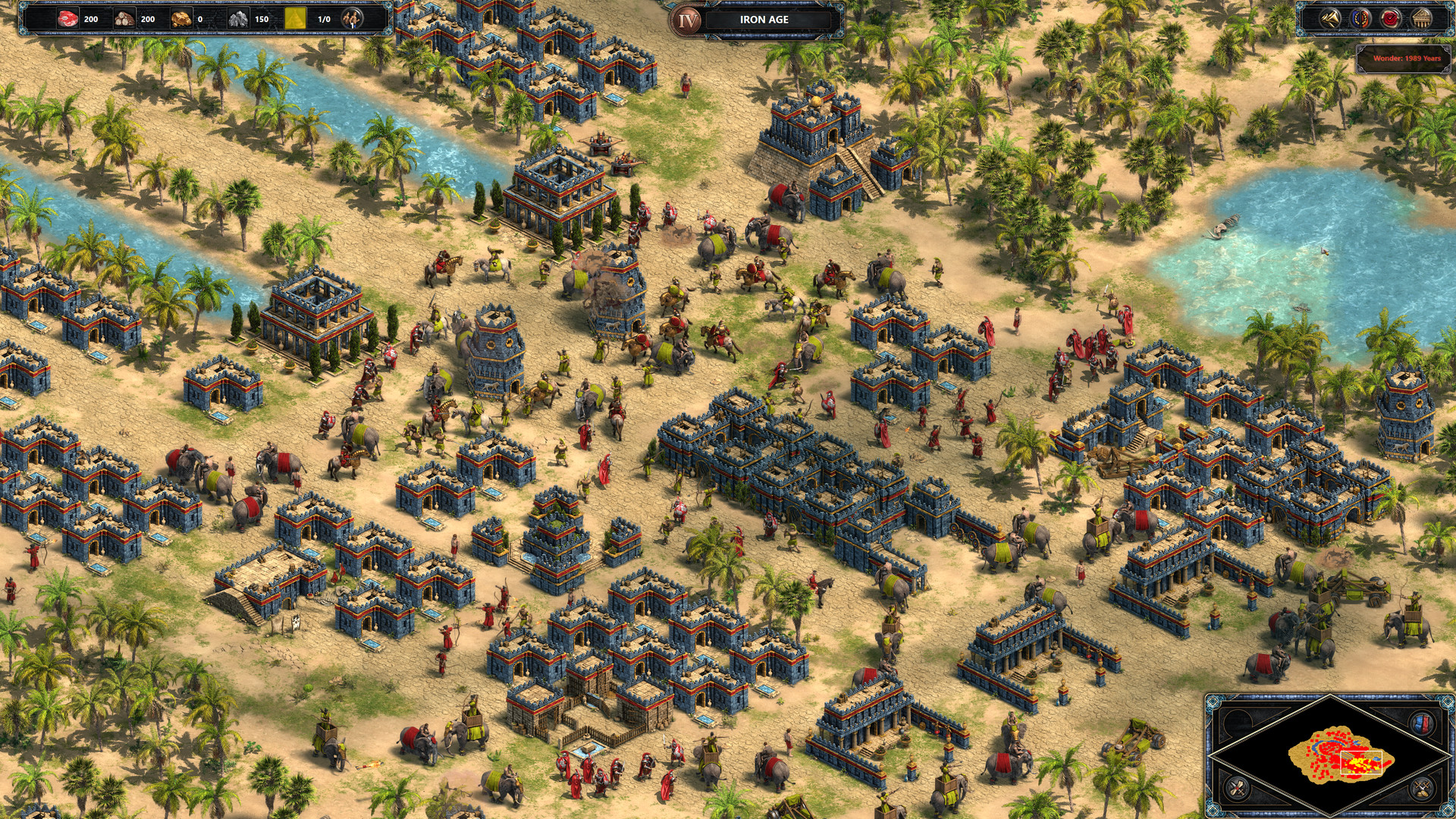
Civilization selection changes the available strengths within that shared framework. The Definitive Edition combines the original game and Rise of Rome expansion, with sixteen civilizations and ten campaigns listed in the edition announcement. Egypt, for instance, is associated with chariot and priest strengths, while the Hittites receive advantages for archers and siege weapons; other civilizations have their own bonuses and technology options. These distinctions influence which buildings and upgrades are most useful, and what kind of army a player can support efficiently. The military roster includes infantry, archers, cavalry, ships, and siege weapons produced from different structures. The player reads the opposing force and chooses a response, while protecting the Villagers who keep the economy working. Because the game’s units and building options differ from those in Age of Empires II, familiar later-series expectations—such as the same early defensive structures or worker upgrades—do not automatically apply here.
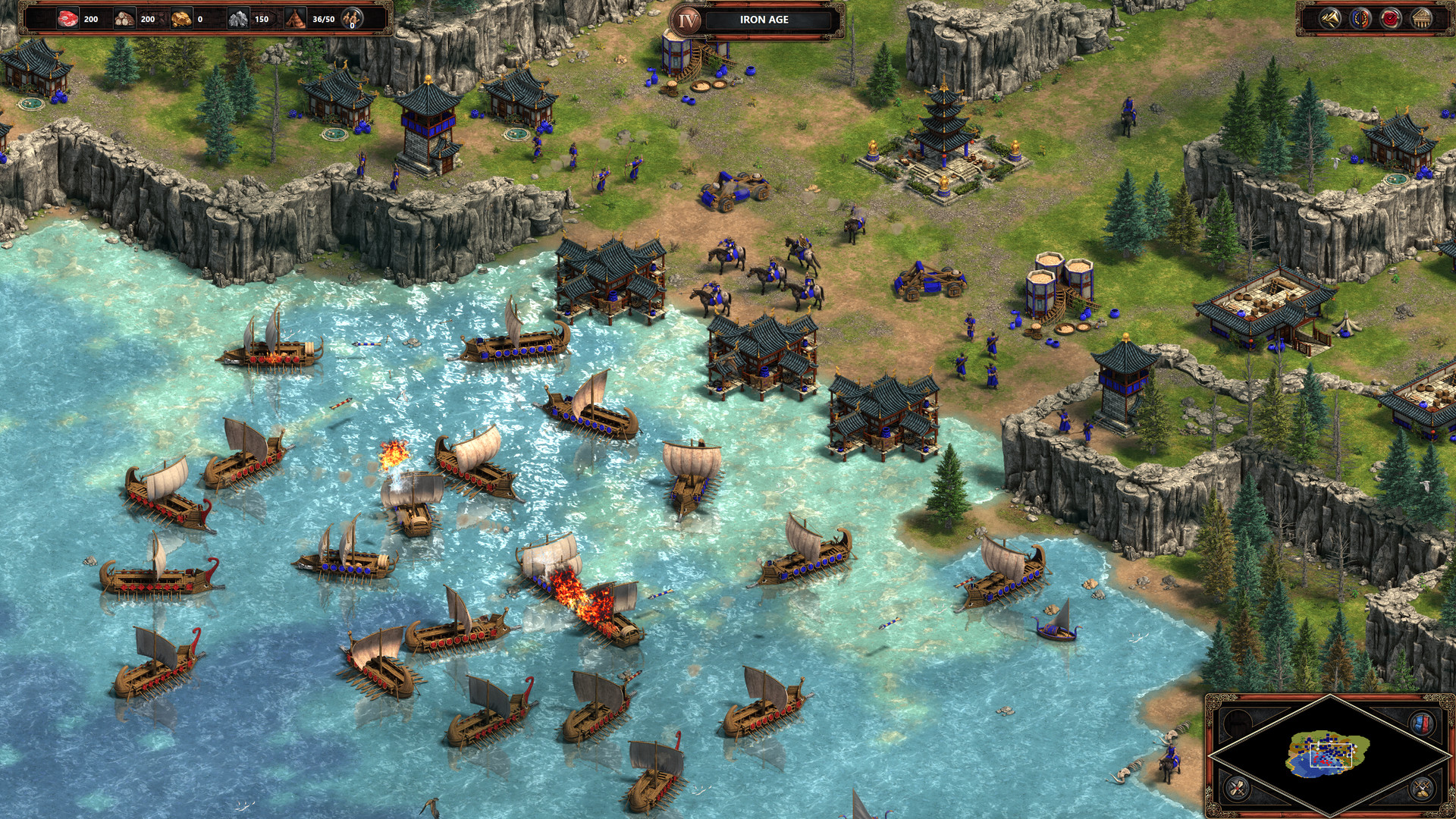
Battles are fought across explored terrain where the position of a force matters as much as its composition. A scouting Villager can locate food, woodlands, deposits of Gold or Stone, coastlines, and enemy settlements; a Dock and fishing boats can turn a shoreline into another source of Food. When fighting begins, the player can send troops to pressure exposed workers, contest an approach, or attack the structures that support enemy production. Fortifications and towers become available through research and Age progression, so a settlement’s defenses change as its civilization advances. Military forces can also pursue more than simple elimination: matches may be won by destroying enemy units and buildings, holding all Ruins or Artifacts for the required in-game period, or constructing a Wonder that survives for that period. Each condition directs attention toward a different map objective, from continuous control of scattered sites to protecting a costly landmark.
The single-player campaigns organize ancient conflicts into scenario chains, with the Ascent of Egypt serving as a learning campaign and other campaigns following Greek, Babylonian, and Roman histories. A scenario may give the player a prepared force, constrained resources, or a particular objective, changing the normal rhythm of growing a settlement and assembling an army. Outside those authored missions, skirmish settings let players choose a map, opponents, teams, and match conditions; multiplayer extends the same real-time contest to human opponents. A scenario builder provides another way to arrange maps, forces, and objectives. The Definitive Edition’s package includes the original base game together with Rise of Rome, and its remaster adds revised visuals, narration, sound, and a classic presentation option. Across those modes, the player is continually weighing the same practical questions: which resource can be secured next, which building unlocks a needed unit, and whether to spend time strengthening the economy or act with the army already available.
- Developer
- World's Edge, Forgotten Empires, and Tantalus (Steam listing)
- Genre
- Real-time strategy