
About Abyssus
A team of brinepunk explorers descends beneath the sea to claim a rare brine deposit beneath an ancient civilization. When its corrupted inhabitants attack, the expedition becomes a four-player roguelite fight through shifting handcrafted stages, using customizable weapons, upgrades, divine blessings and coordinated roles to survive.
Abyssus is set in a world where brine, a powerful substance found in the deepest parts of the sea, provides energy. The player joins a group of brinepunk explorers recruited to claim a large deposit beneath the remains of an ancient civilization. Their assignment changes when the sunken kingdom’s corrupted inhabitants rise against them. What begins as an expedition for a valuable resource becomes a struggle to fight through the ruins and return to the surface. The setting combines industrial technology with oceanic decay: the equipment is built around brine, while the environment and opposition come from a submerged civilization whose history remains mysterious. The narrative supplies a clear reason to descend, then places survival at the center of the mission.
The game is a first-person shooter designed for solo play or online cooperation with up to four players. Each run sends the team through a sequence of handcrafted levels, with the order selected procedurally so that one descent does not follow exactly the same route as another. The larger collection contains more than seventy stages, but a run brings together only a portion of them. This structure makes the expedition a chain of combat spaces rather than a single linear campaign. Players can coordinate as a group, but the basic mission remains legible: advance deeper, face the enemies that defend the ruins, and survive the increasingly demanding route. Playing alone is supported, while a team can divide attention and complement different builds.
Loadout choices begin before the descent. Players select weapons, suits, skills and modifications that define how their Brinehunter approaches a run. The brine-powered armaments can be refitted with weapon mods, while ancient technology and powers add effects beyond ordinary ammunition. Divine blessings can imbue attacks with elemental or mystical properties, changing how a weapon contributes to combat. Additional options come from the Ancient Forge, which offers modifications for both weapons and skills. These systems invite players to shape a build around a preferred weapon or a cooperative role. A choice that increases one kind of damage, adds an effect or improves a skill can influence the team’s response to the enemies and bosses waiting later in the expedition.
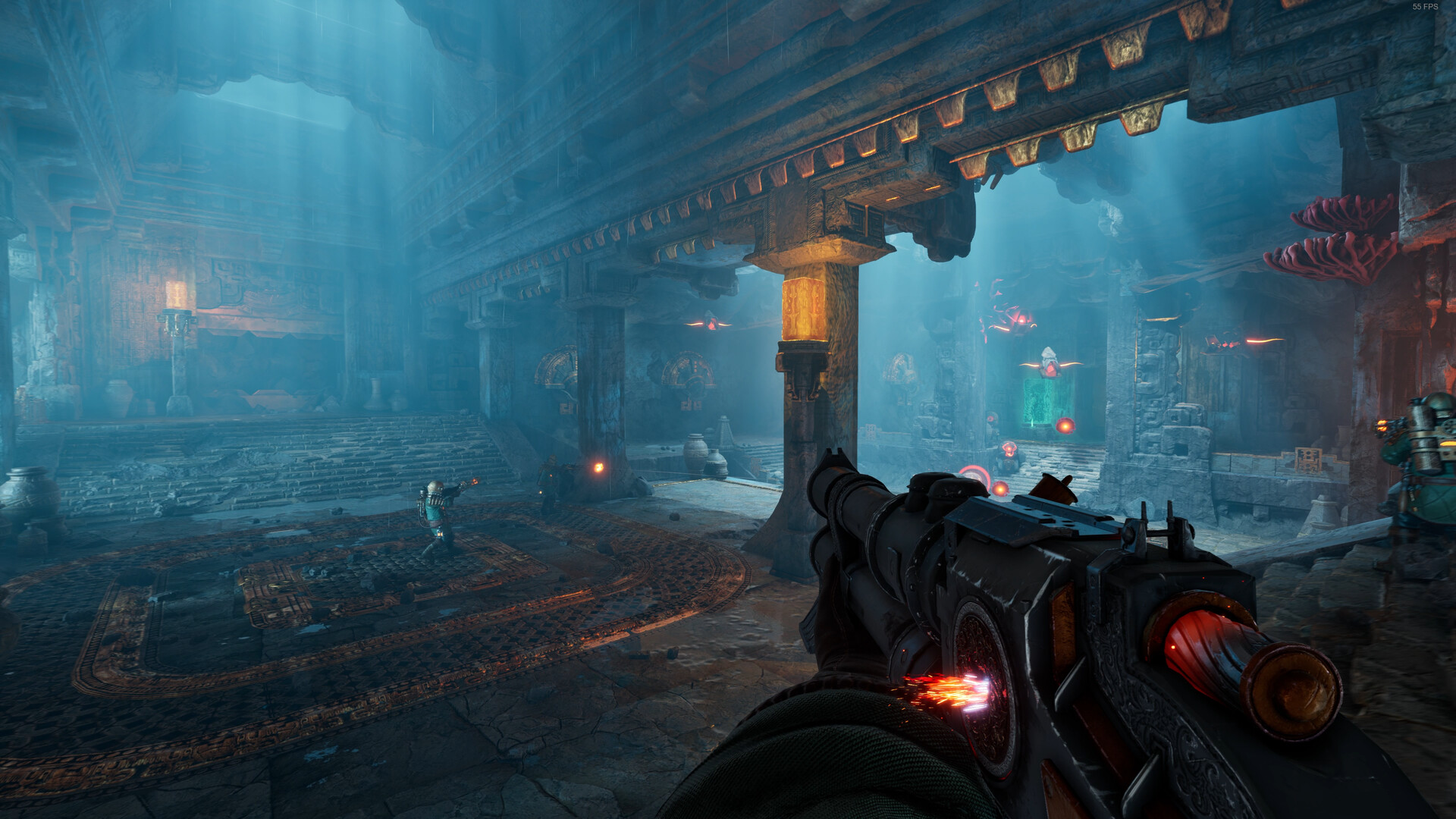
During a run, combat combines aiming with positioning and coordination. The underwater kingdom’s enemies attack the team as it moves through confined spaces, so players have to watch both their targets and their teammates’ situation. A group can benefit from compatible loadouts that cover different needs rather than four identical approaches. Weapon choice matters, but firepower alone is not presented as enough: moving into a useful position, reacting to pressure and supporting the team help determine whether a fight stays manageable. The roster includes thirty-six enemy types and twelve bosses, giving encounters distinct threats across the route. Their presence turns each room into a test of the build and the group’s ability to adapt as new combinations appear.
Abyssus uses roguelite progression to connect individual expeditions. Completing runs and reaching milestones opens further advancements, rewards and unlocks, expanding the choices available for later attempts. A failed descent ends that particular effort, while meta progression gives the player additional options to prepare for another. Charms and blessings provide a broad range of build possibilities, and extensive customization is available both before and during a run. These systems make progression about more than finding a better weapon in the next room: players also develop their selection of equipment and effects over repeated journeys. The result is a loop in which a new run brings a fresh level sequence and a different set of tactical possibilities.
The layers of modification give players room to experiment without requiring a fixed class. A weapon establishes the basic attack, and a weapon mod changes how that armament behaves. Forge choices can then empower weapons or skills, while Charms and Blessings contribute effects to the larger build. Selecting these elements has a practical consequence for each descent: a group might bring different capabilities to cover several kinds of threat, while a solo player can favour tools that support a familiar rhythm of movement and attack. The range of choices makes preparation part of the expedition, alongside the decisions made once combat begins. As new options unlock, an old weapon can also become the starting point for a different approach.
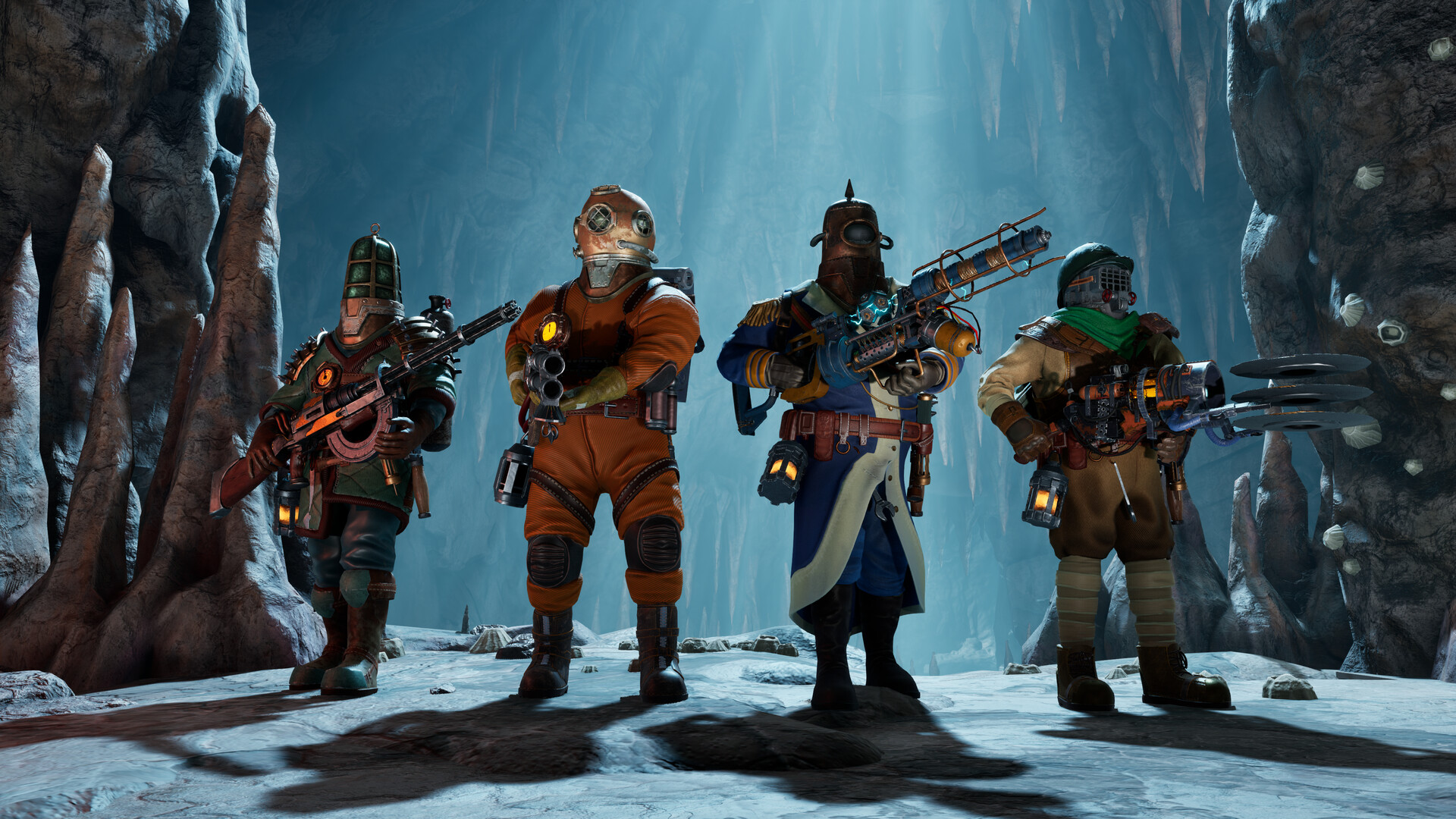
The world’s mysteries sit behind that repeatable combat structure. The ruined kingdom, its mutated guardians and the power of brine hint at a history the expedition does not fully explain at the outset. Environmental variety comes from the handcrafted stages, which are sequenced in different combinations from run to run. The explorers can encounter new rooms and enemy groupings while pursuing the same broad objective: secure the deposit and make it back alive. This framework supports both moment-to-moment action and longer experimentation with builds. Each journey pairs a strange underwater setting with changing tactical demands, asking players to balance weapon selection, upgrades, positioning and teamwork as the abyss presses back.
- Developer
- DoubleMoose Games
- Genre
- First-person shooter, co-op roguelite and brinepunk action adventure