

About A Tiny Sticker Tale
Flynn, a young donkey, travels across Figori Island with a magical sticker album as he searches for his father and helps the island’s animal residents. Objects—and even some inhabitants—can be lifted from one place, stored as stickers, and placed elsewhere to solve connected puzzles, open routes, complete errands, collect album entries, and decorate a home base.
A Tiny Sticker Tale follows Flynn, a young donkey who reaches Figori Island carrying a magical sticker book inherited from his father. The journey is framed by a search for that missing parent: notes left along the way offer clues and encouragement as Flynn moves across the island. The people he meets are animals with immediate needs of their own, so helping them becomes the practical route through the larger mystery. A carpenter needs material to build a bridge, a dog has become separated from its owner, an egg must be returned to its nest, and a turtle musician needs help overcoming shyness. A troublesome raccoon also disrupts the island’s routines. These encounters keep the story local and legible; instead of a distant villain or a large cast of factions, the central relationship is between a child on a journey and a community whose small problems gradually form a path forward.
The island is arranged as a chain of compact, self-contained places rather than a continuous expanse of wilderness. Individual screens connect through paths at their edges, with routes leading to adjacent areas or between elevations. Beaches, woods, caves, swamps, snowy ground and other distinct settings give each stop a clear visual identity, while the limited exits make the surrounding geography easy to remember. Most areas have an obstacle, an object to inspect or an animal who needs assistance, so movement through the map is also a process of reading each little scene. A map becomes useful as the number of visited locations grows, particularly when an item found in one screen must be carried elsewhere. Shortcuts appear as progress opens new links, which reduces the distance between places already visited. The structure supports a gentle back-and-forth rhythm: find a need, notice what it requires, search nearby screens for a usable object, then return to the character or obstacle that prompted the search.
The sticker album turns that search into the game’s main verb. In sticker mode, Flynn can lift many objects out of a scene and store them as illustrated entries, then take them back out and place them in another location. The album functions both as a portable inventory and as a way to alter the environment: a tree can be carried to the carpenter, who turns it into a bridge sticker, and that bridge can then be set across a gap where passage is needed. Other reusable tools include a bucket, fishing rod and ladder. Some animal characters can also be picked up and transported, so the album can move a conversation partner or creature as well as equipment. Objects are not consumed simply because they have been used once; the same tool may be needed again in another place. The album has limited room, making occasional rearrangement part of the practical puzzle, but the sticker system is forgiving about placement and allows objects to be unstuck and repositioned. Its freedom is expressive at the level of decorating a scene, while the intended task solutions remain tied to what each object does.
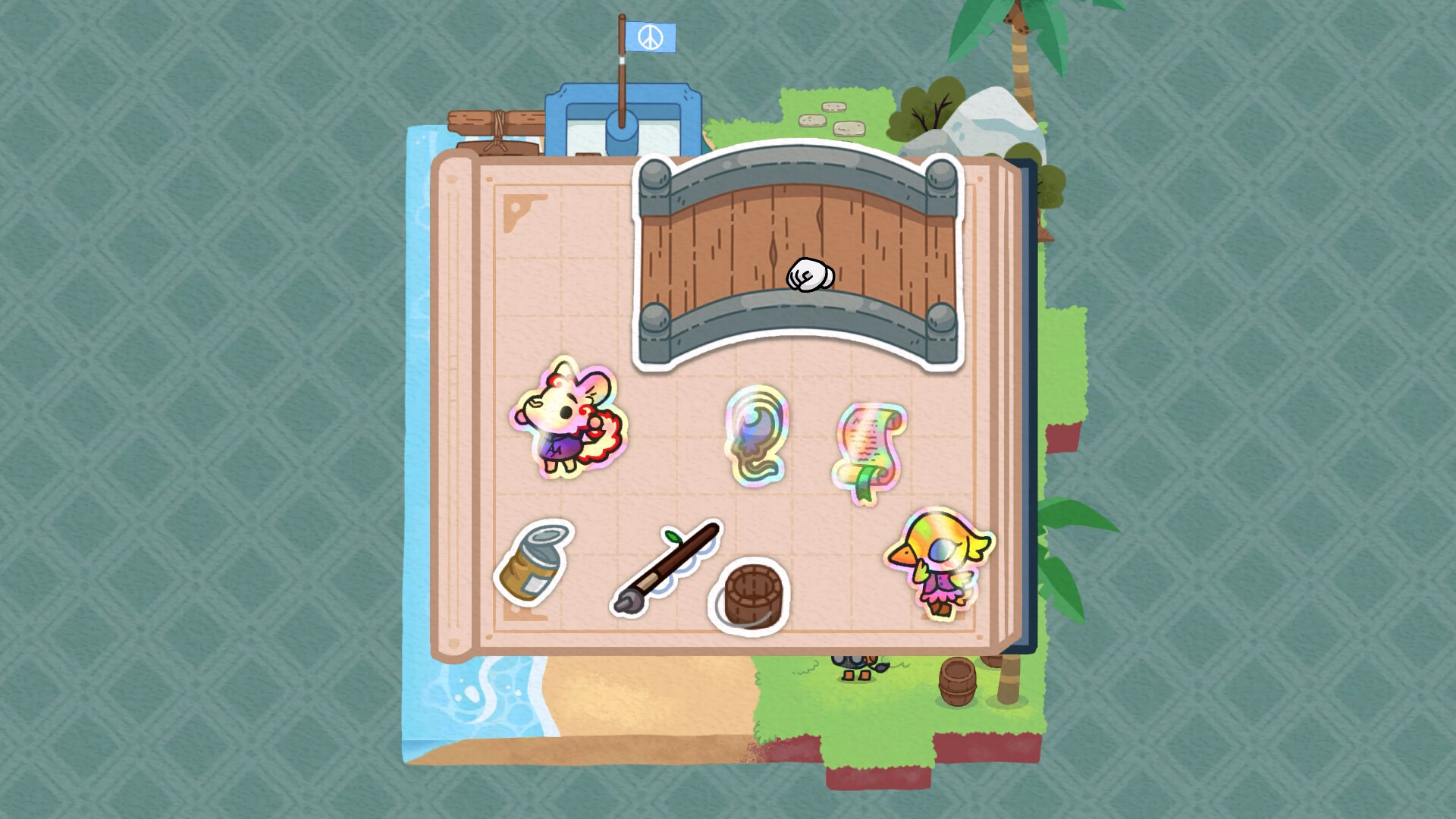
Puzzles connect a visible obstacle to a tool or character whose use has already been established elsewhere. The carpenter is an early example of this chain: a tree is not itself the bridge, but bringing it to the craftsperson produces a portable bridge that can solve a later traversal problem. A more involved sequence described in the game’s mechanics asks Flynn to find an arrow in another area, carry it in the album to a crossbow, place it on the weapon and fire at a target. This combines exploration, inventory, placement and interaction rather than relying on a separate combat system. Other errands ask the player to reunite an animal with its owner, return an egg to a mountain nest, or help a musician who is reluctant to perform. These requests can unlock further areas, develop the main journey or add entries to the collection. A useful hint often comes from matching a character’s stated need with something encountered nearby; when an object cannot solve the current problem, storing it and continuing to explore preserves it for a later connection.
Several stickers change conditions in a location rather than supplying a conventional tool. The sun and moon can be placed into a scene to shift it between day and night, and this affects what some characters can do. A miner, for example, will break large boulders only when there is enough daylight, making the time-of-day sticker part of the sequence that clears a route. This adds a simple environmental rule to the album’s object-transfer logic: the right item is not always sufficient unless the scene is also in the right state. The mischievous raccoon provides another kind of problem, since using stickers can undo some of the interference it has caused. Such tasks expand the central mechanic without turning the game into action combat; the available evidence describes puzzle interactions and environmental changes, not a system built around fighting enemies. Each new sticker therefore broadens the kinds of questions that can be asked of later screens: what can be moved, what can be repaired, and what condition must be changed before an inhabitant or object responds.
Progress has a main-story route and optional reasons to continue exploring. Helping residents opens paths and moves Flynn closer to the clues about his father, but not every side errand is required to reach the ending. A character can help orient the player toward the current objective, while the map and the island’s shortcuts make it practical to revisit earlier locations when a newly acquired tool changes what can be done there. The sticker catalogue records what Flynn has collected and can point toward missing entries, giving completion-focused play a clear purpose beyond the central search. The carpenter also contributes to a personal space: bringing a tree can lead to furniture, and a tent becomes available as a place that can be furnished with collected objects. Decorations do not replace the route puzzles; they offer a parallel use for items that can be placed for visual arrangement. Main tasks, optional requests, catalogue completion and home customisation all draw on the same sticker gathering loop, but they reward different kinds of attention to the island.
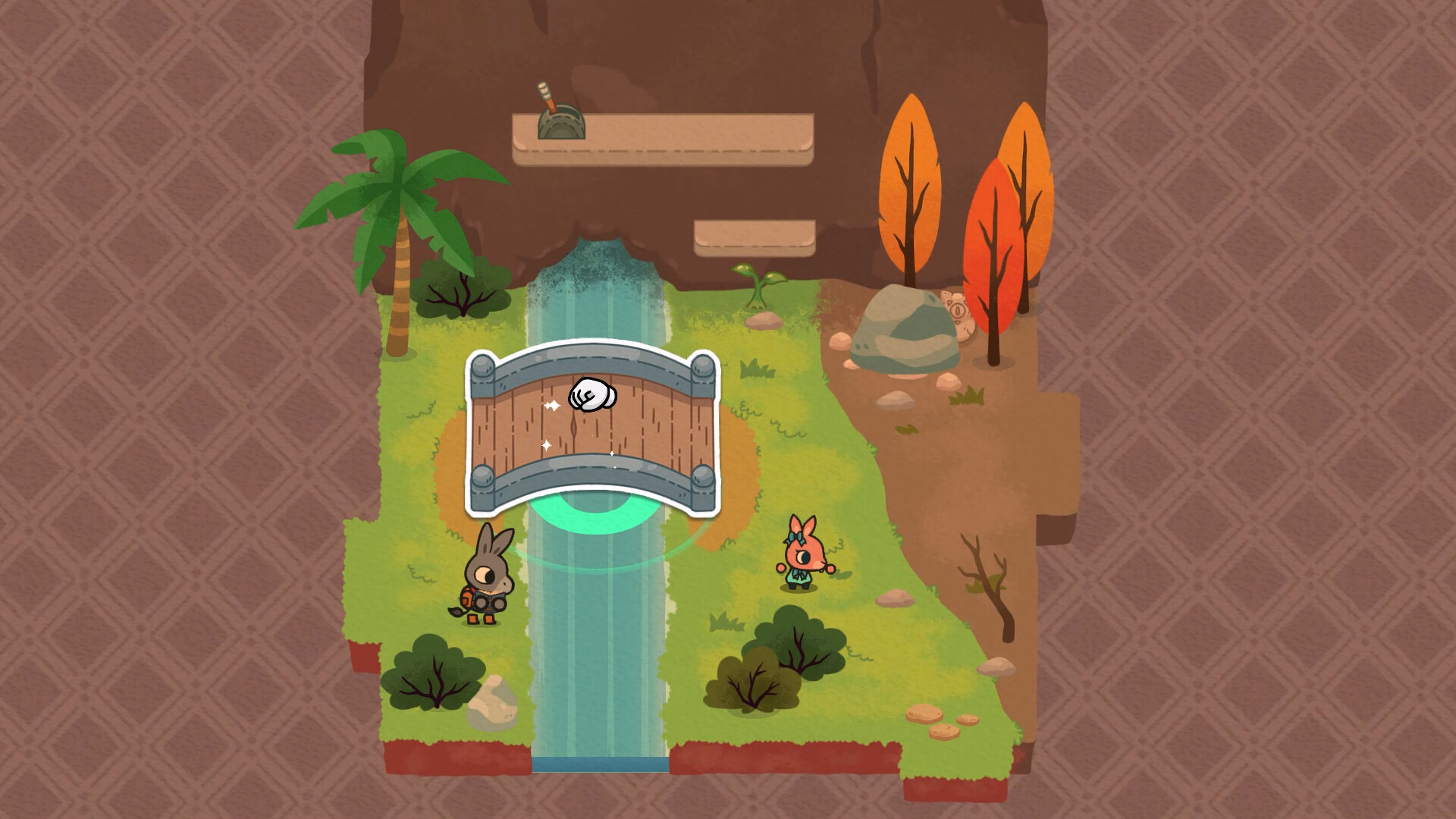
Presentation reinforces the scale of this world. Figori is shown through small, readable scenes with colourful environments and animal characters, giving each screen the feel of a miniature tableau that can be rearranged with stickers. The album’s page is both a menu and a visual record of the objects Flynn has encountered, so collection and puzzle preparation remain part of the same interface idea. The island’s spaces range from familiar outdoor paths to caves and colder regions, while shifts between areas make the map feel like a set of connected model-like places. Individual screens can visibly change when Flynn places a bridge or shifts the time of day, making the album’s illustrated contents part of the island’s changing scenery. The sticker catalogue can point toward entries Flynn has not yet found, giving the collection a navigational role alongside its record of objects encountered. In the tent, collected pieces can be arranged as furniture, so the album’s contents also support a separate activity in which Flynn shapes a personal space.
- Developer
- Ogre Pixel
- Genre
- Adventure; puzzle adventure