
About A Plague Tale: Requiem
After fleeing their devastated home, Amicia and Hugo travel through southern France in search of a place to begin again and a way to manage Hugo’s illness. Requiem expands their journey across new regions and Mediterranean cities, where the siblings rely on stealth, alchemy, allies and a crossbow amid renewed rat outbreaks.
A Plague Tale: Requiem continues the de Rune siblings’ story after their escape from the events of Innocence. Amicia and Hugo head south through 14th-century France, hoping that distance and a new community can give Hugo a chance to live with his illness. Their journey moves through bright Mediterranean landscapes, busy settlements and dangerous stretches of road before the siblings’ hopes draw them toward a remote island. Hugo’s supernatural connection to the rats remains central, but the immediate challenge is also practical: the children have to find shelter, judge whom they can trust and get through increasingly hostile encounters. The new regions make the world feel broader than the first game’s flight through plague-stricken villages, while keeping the story anchored in the siblings’ bond and their struggle to protect one another.
Amicia remains the player’s main character, using her sling, crafted ammunition and growing combat skills to guide Hugo through danger. Hugo is more than a passenger: his unusual sensitivity to the rat swarms can reveal threats and affect how encounters unfold, though engaging with that power carries narrative weight. The siblings also travel with new allies whose skills alter what a group can do. Lucas brings alchemical knowledge; the smuggler Sophia can redirect light with a prism; and Arnaud offers a more direct way to confront armed opponents. Their contributions create moments in which the player coordinates the group, such as using a companion’s ability to open a safe route while Amicia handles a guard or prepares equipment. These relationships broaden the adventure without taking Amicia out of its centre.
Light and darkness still define movement through rat-filled spaces, but Requiem gives Amicia more ways to affect both sides of that boundary. Ignifer lights embers and fuel, Extinguis snuffs flames, Tar creates or strengthens a flammable surface, and Odoris draws rats toward a chosen target. Those mixtures can be combined with jars or sling ammunition, turning a brazier, a patch of fire or an enemy’s position into part of the solution. The player gathers ingredients and decides when to craft or spend each munition; an item can clear a route, redirect a swarm or create an opening against a soldier. Hugo can also interact with nearby rats directly, adding a riskier alternative to Amicia’s careful manipulation of light and crafted tools.

The expanded arsenal changes how Amicia handles soldiers. Her sling remains useful for rocks, distractions and alchemical shots, but the crossbow adds a long-range way to deal with threats that a stone cannot stop. Bolts are limited, and armoured opponents can require preparation or a shot at an exposed weak point, so using the weapon is a resource decision rather than a universal answer. Single-use knives provide another close-range option, while Amicia’s ability to withstand a blow and briefly fight back gives her a chance to recover when an encounter breaks into open combat. Stealth remains viable: crouching through cover, tracking patrols and using sound or light to redirect attention can avoid spending scarce ammunition. Encounters leave room to switch between hiding, environmental tactics and direct action as circumstances change.
Progression responds to the way the player handles major encounters. Prudence grows through avoiding most enemies, Aggressive through defeating them, and Opportunism through a mixed approach; their upgrades improve different parts of Amicia’s movement, combat or crafting. Separately, resources found while exploring can be spent at workbenches across five equipment branches: sling, crossbow, alchemy, gear and instruments. Upgrades can make sling use quieter, expand the crossbow’s quiver, let bolts be recovered from fallen enemies, increase carried alchemical ammunition or change when equipment can be upgraded. These branches create a steady link between searching spaces for materials and deciding how Amicia should be prepared for the next guarded passage. The game does not make every encounter demand the same answer, and the player’s conduct shapes the skills that develop along the way.
The southbound route gives Requiem a wider range of everyday places than a succession of ruined roads. Amicia and Hugo pass through working ports, a pilgrims’ encampment, market streets and the busy dye works of a city, where cloth and trade sit close to the danger around them. Later areas shift toward the island’s villages, old structures and open countryside. These spaces show people continuing familiar routines even as the siblings’ search for safety draws them into danger. Their differences also change how each chapter frames discovery: a crowded public square, a dockside warehouse and a quiet rural path each reveal a different part of the world the children are trying to reach.
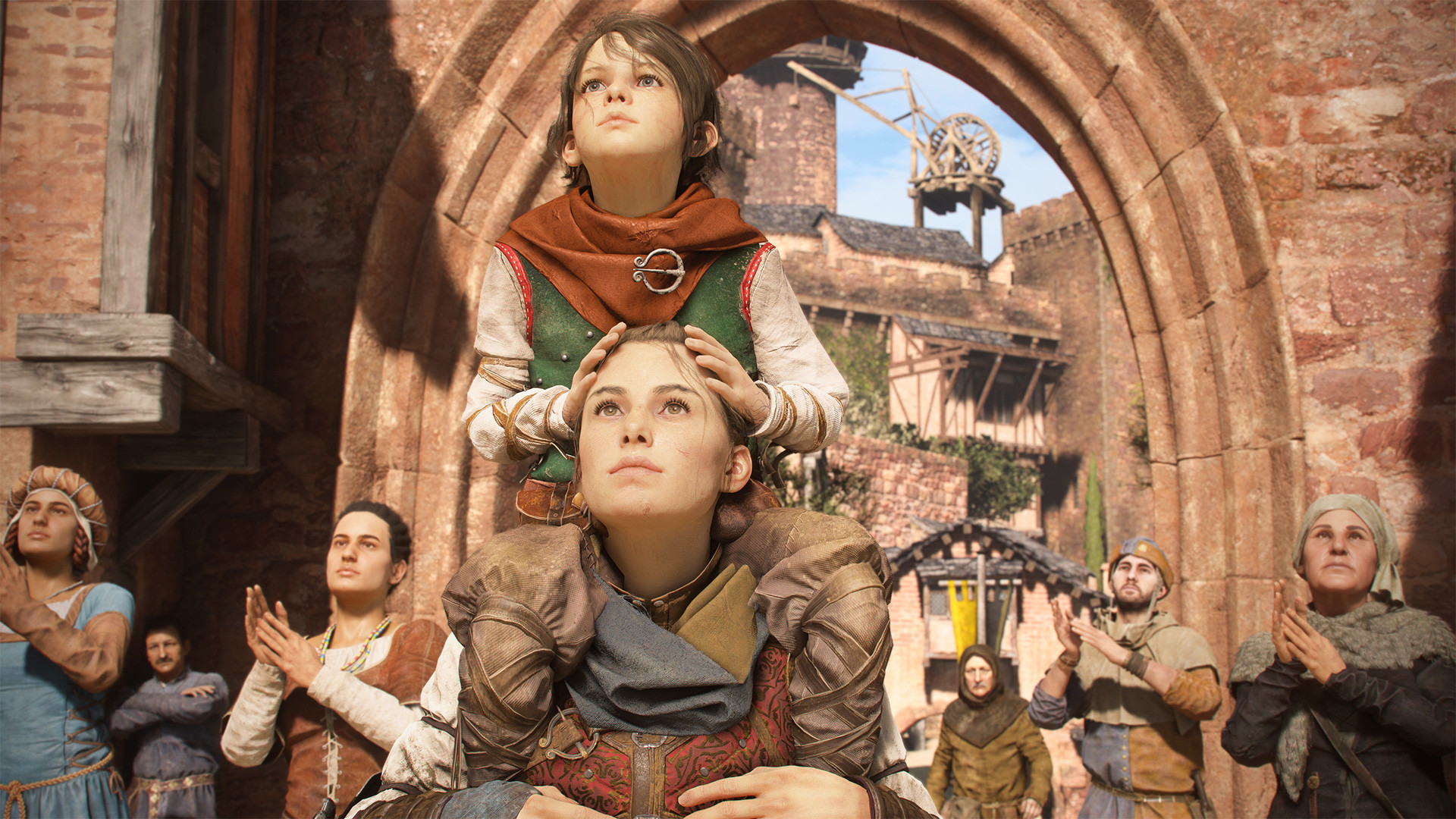
Requiem also gives optional discoveries a personal thread through Hugo’s Collection and the Souvenirs. Flowers and feathers record the natural world Hugo notices as the group travels, while Souvenirs are kept by taking part in small interactions or pausing over an object the siblings encounter. A brief fairground game, a swing in the pilgrims’ camp, dyed cloth, or an ancient olive tree can become a memory from the journey rather than a resource for combat. These moments do not replace the main search for a cure; they show the siblings making room for curiosity and play within it. Side paths therefore serve a different purpose from workbench searches, letting players see what Amicia and Hugo notice about the people and landscapes they pass.
- Developer
- Asobo Studio
- Genre
- Action-adventure with stealth, combat and environmental puzzles